


The industrial manufacturing sector is experiencing an unprecedented structural transformation: the complete digitalization of the commercial supply chain and procurement lifecycle. For over half a century, original equipment manufacturers (OEMs), precision machine shops, contract fabricators, and specialized component producers built multi-million-dollar order books through legacy relationship channels: handshake agreements, industrial trade show exhibits (IMTS, Fabtech), printed product catalogs, and third-party manufacturer sales representatives. Today, that legacy distribution framework has collapsed.
A demographic generational shift has rewritten the industrial buying journey. Millennial and Gen Z mechanical engineers, design architects, sourcing directors, and corporate procurement committees now dominate vendor selection. These technical buyers conduct over 70% of their supplier evaluations entirely online before ever picking up a phone or submitting a formal Request for Quote (RFQ). They do not browse generic corporate brochure websites; they search for exacting technical parameters: precision 5-axis CNC milling tolerances (±0.0001 in), Inconel 718 machining capabilities, ITAR-compliant defense stamping facilities, cleanroom medical injection molding certifications, and downloadable 3D CAD models (STEP, IGES, SolidWorks) that can be immediately dropped into active product assembly simulations.
Because industrial supply contracts represent six-figure tooling investments, multi-year production commitments, and mission-critical operational dependencies, search engine algorithms evaluate manufacturing websites under rigorous B2B quality standards. Algorithmic evaluators demand proven institutional Experience, Expertise, Authoritativeness, and Trustworthiness (E-E-A-T): verifiable ISO certifications, detailed equipment lists, raw material chemical compatibility matrices, and transparent quality control instrumentation.
At Acquisty, our dedicated search engine optimization engineering practice and specialized manufacturing SEO architecture teams engineer high-velocity digital pipeline engines for contract manufacturers, custom fabricators, and industrial equipment builders. This comprehensive master guide outlines the definitive engineering architecture required to index technical specification sheets, capture high-intent CAD part downloads, deploy industrial structured data, and convert organic search visibility into sustainable, high-margin OEM production contracts.
- Digital Sourcing Dominance: Comprehensive industrial buyer behavioral studies published by ThomasNet reveal that over 74% of industrial procurement professionals and mechanical design engineers utilize organic search engines as their primary initial channel for identifying and vetting new custom component fabricators.
- The CAD & Datasheet Decisiveness Multiplier: Rigorous enterprise procurement benchmarking from Forrester Research establishes that 68% of design engineers specify parts from manufacturers whose 3D CAD/BIM models and technical data sheets are immediately accessible and indexable online, with 82% of downloaded CAD models ultimately making it into final bill-of-materials (BOM) production orders.
- Trade Show vs Organic ROI Disparity: Industrial marketing research conducted by IEEE GlobalSpec confirms that while annual trade show booth costs exceed $45,000 to $120,000 with a median cost per qualified lead of $850+, an optimized manufacturing SEO pipeline delivers qualified industrial RFQs at an amortized cost under $145 per lead—an 82% cost reduction.
- Long-Tail Part Number Search Intent: Over 56% of high-value industrial component queries consist of exact alphanumeric part numbers, mil-spec standards, or dimensional parameter combinations, which convert into formal engineering RFQs at a rate 5.1x higher than broad commercial keywords.
1. The Industrial Buying Journey: How Engineers & Sourcing Committees Search
Unlike consumer e-commerce or B2B SaaS where buying cycles can conclude in minutes or days, industrial procurement operates on extended, multi-stakeholder timelines spanning 3 to 18 months. An industrial purchase order is never the unilateral decision of a single individual; it is the culmination of rigorous evaluation conducted by two distinct internal personas: the Design Engineer and the Procurement Sourcing Director.
Understanding how these two personas navigate the search ecosystem is essential for architecting high-converting manufacturing SEO:
- The Design Engineer (Technical Feasibility Phase): Mechanical, aerospace, and electrical engineers seek solutions to immediate physics, material, or dimensional constraints. During early product R&D, engineers execute search queries such as:
- “machining tolerances for inconel 625 turbine blades”
- “custom silicone overmolding minimum wall thickness specs”
- “download step file 2-inch stainless high pressure ball valve”
Engineers prioritize websites that provide instant access to raw technical documentation, dimensional blueprints, and downloadable CAD files without aggressive marketing gating. If an engineer successfully imports your 3D CAD model into their digital prototype, your part is effectively “designed in” to the bill of materials, locking out competing suppliers.
- The Procurement & Sourcing Director (Commercial & Risk Phase): Once a product design is finalized, purchasing managers take ownership of supplier qualification. They search with commercial risk mitigation in mind:
- “ITAR registered cnc machine shop defense aerospace”
- “AS9100 certified titanium precision turning supplier usa”
- “high volume progressive die stamping capacity 500k units”
Procurement directors demand proof of manufacturing scalability, financial stability, lot traceability, and strict quality compliance before issuing a formal Request for Quotation (RFQ).
A successful manufacturing SEO architecture must satisfy both technical engineers and commercial sourcing officers simultaneously. By delivering rigorous technical depth alongside clear commercial capability proofs, manufacturers capture the full breadth of the industrial procurement pipeline.
2. Technical Spec Sheet, Part Number & 3D CAD/BIM File Indexing Architecture
The most egregious mistake committed by industrial manufacturers is locking their critical technical data inside unindexed, scanned PDF files or proprietary CAD portals. While Googlebot can extract raw text from modern PDFs, search crawlers cannot effectively parse complex tabular parameter matrices, dimensional callouts, or dynamic cross-references embedded in static documents. Furthermore, PDFs provide a terrible mobile user experience and lack interactive conversion hooks.
To dominate technical industrial search queries, manufacturers must transition from passive PDF storage to an active Dynamic HTML Specification Architecture:
- Native DOM Rendering of Technical Parameters: Every standard catalog component and custom fabrication capability must be rendered directly in clean semantic HTML. Tables detailing tensile strength (MPa), Rockwell hardness (HRC), thermal expansion coefficients, thread pitches, and tolerance bands (±0.0005 in) must exist in the live Document Object Model (DOM) so search crawlers can index every granular engineering attribute.
- Multi-Format 3D CAD & BIM Model Indexing: Providing 3D CAD model downloads directly on product pages is the ultimate engineering lead magnet. By offering standardized export formats—including STEP (.stp), IGES (.igs), Parasolid (.x_t), SolidWorks (.sldprt), Autodesk Inventor, and Revit BIM files—manufacturers attract thousands of organic visits from engineers searching for exact geometry models. Including interactive 3D WebGL preview canvases allows engineers to inspect parts directly in their browser before downloading.
- Programmatic Part Number & SKU Taxonomy: Industrial equipment and replacement component queries rely heavily on exact alphanumeric sequences (e.g., “SKF 6205-2RSH deep groove ball bearing” or “Parker 4-4 F5OX-S male connector”). Building programmatic product taxonomy pages that map parent part families down to individual child SKUs ensures your site ranks #1 when an MRO buyer or field technician searches for an exact replacement part code.
- Crawl Budget Governance on Faceted Industrial Catalogs: Industrial distributors and catalog manufacturers often maintain millions of SKU permutations across thread types, lengths, diameters, and coatings. Uncontrolled faceted navigation can trigger massive crawler traps. Implementing self-referential canonical tags, parameterized URL governance in Google Search Console, and strategic
robots.txtdirectives protects crawl budget while indexing primary product categories.
For a deep technical analysis of crawl budget governance and server-side log file monitoring across large-scale technical websites, read our guide to enterprise SEO metrics and crawl governance.
3. Custom Fabrication Silos: Process-Specific & Material Capability Architecture
Most contract machine shops and custom fabricators present their manufacturing capabilities on a single generic “Services” page that lists bullet points: “CNC Machining, Sheet Metal Fabrication, Wire EDM, Welded Assemblies.” This flat architecture dilutes topical authority. When an aerospace sourcing manager searches for “5-axis CNC machining for titanium medical implants”, a generic bullet point on a broad capabilities page will never outrank a competitor who maintains an exhaustive, dedicated process silo.
High-performance industrial SEO requires constructing hierarchical Process & Material Capability Silos:
- Process-Specific Architectural Hubs: Every distinct manufacturing discipline must live on a dedicated parent silo that establishes comprehensive operational authority:
-
/capabilities/cnc-machining/5-axis-milling/ -
/capabilities/cnc-machining/swiss-precision-turning/ -
/capabilities/sheet-metal/laser-cutting-press-brake/ -
/capabilities/injection-molding/cleanroom-medical-molding/ -
/capabilities/additive-manufacturing/direct-metal-laser-sintering/
Each hub must detail equipment specifications (e.g., Haas, Mazak, DMG Mori 5-axis work envelopes), maximum bed dimensions, spindle speeds, axis repeatability, and primary industry applications.
-
- Raw Material Capability Matrices: Material selection is the primary operational hurdle for industrial engineers. Fabricators must build programmatic material sub-pages detailing exact machining speeds, feeds, weldability, and corrosion resistance for specific alloys:
- Aerospace Alloys: Titanium Grade 5 (Ti-6Al-4V), Inconel 718, Hastelloy, Monel.
- Precision Metals: 316L Stainless Steel, 6061-T6 Aluminum, Brass 360, Tool Steels (D2, A2).
- Engineering Polymers: PEEK, Delrin (Acetal), PTFE (Teflon), Ultem, Polycarbonate.
Targeting queries like “machining PEEK plastic for semiconductor components” captures niche, ultra-high-margin commercial contracts with virtually zero organic competition.
- Production Volume Segmentation: Engineering sourcing queries differ sharply based on lot size. A startup engineer researching “rapid prototype CNC machining 5 pieces” has entirely different lead time and cost expectations than an automotive procurement manager searching for “high-volume automotive progressive die stamping 250,000 units/month”. Explicitly segmenting production capacity hubs prevents unqualified leads from clogging your sales engineering pipeline.
Structuring technical service pages with this level of operational granularity satisfies Google’s E-E-A-T helpful content guidelines and establishes immediate credibility with visiting engineers. To examine foundational content writing standards across enterprise sectors, review our master guide on what content writing is in digital marketing.
4. Industrial Supply Chain Entity Authority: Certifications, Quality & Trust Signals
In the manufacturing supply chain, trust is quantified through formal accreditation and regulatory certifications. A defense contractor cannot award a precision machining contract to a supplier that lacks active ITAR registration; an aerospace prime cannot issue purchase orders without AS9100 Rev D certification; a medical device OEM requires ISO 13485 compliance and cleanroom validation.
To search engine crawlers and procurement algorithms, these certifications serve as definitive entity validation signals. Establishing authoritative supply chain trust requires four strategic implementations:
- Dedicated Quality Assurance & Certification Hubs: Rather than placing tiny unclickable accreditation logos in your website footer, build a dedicated
/quality-certifications/portal. Feature downloadable, high-resolution PDF copies of active certificates with clear registrar numbers, expiration dates, and issuing bodies (e.g., Perry Johnson, TUV, DNV). - Government & Defense Supplier Identifiers: Display verified corporate registry credentials prominently in your header and schema markup: CAGE Code, DUNS Number, SAM.gov active registration status, and primary NAICS/SIC codes (e.g., NAICS 332710: Custom Computer Numerically Controlled Precision Machining). Sourcing managers frequently search directly by CAGE code to confirm government contracting eligibility.
- Inspection Instrumentation & Metrology Spec Sheets: Highlighting your factory floor inspection capabilities builds immense technical credibility. Detail specific Coordinate Measuring Machines (CMM – Zeiss, Mitutoyo), laser optical comparators, surface roughness profilometers, and FaroArms. Outlining First Article Inspection (FAI) workflows compliant with AS9102 protocols proves your quality department operates at Tier-1 standards.
- Material Traceability & Mill Test Reports (MTR): Explicitly stating that all incoming raw stock is accompanied by full chemical and physical Mill Test Reports (MTRs) and Certificate of Conformance (CoC) documentation eliminates supplier risk for safety-critical aerospace and nuclear applications.
Understanding how search algorithms balance entity validation with backlink authority is essential for industrial engineering brands. For a complete breakdown of core ranking factors, explore our study on critical SEO ranking factors.
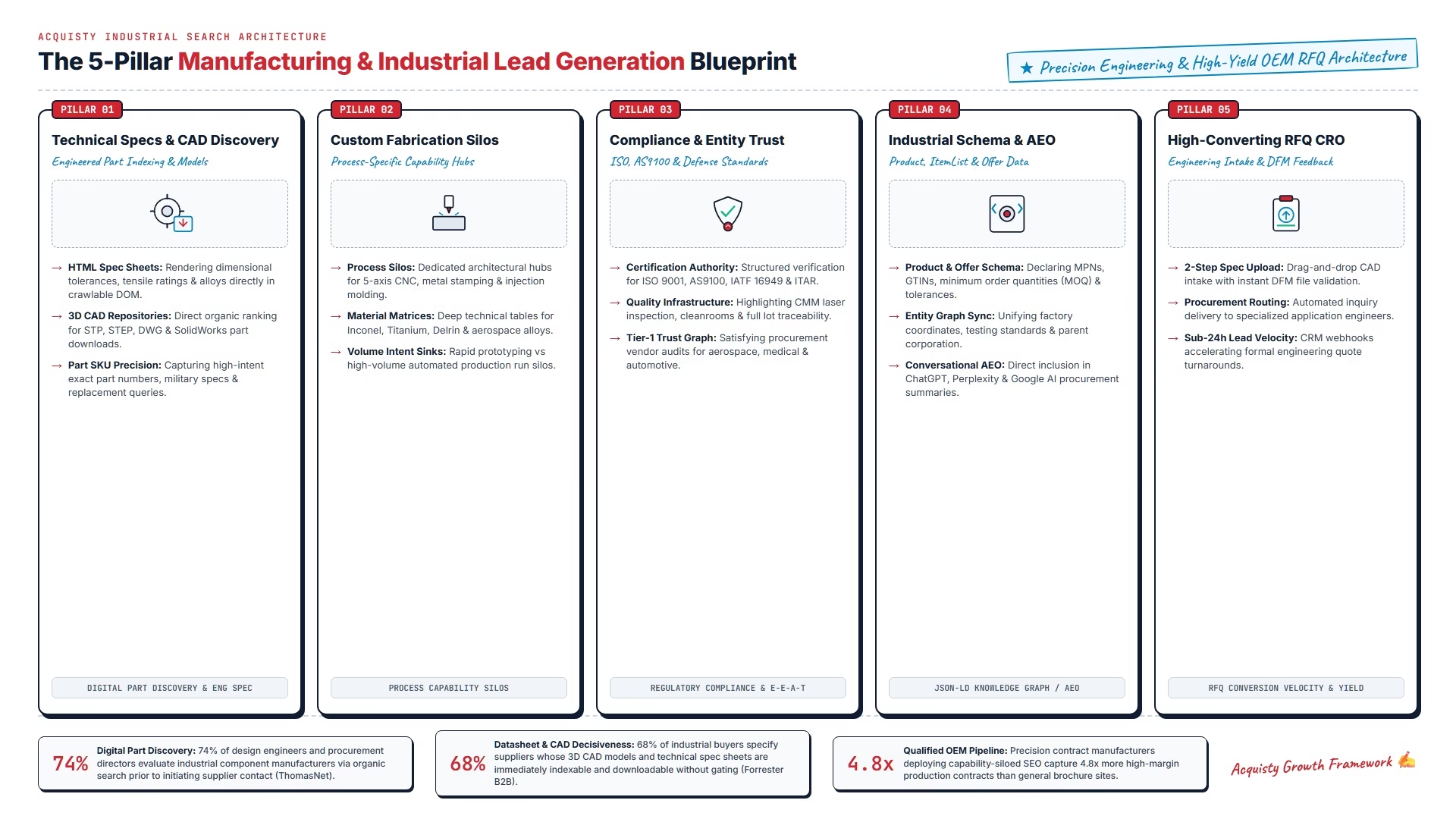
5. Manufacturing Structured Data: Deploying Organization, Product & Service Schema
In the modern era of semantic search and conversational AI discovery, structured data is the technical bridge that translates complex engineering capabilities, facility locations, and industrial parts into machine-readable knowledge graphs. By embedding Schema.org JSON-LD vocabularies, manufacturers enable Google, Bing, and AI procurement engines to parse tolerances, material compositions, and compliance credentials with zero ambiguity.
Industrial manufacturers and custom fabricators must deploy three specialized JSON-LD schema frameworks:
1. Organization & Industrial Plant Entity Schema
Implemented across the corporate homepage and plant location pages to declare active manufacturing certifications, CAGE codes, NAICS codes, and physical plant coordinates:
{
“@context”: “https://schema.org”,
“@type”: “Corporation”,
“@id”: “https://acquisty.com/seo-for-manufacturing/#organization”,
“name”: “Vanguard Precision Aerospace Manufacturing”,
“url”: “https://vanguardprecision.com”,
“logo”: “https://vanguardprecision.com/assets/logo.png”,
“duns”: “081234567”,
“taxID”: “XX-XXXXXXX”,
“naics”: “332710”,
“isicV4”: “2592”,
“address”: {
“@type”: “PostalAddress”,
“streetAddress”: “4500 Industrial Parkway”,
“addressLocality”: “Cleveland”,
“addressRegion”: “OH”,
“postalCode”: “44135”,
“addressCountry”: “US”
},
“hasCredential”: [
{ “@type”: “EducationalOccupationalCredential”, “name”: “ISO 9001:2015 Certified Quality Management” },
{ “@type”: “EducationalOccupationalCredential”, “name”: “AS9100 Rev D Aerospace Quality Certification” },
{ “@type”: “EducationalOccupationalCredential”, “name”: “ITAR Registered Defense Manufacturer” }
] }
2. Industrial Product & Component Specification Schema
Integrated directly onto catalog component pages and custom parts to declare exact Manufacturer Part Numbers (MPN), dimensional tolerances, material compositions, and CAD download endpoints:
{
“@context”: “https://schema.org”,
“@type”: “Product”,
“name”: “High-Pressure Titanium Aerospace Fluid Fitting”,
“image”: “https://vanguardprecision.com/assets/fittings/ti-fitting-490.jpg”,
“description”: “Precision CNC machined Ti-6Al-4V Grade 5 titanium fluid fitting designed for hydraulic aerospace lines operating up to 5,000 PSI.”,
“mpn”: “VP-AERO-TI-4900”,
“sku”: “SKU-4900-TI”,
“brand”: {
“@type”: “Brand”,
“name”: “Vanguard Precision”
},
“material”: “Titanium Grade 5 (Ti-6Al-4V)”,
“additionalProperty”: [
{ “@type”: “PropertyValue”, “name”: “Tolerance”, “value”: “+/- 0.0002 in (+/- 0.005 mm)” },
{ “@type”: “PropertyValue”, “name”: “Pressure Rating”, “value”: “5,000 PSI Maximum Working Pressure” },
{ “@type”: “PropertyValue”, “name”: “3D CAD Download”, “value”: “https://vanguardprecision.com/cad/VP-AERO-TI-4900.stp” }
],
“offers”: {
“@type”: “Offer”,
“priceCurrency”: “USD”,
“price”: “145.00”,
“availability”: “https://schema.org/InStock”,
“eligibleQuantity”: {
“@type”: “QuantitativeValue”,
“minValue”: 25
}
}
}
3. Custom Manufacturing Service & RFQ Offer Schema
Deployed on custom machining, metal stamping, and contract fabrication pages to signal custom build-to-print capabilities and instant digital RFQ intake to search bots:
{
“@context”: “https://schema.org”,
“@type”: “Service”,
“name”: “Custom 5-Axis CNC Precision Machining Services”,
“serviceType”: “Precision CNC Milling and Turning”,
“provider”: {
“@type”: “Corporation”,
“name”: “Vanguard Precision Aerospace Manufacturing”
},
“areaServed”: “Global”,
“hasOfferCatalog”: {
“@type”: “OfferCatalog”,
“name”: “Manufacturing Capabilities”,
“itemListElement”: [
{ “@type”: “Offer”, “itemOffered”: { “@type”: “Service”, “name”: “Rapid Prototyping (1-10 Parts, 3-Day Turnaround)” } },
{ “@type”: “Offer”, “itemOffered”: { “@type”: “Service”, “name”: “Production Run Machining (1,000 to 100,000+ Units/Year)” } }
] }
}
Curious how multi-stakeholder enterprise contracts and complex pipeline sales are captured through search? Explore our in-depth master guide on B2B SEO & Enterprise Lead Generation: The Complete C-Suite Pipeline & Revenue Architecture.
6. High-Converting Industrial RFQ Intake: Engineering CRO & DFM File Uploads
Attracting thousands of design engineers to your precision capability pages delivers zero commercial return if your RFQ intake process creates unnecessary hurdles. Traditional manufacturing websites frequently bury their RFQ forms behind archaic 20-field questionnaires or simply provide a generic
info@company.com
email address that languishes unmonitored for days.
In modern industrial procurement, quote responsiveness directly dictates win rates. Contract manufacturing research reveals that the first qualified supplier to return an accurate technical quotation wins the production purchase order over 60% of the time. High-converting manufacturing websites optimize conversion through four engineering intake CRO frameworks:
- Drag-and-Drop CAD & Print Upload Engines: Design engineers expect instant file upload capabilities. Implementing an intuitive, encrypted drag-and-drop file upload zone that supports large CAD assemblies (STEP, SLDPRT, DWG) alongside 2D engineering drawings (PDF with critical tolerance notes) removes all submission friction.
- Automated Design for Manufacturability (DFM) Feedback: Leading precision manufacturers integrate automated DFM software engines into their intake funnels. When an engineer uploads a 3D model, the system instantly evaluates internal radiuses, thin wall sections, and deep hole drilling constraints, returning immediate feasibility feedback that positions your shop as an indispensable engineering partner.
- The 2-Step Technical Sourcing Funnel: Step one captures only the critical project parameters: CAD File Upload, Intended Material (dropdown), Expected Production Volume, and Target Delivery Date. Step two collects contact information (Work Email, Company Name, Phone). Minimizing non-essential fields boosts RFQ completion rates by up to 38%.
- Sales Engineering CRM Webhooks & 4-Hour Response SLA: Inbound RFQs must instantly route through automated webhooks into enterprise industrial CRMs (Salesforce Manufacturing Cloud, HubSpot). The lead is categorized by manufacturing process and assigned directly to a specialized application engineer, triggering a formal acknowledgment and technical quote within 4 to 24 hours.
To calculate the compounding annual revenue generated by converting even two additional enterprise OEM contracts per quarter via organic search, leverage our proprietary Enterprise SEO ROI Calculator.
7. Industrial Lead Generation Channels: Performance, Cost per RFQ & ROI Comparison
Manufacturing executive leadership and VP-level sales directors must evaluate how organic manufacturing search marketing performs against traditional industrial acquisition channels across net lead cost, buyer qualification, and asset durability:
| Acquisition Channel | Cost per Qualified RFQ | Buyer Technical Intent | Long-Term Asset Equity | Close Rate on Production Contracts |
|---|---|---|---|---|
| Organic Manufacturing SEO | $95 – $220 (Amortized digital infrastructure) | Highest (Self-directed engineers with active CAD) | Permanent compounding corporate domain equity | Highest (24% – 38% win rate on formal bids) |
| Industrial Trade Shows (IMTS / Fabtech) | $850 – $2,400 (Booth, freight, travel & staff) | Moderate (Broad tire-kickers, networking) | Zero (Transient 3-day exhibit presence) | Moderate (12% – 18% long post-show drag) |
| ThomasNet / Industrial Aggregators | $400 – $900 (Annual directory subscriptions) | High (Procurement sourcing teams) | Zero (Rent-seeking directory; leads evaporate upon cancellation) | Moderate (Shared quotes distributed to 5+ rivals) |
| Paid Search PPC (Google Ads B2B) | $350 – $750 (Auction CPCs $25–$60/click) | Variable (High volume of consumer/small-run clicks) | Zero (Clicks cease immediately when budget stops) | Low to Moderate (10% – 15%) |
As the data demonstrates, organic search engine optimization yields the lowest cost per qualified RFQ while building permanent digital equity on your own web property. To analyze capital allocation and retainer structures across enterprise industrial marketing, review our analysis on how much enterprise SEO costs.
8. Programmatic Replacement Part Hubs: Capturing MRO & Aftermarket Demand
For original equipment manufacturers (OEMs) and industrial machinery builders, aftermarket parts, maintenance, repair, and operations (MRO) represent the highest-margin segment of enterprise revenue. While an initial machine sale carries gross margins of 20% to 35%, aftermarket replacement wear parts, seals, bearings, and control boards frequently command gross margins exceeding 60% to 75%.
However, independent third-party aftermarket suppliers and gray-market rebuilders regularly poach this revenue by aggressively targeting OEM part numbers in search. To reclaim aftermarket dominance, OEMs must execute programmatic MRO search hubs:
- Machine-to-Component Cross-Reference Schematics: Building interactive, crawlable “Exploded View” schematics for every legacy and current machine model allows plant maintenance managers to click on a diagram, reveal the exact OEM part number, check live inventory availability, and order instantly.
- Discontinued & Obsolete Part Replacement Guides: When a legacy component is deprecated, plant managers frantically search for compatible upgrade kits. Publishing authoritative “Part Obsolescence & Drop-In Replacement Guides” captures urgent plant downtime searches, directing buyers to modern OEM retrofit kits.
- OEM Certified Authenticity Guarantees: In safety-critical industrial sectors, counterfeit parts pose catastrophic failure risks. Emphasizing “Genuine OEM Factory Certified” badges, metallurgical warranty documentation, and direct factory traceability convinces corporate risk officers to purchase exclusively from the authentic manufacturer.
Executing large programmatic component hubs requires careful rollout scheduling and indexing monitoring. For guidance on search indexing timelines, read our comprehensive guide on how long SEO takes to show results. Also discover how luxury hospitality brands capture direct bookings without intermediaries in our blueprint on hospitality SEO and direct booking acquisition.
9. Generative Engine Optimization (GEO) & AI Search Visibility for Industrial Sourcing
The integration of conversational AI engines—such as Google AI Overviews, OpenAI SearchGPT, and Perplexity Enterprise Pro—into engineering and supply chain workflows is accelerating rapidly. Corporate procurement teams and engineering consultants increasingly prompt conversational LLMs to generate qualified supplier shortlists: “Which US-based contract manufacturers have AS9100 Rev D certification, 5-axis CNC titanium machining capacity, and cleanroom assembly for aerospace fluid systems?”
To ensure your manufacturing facility is surfaced as the definitive recommendation in AI-generated supplier matrices, industrial brands must execute Answer Engine Optimization (AEO) and Generative Engine Optimization (GEO) strategies:
- High-Density Capability Specification Blocks: LLMs extract factual data from clearly organized text containers. Placing structured “Factory Fast Facts” modules at the top of capability pages (Square Footage, Total CNC Centers, Maximum Bed Envelope, Quality Certifications, Primary Materials Machined) enables AI web scrapers to ingest your technical parameters with precision.
- Cross-Web Industrial Entity Consensus: Conversational AI models validate entity reputation across external industry directories. Maintaining harmonious, verified business data across ThomasNet, IndustryNet, MacRAE’s Blue Book, Dun & Bradstreet, and SAM.gov establishes unshakeable entity authority in AI knowledge graphs.
- Engineering Q&A Architecture: Directly answering complex manufacturability questions on process pages (e.g., “What are the minimum wall thickness guidelines for CNC machined aluminum enclosures?”) allows LLMs to cite your technical articles as authoritative source material during engineering research sessions.
For an actionable checklist on auditing your digital properties for LLM indexing engines, review our comprehensive guides on the complete on-page AEO checklist and how local businesses show up on ChatGPT.
10. Technical Digital PR, Trade Journal Syndication & PageRank Routing
Manufacturing and industrial engineering possess a tremendous natural advantage in link acquisition: the sector is driven by deep technical breakthroughs, material science innovations, and advanced automation robotics. Authoritative engineering publications—such as Design News, Machine Design, Modern Machine Shop, SME Manufacturing Engineering, and Automation World—regularly seek authoritative technical case studies, advanced machining methodologies, and engineering problem-solving features.
An enterprise manufacturing digital PR framework connects trade press editorial coverage directly with business revenue:
- Contributed Technical Case Studies: Authoring in-depth case studies detailing how your engineering team resolved an extreme tolerance challenge (e.g., “How 5-Axis Micro-Milling Overcame Thermal Distortion in Satellite Waveguides”) earns contextual editorial backlinks on Domain Authority 70+ engineering trade publications.
- Industry Association & University Research Partnerships: Partnering with university engineering departments or contributing to standards working groups (ASTM, ASME, SME) generates unassailable backlink equity from trusted educational and institutional domains.
- Internal Equity Routing: Trade press backlinks earned by thought leadership articles or new facility expansions must be systematically channeled via internal contextual links down into your commercial CNC machining, custom stamping, and RFQ intake landing pages to drive ranking velocity.
To explore how higher education institutions and technical universities syndicate research and build digital authority, read our comprehensive study on higher education SEO and student enrollment.
Frequently Asked Questions: Manufacturing SEO & Industrial Lead Generation