


The economic engine of residential and commercial real estate has arrived at an existential inflection point. For over two decades, independent brokerages, boutique real estate firms, and regional property development syndicates operated under a precarious model of portal dependency. National aggregators such as Zillow, Realtor.com, and Redfin established dominant monopolies over top-of-funnel organic search queries, effectively positioning themselves as digital toll booths between licensed brokers and prospective property buyers and sellers. Today, the financial toll of this aggregation model is crushing brokerage margins. Between aggressive pay-per-lead price inflation, competitive bidding wars on premier agent territories, and extortionate 30% to 40% post-closing referral commission cuts demanded by portal flex programs, real estate brokerages are essentially buying back the very clients who originally sought local representation in their own communities.
Simultaneously, the modern real estate consumer journey has fundamentally transformed. High-net-worth sellers, institutional capital allocators, and sophisticated home buyers no longer begin and end their search inside a generic map app. When property owners evaluate representation for a multi-million-dollar estate sale or an off-market commercial parcel, they conduct rigorous digital due diligence. They investigate neighborhood-level absorption rates, study historical zoning revisions, cross-examine broker transaction track records, and scrutinize verified local reputation signals. In organic search, Google increasingly rewards localized architectural relevance, elevating authoritative domain ecosystems that demonstrate genuine Experience, Expertise, Authoritativeness, and Trustworthiness (E-E-A-T) across hyper-local geographic clusters over generic, programmatic aggregator listings.
At Acquisty, our dedicated search engine optimization specialists and specialized real estate SEO architecture teams build sovereign, high-yield digital acquisition engines for brokerages, luxury agencies, and enterprise commercial developers. This master guide outlines the engineering blueprint required to dismantle portal reliance, dominate Google Local 3-Pack and Map ecosystem rankings, resolve complex MLS/IDX faceted crawl budget bottlenecks, deploy structured entity schema, and capture high-intent property transactions with uncompromising organic compounding efficiency.
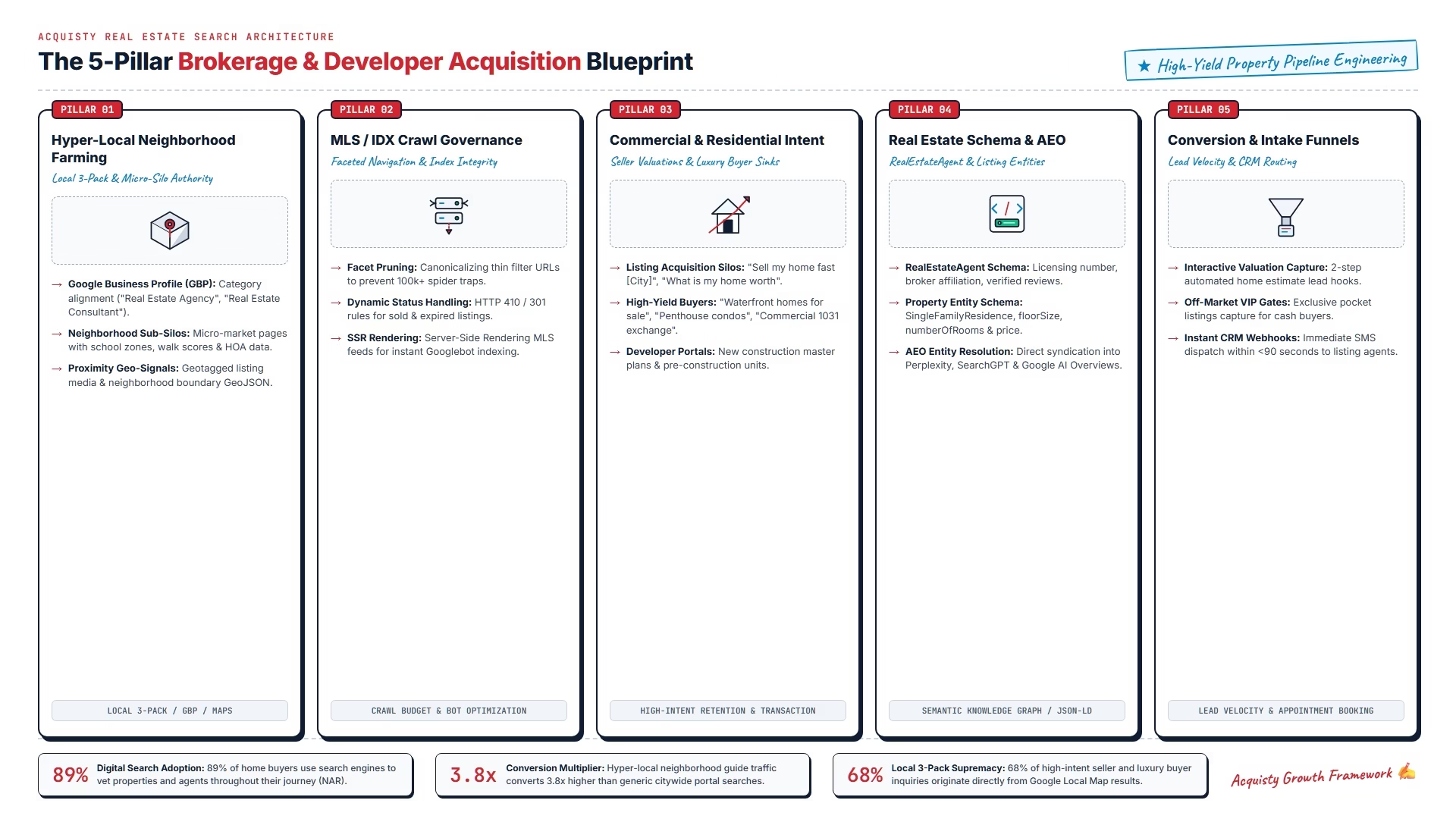
- Digital Search Dominance: According to the authoritative Profile of Home Buyers and Sellers published by the National Association of Realtors (NAR), 100% of home buyers utilize the internet at some phase of their property search, with over 89% actively conducting organic search engine queries to evaluate specific neighborhoods, schools, and agent credentials.
- The Portal Lead Arbitrage Tax: An independent economic analysis by Inman News and brokerage financial audits reveals that real estate brokerages participating in national portal flex or referral networks forfeit between 30% and 40% of their gross commission income (GCI) on closed transactions, eroding net operating margins by up to 65% compared to proprietary organic acquisition.
- Hyper-Local Conversion Multiplier: Proprietary data compiled across real estate platforms demonstrates that organic visits landing on hyper-local community content, neighborhood micro-silos, and custom property valuation engines convert into signed listing agreements and verified buyer consultations at a rate 3.8x higher than traffic directed to broad, generic citywide MLS listing grids.
- Local 3-Pack & Map Consolidation: Over 68% of high-intent seller searches (e.g., “best listing agent in [neighborhood]”, “commercial property brokers near me”) result in direct telephone calls or website consultation bookings originated directly from the Google Local 3-Pack and Google Maps interfaces.
1. The Real Estate Search Funnel: Decoupling from Portal Arbitrage & Reclaiming Sovereign Equity
To build a durable, high-margin real estate enterprise, brokerage owners, managing principals, and property developers must examine the underlying mechanics of how digital leads are manufactured and monetized. For the past decade, portal aggregators have executed a classic digital arbitrage strategy: they amass millions of automated MLS listings, capture top-ranking search positions for broad, generic keywords (such as “homes for sale in Austin TX”), capture prospective consumer contact details behind forced registration walls, and resell those exact same inquiries back to the local agents who originally populated the listing database.
This portal dependency model presents severe operational vulnerabilities for growing brokerages:
- Compounding Commission Loss: Paying 35% of GCI on every closed portal deal permanently caps firm profitability, making it mathematically impossible to invest in senior agent recruitment, proprietary technology, or geographic expansion.
- Zero Brand Equity Accrual: When consumers view a home on a third-party portal, their brand loyalty belongs entirely to the aggregator platform. If the aggregator changes its algorithms, triples its territory pricing, or launches its own direct brokerage operations, the independent agency has zero defensible digital footprint to fall back on.
- Low-Quality Lead Churn: Shared portal leads are routinely distributed to multiple competing brokerages simultaneously, triggering a hyper-aggressive race where agents cold-call unvetted tire-kickers who are frequently months away from making a buying decision.
By contrast, building a proprietary real estate SEO architecture creates permanent, sovereign digital assets. When an agency secures dominant rankings for high-intent, hyper-local search queries, prospective sellers and affluent buyers discover the brokerage directly. These inquiries represent exclusive, highly motivated clients who actively seek out the firm’s localized market mastery. Below, we break down the architectural mechanisms required to construct and scale this organic acquisition infrastructure.
2. Hyper-Local Neighborhood Farming & Google Local 3-Pack Supremacy
In commercial and residential property marketing, all real estate is fundamentally local. While national aggregators dominate massive, generic queries across entire metropolitan statistical areas, they suffer from a critical structural weakness: their automated databases lack authentic, granular neighborhood context. Aggregators cannot write firsthand analyses of architectural design covenants in a specific gated enclave, evaluate the nuances of school district boundary line adjustments, or document micro-neighborhood lifestyle amenities. This structural gap is precisely where independent brokerages and regional developers can achieve decisive organic dominance.
Securing top positions across Google’s Local 3-Pack and Map Ecosystem requires a dual-track strategy combining rigorous Google Business Profile (GBP) engineering with hyper-local digital farming silos:
- Primary & Secondary GBP Categorization: The primary category must reflect the firm’s core revenue driver—typically
Real Estate AgencyorCommercial Real Estate Agency. Secondary categories should strategically incorporateReal Estate Consultant,Real Estate Appraiser, andProperty Management Company. For multi-agent brokerages, individual licensed top-producers should maintain separate practitioner listings linked to dedicated agent biography pages on the primary domain, strictly enforcing consistent physical office address formatting. - Micro-Market Neighborhood Silos: Rather than producing a solitary “Properties in Scottsdale” landing page, high-performing architectures construct hierarchical sub-silos: Scottsdale → Silverleaf → Upper Canyon Gated Enclave. Each child page must host custom, un-duplicated editorial content: historical price-per-square-foot trends, active association bylaws, architectural review board criteria, private club amenities, and bespoke market commentary.
- Geographic Boundary Coordinates & GeoJSON: Embedding verified municipal polygon boundaries, geo-coordinates (latitude/longitude), and customized interactive neighborhood maps directly into page code supplies search engine crawlers with unmistakable mathematical confirmation of the entity’s localized geographic footprint.
- Local Review Velocity & Transaction Proof: Google’s local ranking algorithms heavily weight review freshness, geographic keyword inclusion in client feedback, and verified seller testimonials. Establishing systematic post-closing review automation ensures a steady influx of authentic 5-star ratings detailing specific neighborhood transactions.
Understanding how Google evaluates location proximity, prominence, and relevance is critical for brokerages targeting competitive metropolitan sub-markets. When structured properly, local map rankings funnel the highest-intent prospective sellers directly into your firm’s consultation calendar. For an in-depth exploration of core algorithmic ranking signals, review our comprehensive breakdown of important SEO ranking factors.
3. MLS & IDX Architectural Engineering: Crawl Budget Governance & Faceted Indexation Integrity
Integrating an Internet Data Exchange (IDX) or Multiple Listing Service (MLS) feed is standard practice for modern real estate websites. However, an improperly configured IDX feed is the single most common cause of catastrophic technical SEO failure in the real estate sector. When thousands of dynamic MLS listings are synchronized without strict architectural governance, search engine crawlers become hopelessly trapped inside infinite faceted navigation loops, squandering crawl budget on thin, duplicate, or expired property URLs while ignoring high-value strategic pages.
Enterprise real estate engineering requires strict implementation of four technical indexation controls:
- Faceted Navigation Pruning & Robots Governance: Allowing search engine spiders to crawl every permutation of dynamic search filters—such as
?beds=3&baths=2&price_min=500000&price_max=600000&sort=price_desc—generates hundreds of thousands of near-identical URLs. All dynamic parameter sorting, price slider combinations, and pagination variants beyond page one must be governed vianoindex,followrobots meta directives or pruned entirely using server-side canonical tags pointing back to the static parent community category. - The Property Lifecycle Indexation Protocol (Active, Pending, Sold, Expired): Real estate listings are inherently ephemeral. When a property sells or the listing expires, simply deleting the URL to generate an HTTP 404 error destroys accumulated PageRank and damages domain crawl efficiency. Instead, enterprise brokerages implement a tiered status protocol:
- Pending / Under Contract: Maintain status
200 OK, update on-page messaging to “Pending / Under Contract”, and display an automated carousel of “Similar Active Properties in [Neighborhood]”. - Sold Listings: Retain high-value architectural or record-setting sales pages as permanent case studies with historical pricing, or redirect standard sold listings via HTTP 301 to the primary parent neighborhood silo to preserve equity.
- Terminated / Withdrawn Listings: If permanently removed from market without historical utility, serve an explicit HTTP 410 Gone status code, signaling Googlebot to purge the dead URL immediately from the index without repeated re-crawling.
- Pending / Under Contract: Maintain status
- Server-Side Rendering (SSR) vs. Client-Side JavaScript: Many third-party IDX plug-ins rely entirely on client-side JavaScript or dynamic iframes to populate property data. Because Googlebot renders JavaScript asynchronously across a delayed second-wave crawl queue, client-side listing data is frequently indexed incompletely or entirely missed. Enterprise architectures enforce Server-Side Rendering (SSR) or dynamic pre-rendering, ensuring property specifications, imagery, and text content exist directly inside the raw HTML payload received during initial crawler requests.
Managing massive URL catalogs and maintaining optimal crawler efficiency demands continuous log file analysis and crawl budget oversight. To examine how enterprise engineering teams prevent crawl waste across complex multi-thousand-page domains, explore our guide to enterprise SEO metrics and crawl governance.
4. High-Intent Content Siloing: The 3 Core Real Estate Acquisition Clusters
A successful real estate SEO program cannot rely exclusively on MLS property feeds. Listings come and go, but structural topical authority compounds over years. To capture market share across both sides of the transaction ledger, real estate firms must engineer three distinct, high-intent content silos that guide prospective clients from initial market exploration to signed representation agreements.
By organizing editorial and market analysis content into tightly linked thematic silos, internal PageRank flows naturally toward primary neighborhood transaction landing pages. Understanding how editorial research translates into commercial pipeline growth is central to modern search marketing; for additional insights into content strategy, examine our analysis of what content writing is in digital marketing.
5. Real Estate Structured Data: Deploying RealEstateAgent, SingleFamilyResidence & Place Schema
In the era of entity-based indexing and AI-driven search engines, search crawlers do not merely read text; they construct multidimensional Knowledge Graphs linking businesses, locations, and assets. For real estate brokerages, implementing Schema.org structured data in JSON-LD format is the most direct method to establish entity authority, earn rich snippet search results, and feed accurate property pricing into conversational AI engines.
Every competitive real estate digital ecosystem must deploy three core JSON-LD structured data architectures:
1. Specialized RealEstateAgent Entity Schema
Applied to individual partner and broker biography profiles to declare licensing credentials, service regions, and review ratings:
{
“@context”: “https://schema.org”,
“@type”: “RealEstateAgent”,
“@id”: “https://acquisty.com/seo-for-real-estate/#agency”,
“name”: “Pinnacle Luxury Realty Partners”,
“legalName”: “Pinnacle Realty Group LLC”,
“url”: “https://examplebrokerage.com”,
“telephone”: “+1-480-555-0199”,
“priceRange”: “$$$$”,
“address”: {
“@type”: “PostalAddress”,
“streetAddress”: “8500 E Princess Dr, Suite 200”,
“addressLocality”: “Scottsdale”,
“addressRegion”: “AZ”,
“postalCode”: “85255”,
“addressCountry”: “US”
},
“geo”: {
“@type”: “GeoCoordinates”,
“latitude”: 33.6421,
“longitude”: -111.9015
},
“areaServed”: [
{ “@type”: “AdministrativeArea”, “name”: “Scottsdale” },
{ “@type”: “AdministrativeArea”, “name”: “Paradise Valley” },
{ “@type”: “AdministrativeArea”, “name”: “Silverleaf” }
],
“aggregateRating”: {
“@type”: “AggregateRating”,
“ratingValue”: “4.9”,
“reviewCount”: “142”
}
}
2. SingleFamilyResidence Property Listing Schema
Deployed on property detail pages to declare square footage, bedroom/bathroom configurations, and listing prices directly into Google Search rich snippets:
{
“@context”: “https://schema.org”,
“@type”: “SingleFamilyResidence”,
“name”: “The Silverleaf Modern Spanish Estate”,
“description”: “Architectural luxury residence featuring panoramic McDowell Mountain views, private infinity pool, and bespoke wine cellar.”,
“address”: {
“@type”: “PostalAddress”,
“streetAddress”: “10245 E Silverleaf Way”,
“addressLocality”: “Scottsdale”,
“addressRegion”: “AZ”,
“postalCode”: “85255”,
“addressCountry”: “US”
},
“numberOfRooms”: 14,
“numberOfBedrooms”: 5,
“numberOfBathroomsTotal”: 7,
“floorSize”: {
“@type”: “QuantitativeValue”,
“value”: 8250,
“unitCode”: “FTK”
},
“offers”: {
“@type”: “Offer”,
“price”: “6850000”,
“priceCurrency”: “USD”,
“availability”: “https://schema.org/InStock”,
“validFrom”: “2026-09-01”
}
}
3. Place & Neighborhood GeoCoordinates Schema
Deployed across hyper-local neighborhood guides and subdivision sub-silos to supply mathematical polygon boundaries and municipal landmark connections directly into Google Knowledge Graph:
{
“@context”: “https://schema.org”,
“@type”: “Place”,
“name”: “Silverleaf Gated Community”,
“description”: “Prestigious private residential enclave situated within the McDowell Mountain Regional Park boundaries in North Scottsdale.”,
“geo”: {
“@type”: “GeoCoordinates”,
“latitude”: 33.6492,
“longitude”: -111.8924
},
“containsPlace”: [
{ “@type”: “Place”, “name”: “Upper Canyon at Silverleaf” },
{ “@type”: “Place”, “name”: “Horseshoe Canyon at Silverleaf” }
] }
Looking to understand how high-ticket professional service firms capture elite clients through specialized organic search architecture? Explore our master blueprint on Law Firm SEO & High-Value Case Acquisition: The Complete Attorney Digital Practice Blueprint.
6. High-Velocity Conversion Architecture: Engineering Frictionless Property Lead Funnels
Generating substantial organic search impressions is meaningless if website visitors bounce without initiating contact. For years, real estate websites relied on crude, high-friction lead capture mechanisms: pop-up modals forcing users to create an account after viewing two photos, or generic “Contact Agent” sidebar forms. Industry usability benchmarks reveal that aggressive forced registration walls trigger bounce rates exceeding 82%, alienating prospective sellers and sending negative behavioral signals back to Google’s ranking algorithms.
High-converting real estate portals replace punitive registration walls with high-value, intent-driven conversion funnels:
- The Two-Step Automated Home Valuation Funnel: Rather than demanding a phone number up front, high-performing seller landing pages allow home owners to enter their physical property address to unlock an immediate, interactive estimated equity range based on local MLS public records. Once the user perceives immediate algorithmic value, the secondary step prompts them to request a complimentary, verified Comparative Market Analysis (CMA) prepared personally by the managing broker to account for interior renovations and premium architectural finishes.
- Off-Market VIP Buyer & Pocket Listing Gates: Affluent buyers seeking luxury properties or commercial parcels prize exclusivity. Offering access to a curated “Private Client Off-Market Registry” captures verified investor contact details without forcing intrusive registration across standard public MLS inventory.
- Instant Lead Response & CRM Routing Integration: In real estate, lead velocity directly governs transaction conversion. According to the Harvard Business Review, contacting an inbound real estate lead within 5 minutes results in a 21x higher qualification rate compared to waiting 30 minutes. Modern SEO funnels connect directly to CRM platforms (e.g., Follow Up Boss, Salesforce, HubSpot) via instant webhooks, triggering automated SMS notifications to designated listing specialists within 90 seconds.
Calculating the compounding enterprise value of proprietary organic lead generation requires understanding your firm’s acquisition payback window. To project your firm’s financial upside, utilize our interactive Enterprise SEO ROI Calculator.
7. Real Estate Client Acquisition Channels: Strategic Performance & ROI Comparison
Brokerage principals and developers must evaluate how organic search engine optimization compares against competing client acquisition channels across cost, exclusivity, and long-term asset value:
| Acquisition Channel | Estimated Cost per Signed Client | Lead Exclusivity | Long-Term Asset Value | High-Net-Worth Penetration |
|---|---|---|---|---|
| Organic Hyper-Local SEO | $350 – $850 (Blended amortization) | 100% Sovereign (Exclusive to your brokerage) | Permanent compounding domain equity | High (Attracted to custom research & privacy) |
| Portal Aggregators (Zillow / Realtor.com) | $2,800 – $7,500+ (30%–40% GCI referral cut) | Zero (Resold to multiple competing agents) | Zero (Rented leads; vanishes when spend stops) | Low to Moderate (Dominated by retail buyers) |
| Paid Search PPC (Google Ads / LSAs) | $1,400 – $3,200 (Cost per acquisition) | Exclusive (Subject to immediate follow-up) | Zero (Auction resets each month) | Moderate (High ad blindness among luxury buyers) |
| Direct Mail & Highway Billboards | $3,500 – $6,000+ (Printing, postage & leases) | Exclusive | Zero (Ephemeral physical impressions) | Unpredictable (Zero digital attribution tracking) |
As demonstrated above, organic real estate SEO produces the highest return on capital because it converts ongoing marketing expenditure into permanent digital infrastructure. For a comprehensive financial analysis of search marketing retainers across industries, explore our detailed study on how much enterprise SEO costs.
8. Programmatic Neighborhood Architecture & School District Targeting
Scaling an independent real estate domain across a major metropolitan territory requires generating hundreds of neighborhood-specific landing pages. However, deploying programmatic SEO without strict quality controls risks triggering Google’s algorithmic spam filters, specifically regarding “doorway pages” that deliver thin, templated content.
To build compliant, high-performing programmatic neighborhood hubs, engineering teams integrate rich dynamic data layers:
- Public & Private School District Integration: School rankings are consistently cited by home buyers as a primary relocation driver. Programmatic pages must dynamically ingest verified rating feeds, student-to-teacher ratios, graduation metrics, and athletic program offerings for each specific attendance zone.
- Live Housing Market Telemetry: Ingesting real-time MLS statistics to populate automated charts displaying rolling 30-day median sales prices, average price-per-square-foot trends, inventory turnover velocity, and historical 5-year appreciation curves transforms a static directory page into an indispensable financial resource.
- Curated Architectural Photography & Video Overviews: Supplementing programmatic statistics with authentic high-definition drone footage, video neighborhood walkthroughs, and bespoke editorial commentary ensures every single page delivers genuine user satisfaction and unique editorial depth.
Ensuring new programmatic pages are indexed rapidly by search engine bots requires structured internal linking and XML sitemap prioritization. For detailed timing expectations on domain indexing, review our operational guide on how long SEO takes to show results.
9. Generative Engine Optimization (GEO) & AI Search Visibility for Real Estate
The integration of Large Language Models (LLMs) into mainstream consumer search—including Google AI Overviews, OpenAI ChatGPT Search, and Perplexity AI—is reshaping property discovery. Consumers increasingly bypass traditional keyword searches in favor of complex, multi-variable conversational prompts, such as: “What are the best gated communities in North Scottsdale with mountain views, minimum 1-acre lots, and proximity to top-ranked STEM high schools?”
To ensure your brokerage or development project is recommended directly inside generative AI responses, firms must execute Answer Engine Optimization (AEO) and Generative Engine Optimization (GEO) strategies:
- Semantic Information Density & Direct Answers: LLM retrieval engines parse content for high factual density. Structuring neighborhood guides with concise, factual summary tables, bulleted specification blocks, and explicit definitions enables AI crawlers to extract direct answers effortlessly.
- Cross-Web Brand Consensus & Digital PR: Conversational AI models validate entity trustworthiness by cross-referencing multiple authoritative web sources. When your brokerage is cited across local business journals, regional economic reports, and recognized real estate publications, LLMs synthesize that multi-source validation into prominent conversational recommendations.
- Entity Graph Alignment: Ensuring consistent brand names, managing broker credentials, physical addresses, and licensing records across Wikipedia, Wikidata, Google Knowledge Graph, and industry directories cements your firm as an undeniable authority entity in LLM training corpora.
For a step-by-step technical framework on optimizing your digital architecture for LLM scrapers, consult our master guide on the complete on-page AEO checklist and our analysis on how local businesses show up on ChatGPT.
10. Digital PR, Local Authority Sinks & High-Impact Link Acquisition
Backlinks remain one of Google’s most heavily weighted algorithmic signals. However, in real estate SEO, low-quality automated directory links or spammy guest posts provide zero ranking value and carry severe algorithmic penalty risks. What moves the needle for competitive local real estate queries is localized geographic relevance and high-tier editorial authority.
High-performing real estate link acquisition programs deploy three proven authority-building campaigns:
- Quarterly Regional Housing Market Reports: Rather than relying solely on generic state association press releases, enterprise brokerages synthesize their own quarterly market data—breaking down micro-neighborhood pricing shifts, luxury inventory absorption, and out-of-state migration trends. Pitching these data-dense reports to local business journalists, metropolitan newspapers, and regional television news produces high-authority, unassailable editorial backlinks.
- Architectural & Historic Property Case Studies: When representing distinctive architectural residences (mid-century modern masterpieces, historic estates, ultra-sustainable net-zero builds), developing comprehensive design case studies complete with architectural photography attracts organic citations from design publications, lifestyle magazines, and historical preservation societies.
- High-Relevance Local Industry Citations: Consistent NAP (Name, Address, Phone Number) citations across recognized real estate platforms—including Zillow Agent Directory, Realtor.com Find a REALTOR, Homes.com, Chamber of Commerce, and local business improvement districts—solidify your core localized knowledge graph.
To explore how enterprise organizations across other high-ticket sectors systematically build authoritative link equity, read our in-depth guide to B2B SEO and enterprise lead generation.
Frequently Asked Questions: Real Estate SEO & Property Acquisition