


The economics of legal client acquisition have undergone an unprecedented structural shift. For decades, ambitious law firm managing partners relied on high-visibility legacy advertising: interstate highway billboards, broadcast television commercials, sports arena sponsorships, and yellow-page directories. As digital consumption centralized into smartphone search bars, law firms pivoted toward Google Ads, driving pay-per-click (PPC) auction prices to astronomical records. Today, competitive legal search terms—such as “commercial litigation attorney”, “truck accident lawyer”, or “mesothelioma legal counsel”—routinely exceed $450 to $900 per single click. For growing law practices, boutique litigation firms, and regional multi-office partnerships, relying exclusively on paid search auction arbitrage has become financially unsustainable.
Simultaneously, the modern legal consumer journey has evolved into an exhaustive, multi-step digital investigation. Whether an enterprise General Counsel is vetting specialized antitrust trial attorneys or an individual is navigating a devastating catastrophic injury, prospective clients rarely make an unresearched call based on a slogan. They research statutory precedents online, scrutinize verified judicial trial records, verify State Bar disciplinary standings, and cross-reference peer reviews. In legal marketing, search algorithms categorize legal content under the uncompromising standards of Your Money or Your Life (YMYL), demanding absolute fidelity to Google’s Experience, Expertise, Authoritativeness, and Trustworthiness (E-E-A-T) framework, while operating under the ethical advertising mandates of the American Bar Association (ABA) Model Rules of Professional Conduct.
At Acquisty, our dedicated search engine optimization practice and specialized legal SEO architecture teams design compliant, high-velocity case acquisition engines for trial lawyers and corporate law firms. This master blueprint details the complete end-to-end framework required to dominate Google Local 3-Pack rankings, build impenetrable practice area topical authority, deploy structured legal schema, and convert qualified search visitors into high-value signed fee retainers.
- Digital Search Adoption: According to the comprehensive Legal Trends Report by Clio, over 76% of legal consumers utilize online search engines to research, evaluate, and select an attorney before ever placing a telephone call or initiating an office consultation.
- Local 3-Pack Click Share: For high-urgency, localized legal queries containing proximity modifiers (“trial lawyer near me”, “commercial litigation attorney Dallas”), the Google Local 3-Pack captures 58.6% of all organic clicks, with 48% of users contacting an attorney within 4 hours (American Bar Association Legal Technology Survey).
- Cost-Per-Retained-Case Efficiency: Establishing dominant organic practice area silos delivers a customer cost-per-retained-case that is 65% lower than Google Local Services Ads (LSA) and 80% lower than traditional non-branded PPC auctions (Thomson Reuters Institute).
- Lifetime Case Value Multiple: High-ticket enterprise and catastrophic injury cases originating from organic search authority demonstrate a 3.4x higher average fee value than paid banner or social media inquiries, driven by high user intent and pre-established institutional trust.
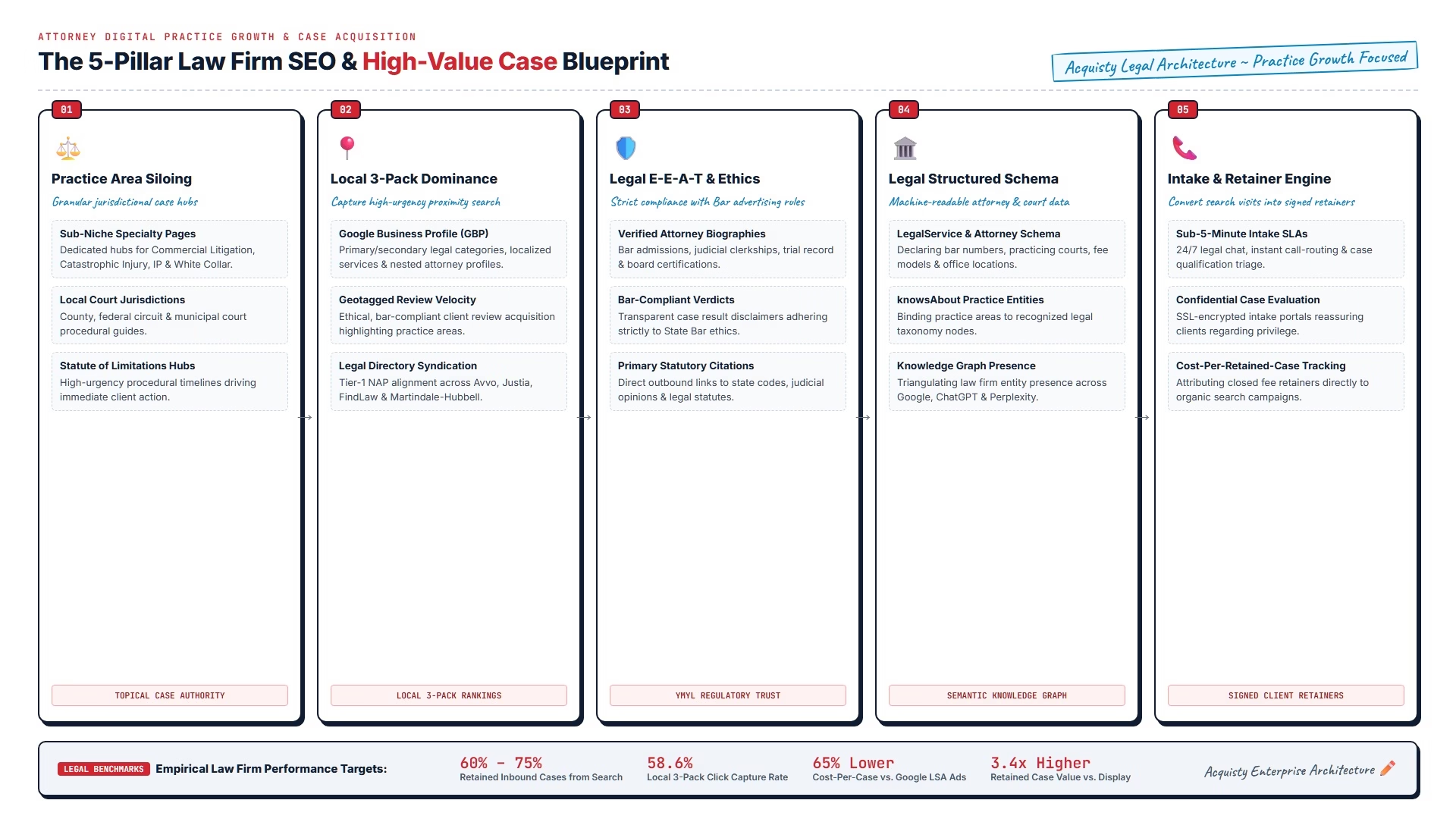
1. The Modern Legal Consumer Journey: Crisis Search vs. Commercial Diligence
Unlike consumer retail or casual software shopping, legal search behavior is uniquely characterized by high personal, operational, or financial stakes. Prospective legal clients search under two distinct psychological and operational paradigms:
A law firm that attempts to address both paradigms with generic, thin marketing pages will inevitably fail. An elite legal SEO architecture requires developing two distinct functional silos: Emergency Response Funnels optimized for rapid mobile local intake, and Deep Practice Authority Silos engineered to satisfy the rigorous vetting standards of corporate general counsels and institutional decision-makers.
The legal client discovery cycle follows four interconnected phases: (1) Acute Legal Problem Identification, (2) Statutory Rights Exploration & Statute of Limitations Assessment, (3) Attorney Credential & Trial Record Verification, and (4) Intake Triage & Formal Retainer Execution. When your website provides the authoritative statutory answers during Phase 2, prospective clients view your partners as the natural trial advocates when executing Phase 4.
2. Practice Area Siloing & Jurisdictional Content Hubs
The most pervasive structural flaw found across law firm websites is the Generic Practice Area Catch-All. A law firm creates a single page titled “Business Litigation” or “Personal Injury” containing 500 words of superficial marketing fluff, expecting to rank against specialized boutique practices. In modern legal search, Google rewards deep, granular topical completeness.
To build unshakeable topical authority that dominates organic search results across your target metro or regional jurisdiction, deploy a structured Practice Area Sub-Niche Hub Hierarchy:
Pillar 1: Granular Sub-Niche Specialty Pages
Rather than consolidating all commercial disputes into one broad URL, construct dedicated, multi-thousand-word master guides for specific operational claims:
Pillar 2: County, Circuit & Court Jurisdictional Guides
Law is inherently jurisdictional. An attorney licensed in New York cannot handle a matter in Texas without pro hac vice admission, and civil procedural rules vary significantly between municipal courts, county courts of law, and federal district courts. Publishing localized court procedural guides (e.g., “Navigating Commercial Division Rules in New York County Supreme Court” or “Local Discovery Rules in the Northern District of Texas”) provides undeniable local algorithmic relevance while demonstrating direct courtroom familiarity to clients.
To understand how similar high-ticket B2B service silos operate across corporate procurement pipelines, explore our master framework for B2B SEO and enterprise lead generation.
3. Dominating the Local 3-Pack: Google Business Profile (GBP) & Geolocation Beacons
In legal search marketing, the Google Local 3-Pack represents the single most valuable visual real estate in modern search. Positioned prominently above organic blue links, the map pack captures over 58% of all high-intent prospective client clicks. Securing and defending a top-3 ranking across your practice metro requires optimizing three foundational local algorithmic pillars:
To calculate the economic returns of dominating localized commercial search across your practice groups, utilize our interactive enterprise SEO ROI calculator and forecast retained fee growth.
4. Legal E-E-A-T & State Bar Advertising Compliance: Engineering Algorithmic Trust
Because legal representation directly impacts an individual’s personal liberty, constitutional rights, and financial survival, search engines classify legal content under the most stringent Your Money or Your Life (YMYL) quality guidelines. Any law firm publishing anonymous, uncredited, or AI-generated legal summaries will face severe algorithmic penalties. To rank in competitive legal verticals, your practice must demonstrate unquestionable clinical E-E-A-T (Experience, Expertise, Authoritativeness, and Trustworthiness).
Simultaneously, legal marketing must adhere strictly to State Bar ethics rules, notably ABA Model Rule 7.1 (prohibiting false or misleading communications) and Rule 7.2 (governing advertising disclosures). Balancing algorithmic optimization with regulatory ethics requires executing four operational standards:
To explore how similar strict YMYL and regulatory frameworks operate in highly governed clinical environments, examine our complete blueprint for healthcare SEO and patient acquisition.
For an empirical analysis of organic ranking timelines, read our guide on how long SEO takes to show measurable ROI and examine our technical on-page AEO checklist for AI search visibility.
5. Legal Structured Data Architecture: Deploying LegalService, Attorney & LawFirm Schema
Structured data markup is the machine-readable translation layer that allows search engine web crawlers and conversational AI assistants (ChatGPT Search, Perplexity, Google AI Overviews) to parse your law firm’s attorneys, bar licenses, office locations, and practice specializations without ambiguity. Schema.org provides an extensive legal vocabulary engineered specifically for the legal sector.
Every competitive law firm domain must deploy three core JSON-LD schema architectures:
1. Specialized Attorney Person Schema
Applied to individual partner and associate biography profiles to declare bar numbers, alumni credentials, and practice areas:
{
“@context”: “https://schema.org”,
“@type”: “Attorney”,
“name”: “Victoria Vance, Esq.”,
“jobTitle”: “Managing Trial Partner”,
“alumniOf”: “Columbia Law School”,
“knowsAbout”: [
“Commercial Litigation”,
“Antitrust Law”,
“Appellate Advocacy”
],
“worksFor”: {
“@type”: “LegalService”,
“name”: “Acquisty Legal Group LLP”
},
“sameAs”: [
“https://www.linkedin.com/in/victoria-vance-law”,
“https://www.avvo.com/attorneys/victoria-vance”
] }
2. Practice Area LegalService Schema
Deployed on specific practice area sub-hubs to declare service offerings, geographic jurisdictions, and fee structures:
{
“@context”: “https://schema.org”,
“@type”: “LegalService”,
“name”: “Enterprise Commercial Dispute Resolution Practice”,
“serviceType”: “Complex Commercial Litigation & Arbitration”,
“areaServed”: [“New York”, “Texas”, “California”],
“priceRange”: “$$$$”,
“provider”: {
“@type”: “LawFirm”,
“name”: “Acquisty Legal Group LLP”
}
}
3. LawFirm Entity & Local Office Schema
Deployed across law firm office location profiles to connect physical address, telephone, hours of operation, and aggregate client ratings:
{
“@context”: “https://schema.org”,
“@type”: “LawFirm”,
“name”: “Acquisty Legal Group LLP”,
“url”: “https://acquisty.com/seo-for-legal/”,
“telephone”: “+1-212-555-0199”,
“address”: {
“@type”: “PostalAddress”,
“streetAddress”: “400 Madison Avenue, 18th Floor”,
“addressLocality”: “New York”,
“addressRegion”: “NY”,
“postalCode”: “10017”
},
“openingHoursSpecification”: [
{
“@type”: “OpeningHoursSpecification”,
“dayOfWeek”: [“Monday”, “Tuesday”, “Wednesday”, “Thursday”, “Friday”],
“opens”: “08:30”,
“closes”: “18:30”
}
] }
6. Legal Acquisition Channel Benchmark Matrix: Cost, Quality & Case Value
To help law firm managing partners and executive committees allocate marketing capital rationally, the following empirical matrix compares Organic Legal SEO against Google Local Services Ads (LSA), Pay-Per-Click Search Auctions, and Traditional Out-of-Home (OOH) Advertising across case acquisition cost, lead quality, and compounding return:
For a complete analysis of enterprise marketing retainer models and agency structures, explore our comprehensive pricing guide on how much enterprise SEO services cost.
7. AI Search Optimization (GEO/AEO) for Attorneys: Winning Recommendations in ChatGPT, Perplexity & Claude
The legal evaluation landscape is rapidly integrating generative AI models into client advisory workflows. Corporate general counsel, business executives, and injured individuals are turning to conversational AI platforms (ChatGPT Search, Perplexity Pro, Claude, and Google AI Overviews) with complex, factual legal queries: “Who are the most accomplished commercial litigation trial attorneys in Manhattan with proven trade secret defense trial verdicts?” or “What is the statute of limitations for medical device product liability in California?”
To ensure your law firm is actively synthesized, recommended, and cited as the leading counsel across generative AI responses, execute these three generative engine optimization (GEO) mandates:
To explore how local commercial practices win prominent recommendations inside generative AI platforms, review our practical guide to how local businesses show up on ChatGPT.
8. Reverse Link Equity Routing: Channeling Domain Authority to Core Retainer Pages
In legal publishing, external editorial backlinks naturally congregate around groundbreaking appellate commentary, Supreme Court case analyses, and community legal news stories. However, prospective clients do not retain a lawyer on a news commentary page; they retain counsel on dedicated practice area landing pages and attorney consultation profiles.
To prevent link equity hoarding and ensure your commercial practice landing pages receive the PageRank necessary to rank #1, deploy Reverse Link Equity Routing:
To explore how internal PageRank distribution directly influences enterprise ranking velocity across competitive sectors, review our comprehensive analysis of critical SEO ranking factors.
9. The 24/7 Legal Intake Engine: Converting Search Visitors into Signed Retainers
Driving thousands of qualified legal search visitors to your website is completely meaningless if your internal intake operations cannot convert inquiries into signed fee retainers. In consumer and commercial legal search, client conversion follows a brutal decay curve: prospective clients contacted within 5 minutes of inquiry submission are 21 times more likely to retain the firm than those contacted after 30 minutes. If your intake team takes 24 hours to return an email, that prospect has already retained your competitor down the street.
To achieve an elite visitor-to-retained-case conversion rate, deploy the four-part High-Velocity Legal Intake Architecture:
To understand how high-impact content writing integrates with broader technical search strategies, review our foundational guide on what content writing is in digital marketing.
10. Technical Law Firm SEO & Core Web Vitals Optimization
A law firm website must balance heavy digital collateral—high-resolution attorney portraits, video depositions, interactive case result libraries, and court filing PDFs—with lightning-fast technical performance. Over 68% of legal searches occur on mobile devices, often under stressful real-world conditions where prospective clients abandon slow-loading websites within 3 seconds.
To achieve perfect Google Core Web Vitals scores and maximize crawl efficiency, implement these technical engineering protocols:
For enterprise practices managing complex multi-regional websites, explore our detailed operational framework for enterprise SEO metrics and crawl governance.
11. The 90-Day Law Firm Digital Practice Scaling Sprint
Transforming a law firm domain from an underperforming brochure into an aggressive case acquisition engine requires a structured, phased implementation roadmap: