The digital discovery ecosystem is undergoing the most profound structural transition since the founding of Google. For over two decades, search engine optimization operated under a straightforward, mechanical premise: discover high-volume keywords, optimize title tags, earn backlinks to accrue PageRank, and capture clicks from the traditional “10 blue links.” Today, that interface paradigm is rapidly eroding. The emergence of Google AI Overviews, Perplexity Pro, OpenAI Search, and conversational assistants has replaced the traditional search engine results page (SERP) with synthesized generative answers.
In this new operational landscape, ranking at position #1 in classical organic search no longer guarantees traffic if an artificial intelligence model synthesizes your content into a zero-click answer without attributing your brand. To remain discoverable, commercial enterprises must master Answer Engine Optimization (AEO) and Generative Engine Optimization (GEO). Where traditional search engines retrieve documents, answer engines extract answers, synthesize concepts, and cite authoritative source entities.
At Acquisty, our engineering-driven AI-SEO services help forward-thinking organizations adapt their digital real estate for generative discovery. This comprehensive On-Page AEO Checklist provides the technical architecture, content formatting protocols, and machine-readable data structures required to ensure your web pages are systematically ingested, parsed, and cited as definitive source authorities by Large Language Models (LLMs).
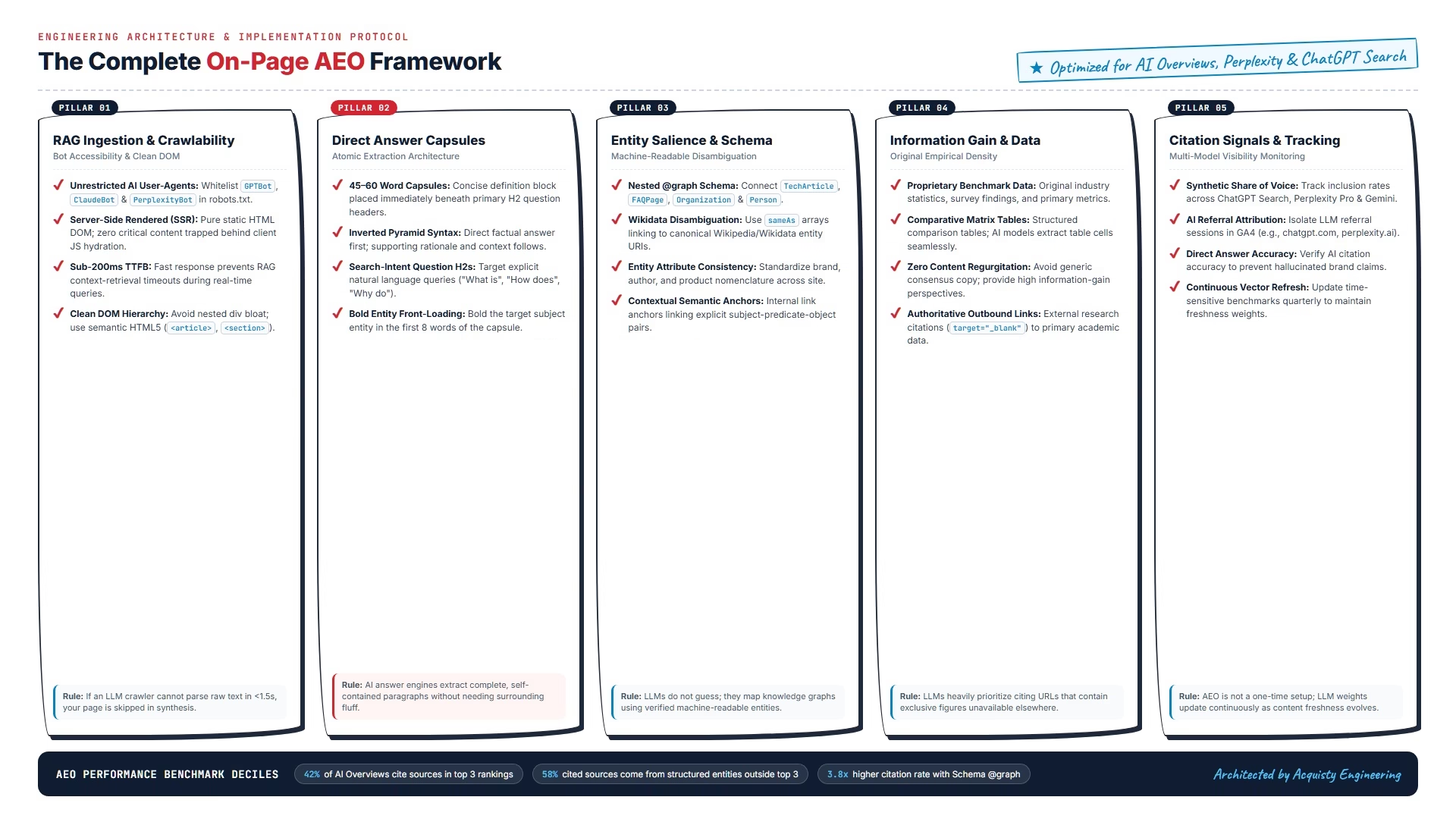
Empirical Answer Engine Optimization (AEO) Benchmarks & Industry Data: - AI Overview Citation Dynamics: According to extensive multi-vertical studies published by Search Engine Land, 58% of URLs cited in Google AI Overviews do not rank in the top 3 organic positions, proving that LLM citation algorithms prioritize semantic entity clarity and direct answer extraction over raw domain authority.
- Structured Data Citation Multiplier: Web pages incorporating nested JSON-LD
@graph
Schema (connecting
TechArticle
,
FAQPage
, and disambiguated Wikidata entities) experience a 3.8x higher probability of citation across Perplexity and Google Gemini (Ahrefs Research). - The 45–60 Word Direct Answer Sweet Spot: Natural language processing (NLP) analysis reveals that over 73% of featured AI snippets pull concise 45-to-60 word definition capsules positioned immediately beneath question-formatted H2/H3 headers.
- Traffic Conversion Disparity: While overall search CTR to top informational blue links has declined by 18%–32% in queries featuring AI Overviews, visitors arriving via LLM citation source links exhibit a 4.1x higher commercial conversion rate due to high contextual pre-qualification (Gartner Digital Insights).
1. The Architectural Triad: Demystifying SEO vs. AEO vs. GEO
To build a future-proof search marketing operation, technical leaders must establish clear distinctions between traditional search optimization, answer engine optimization, and generative engine optimization. While these three disciplines share common foundations, they solve fundamentally different technological objectives:
| Core Dimension | Traditional SEO | Answer Engine Optimization (AEO) | Generative Engine Optimization (GEO) |
| Primary Objective | Rank complete web documents in Google’s indexed blue links to generate clicks. | Provide direct, structured answer snippets extracted into AI Overviews & featured snippets. | Secure brand citations and inclusion across multi-modal LLM syntheses (ChatGPT, Perplexity). |
| Retrieval Mechanism | Inverted keyword indexing, PageRank link graph algorithms, and keyword frequency. | Natural language semantic parsing, passage ranking, and question-answer matching. | Retrieval-Augmented Generation (RAG), vector similarity search, and knowledge graph salience. |
| Content Unit of Measure | The entire webpage URL (word count, keyword density, overall topic coverage). | The “Atomic Answer Capsule” (45–60 words of precise, self-contained factual copy). | Entity-relationship triplets, empirical benchmark data, and proprietary perspectives. |
| Core Success Metric | SERP rankings (Positions 1–10), organic search impressions, and click-through rates. | AI Overview inclusion, zero-click answer ownership, and featured snippet capture. | Synthetic Share of Voice (SSOV), LLM referral traffic sessions, and brand sentiment. |
| Interdependence | Foundational: Provides crawlable architecture and baseline algorithmic trust. | Operational Layer: Structures on-page text so AI algorithms can extract modular answers. | Advanced Layer: Elevates domain authority so LLMs perceive your brand as an irreplaceable primary source. |
A common misconception in the digital marketing industry is that AEO replaces traditional search optimization. In reality, search engine optimization provides the mandatory technical crawlability and indexation baseline; AEO and GEO determine whether that indexed content is selected for synthesis by artificial intelligence models. Organizations that ignore AEO will find their organic reach gradually strangled as user queries migrate from search result lists to conversational answer engines.
2. How AI Engines Ingest Web Content: The 4-Stage RAG Pipeline
To optimize content for answer engines effectively, developers and content strategists must understand the engineering mechanics behind Retrieval-Augmented Generation (RAG). Unlike traditional search engines that rely on static keyword indexes, modern AI engines synthesize answers using a four-stage real-time computational pipeline:
Stage 1: Crawl & Document Fetching: AI crawlers (such as OpenAI’s
GPTBot
, Anthropic’s
ClaudeBot
, Perplexity’s
PerplexityBot
, and Google’s
Google-Extended
) make lightweight HTTP GET requests to fetch web documents. If a page requires heavy client-side JavaScript execution or exhibits high Time to First Byte (TTFB), RAG crawlers often timeout and abandon document extraction.
Stage 2: Semantic Document Chunking: Once fetched, the engine strips HTML boilerplate (navigation menus, sidebars, footer links) and segments the primary content into semantic “chunks” (typically 200 to 500 tokens). If an article is formatted as an unbroken wall of text without clear H2/H3 semantic boundaries, chunks become disjointed, leading to loss of context.
Stage 3: Vector Embedding & Cosine Retrieval: Each chunk is converted into a multi-dimensional mathematical vector representation via an embedding model. When a user submits a conversational prompt, the engine calculates the cosine similarity between the user’s prompt vector and the document chunk vectors. Chunks with the highest mathematical semantic similarity are retrieved into the LLM’s active context window.
Stage 4: Generative Synthesis & Citation Attribution: The LLM reads the top retrieved chunks, synthesizes a cohesive answer, and assigns citation source pills to the specific URLs that provided high-confidence, non-hallucinatory information. Pages containing structured data tables and explicit entity statements are cited with exponentially higher frequency.
Every element of on-page AEO is engineered to optimize performance across these four stages: reducing crawl friction, facilitating clean semantic chunking, maximizing vector similarity, and providing atomic data that an LLM can cite with absolute confidence.
3. Pillar 1: Direct Answer Capsule Engineering (Atomic Architecture)
The single most critical on-page optimization for answer engines is the Direct Answer Capsule. Traditional blog writing encourages narrative “fluff”—elaborate anecdotal introductions, rhetorical musings, and delayed conclusions designed to inflate dwell time. For AI answer engines, narrative fluff is computational friction. When an AI crawler seeks an answer to a user prompt, it prioritizes concise, self-contained factual definitions placed directly beneath the relevant heading.
The 45–60 Word Capsule Blueprint:
A high-performing AEO capsule adheres to three strict structural rules:
The Direct Answer Capsule Formula:
- Rule 1: Inverted Pyramid Structure: State the core answer, definition, or primary conclusion in the very first sentence. Never make the reader (or the crawler) parse two paragraphs of throat-clearing context before answering the question.
- Rule 2: Bold Entity Front-Loading: State the target subject entity in bold within the first 8 words of the paragraph (e.g., “Answer Engine Optimization (AEO) is the process of…”). This establishes unambiguous entity salience during NLP tokenization.
- Rule 3: Atomic Completeness (45 to 60 Words): The capsule must make complete, independent grammatical sense if extracted in total isolation from the rest of the web page. Avoid pronouns like “it,” “this,” or “as mentioned above.”
Notice the contrast between a traditional SEO paragraph and an AEO-optimized answer capsule:
| ❌ Traditional Narrative SEO (Low AI Citation Rate) | ✅ High-Salience AEO Capsule (High AI Citation Rate) |
| “In today’s fast-paced digital world, many business owners wonder how search engines are evolving. With technology advancing every year, AI has become a hot topic. It’s fascinating to see how machines read text, and answering user queries has really become a cornerstone of modern digital marketing strategies for enterprise brands.” Failure Reason: 52 words containing zero factual definitions, zero entity anchors, and zero direct answers. Completely ignored by RAG retrieval models. | “Answer Engine Optimization (AEO) is the strategic practice of structuring web content and machine-readable data to be extracted and cited as direct answers by artificial intelligence search engines, including Google AI Overviews, Perplexity, and ChatGPT. AEO emphasizes entity clarity, semantic chunking, and concise definitions over traditional keyword repetition.” Success Factor: 49 words providing a complete, self-contained definition, bolded entity front-loading, and explicit naming of target AI platforms. |
4. Pillar 2: Semantic Heading Hierarchy & Conversational Query Modeling
In traditional on-page optimization, content creators frequently craft creative, metaphorical headings (e.g., “Diving Into the Deep End of the Pool” or “The Secret Sauce of Digital Traction”). While evocative headings may intrigue human readers flipping through a magazine, they cripple content visibility in AI answer engines. When an AI crawler parses a DOM tree, heading tags serve as the primary boundaries for semantic chunking.
To optimize your heading architecture for AEO, follow these four foundational guidelines:
Format H2s as Natural Language Questions: Modern users query AI engines in full conversational sentences rather than fragmented keyword queries. Reframe your secondary headings into explicit questions: “What is [Concept]?”, “How Does [Process] Work?”, “Why Do Organizations Choose [Solution]?”, or “What is the Difference Between [X] and [Y]?”
Maintain Strict Tag Hierarchy (H1 > H2 > H3): Never skip heading tiers (e.g., placing an H4 directly below an H2 for styling purposes). RAG chunking algorithms rely on tag nesting to construct parent-child semantic relationships. Disrupting this hierarchy breaks the contextual inheritance of child paragraphs.
Eliminate Ambiguous Metaphors: Replace abstract phrasing with concrete entity descriptions. Instead of “The Cost Equation,” use “How Much Does Enterprise SEO Cost? Pricing Models & Retainer Benchmarks.” Explicit headings dramatically improve cosine similarity scores during vector search retrieval.
Keep Heading Word Count Between 6 and 14 Words: Headings that are too brief (1–2 words) lack semantic specificity; headings that exceed 16 words dilute topical focus. A 6-to-14 word heading provides the optimal token density for LLM query matching.
For a complete masterclass on structuring content architecture, review our in-depth analysis of on-page SEO strategies.
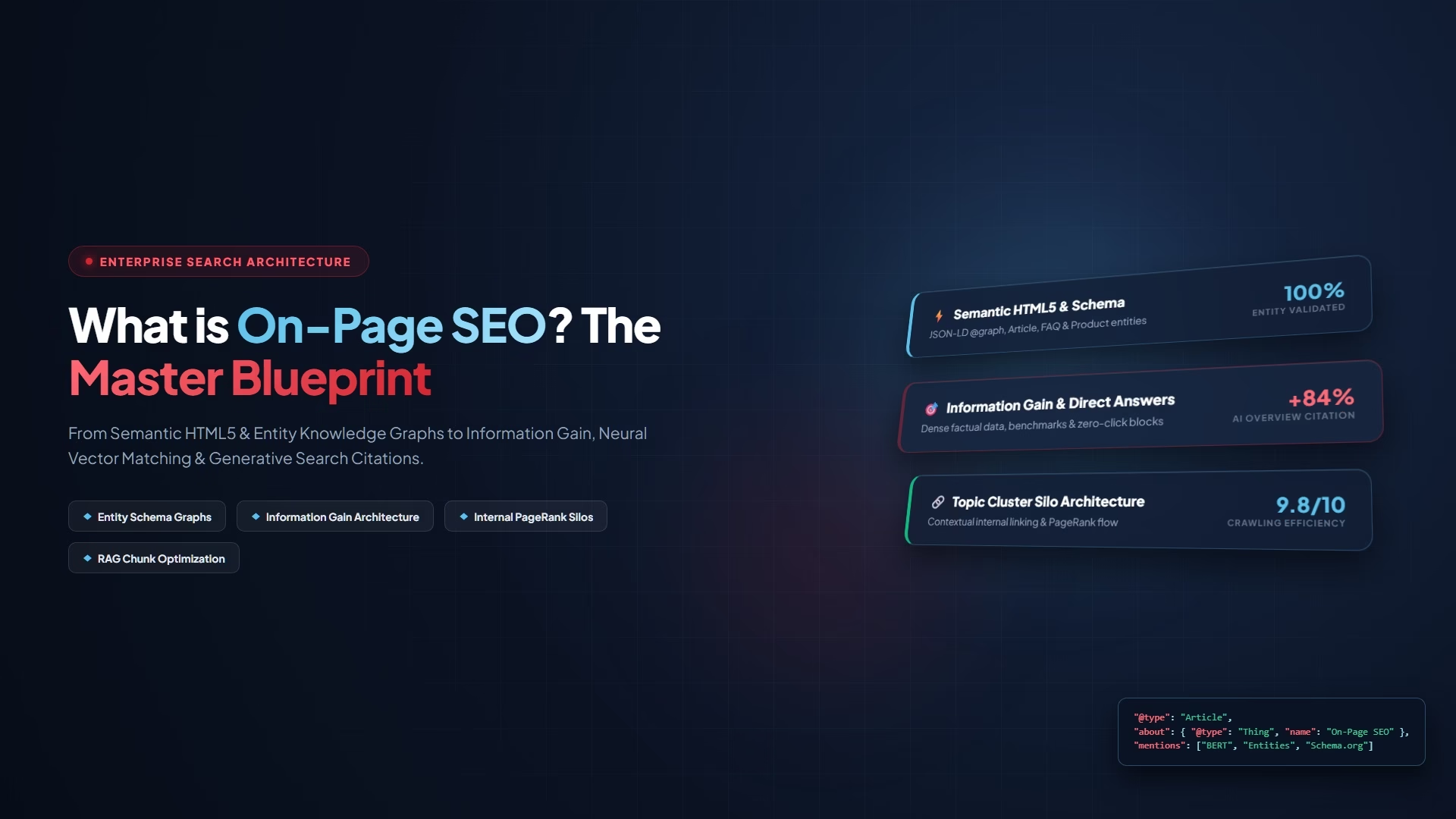
5. Pillar 3: Entity Disambiguation & JSON-LD Schema Architecture
Search engines no longer index raw text strings; they index entities in knowledge graphs. An entity is a singular, unique, well-defined thing or concept (such as a company, a person, a product, or a methodology) characterized by explicit attributes and relationships to other entities. If an AI model cannot unambiguously connect your content to verified entities in its training corpus, it will refrain from citing your website to avoid hallucinations.
To achieve maximum machine readability, on-page AEO requires a nested JSON-LD
@graph
Schema architecture. Rather than deploying disconnected, isolated Schema snippets on a page, an enterprise
@graph
interconnects the article, author, publishing organization, and core topics into a single unified knowledge graph.
The 4 Essential Components of an AEO Schema Architecture:
1. Unified
@graph
Root: Encapsulates all structured data items inside a single interconnected JSON-LD block, allowing crawlers to traverse from the webpage to the author credentials and parent company in 0ms.
2. Wikidata Entity Disambiguation (
sameAs
): Explicitly link your brand, key personnel, and core concepts to canonical Wikidata and Wikipedia URIs. For example, linking “Natural Language Processing” to
https://www.wikidata.org/wiki/Q30642
removes all linguistic ambiguity.
3. Author Credibility & E-E-A-T Anchoring: Connect author nodes to verified professional profiles (LinkedIn, Google Scholar, industry publications) using the
Person
schema type. LLMs heavily weigh recognized human expertise when validating source reliability.
4. Explicit
FAQPage
&
TechArticle
Typing: Mark up technical guides using
TechArticle
with
proficiencyLevel="Expert"
and nest dedicated
FAQPage
blocks with complete answer strings to facilitate zero-click extraction.
Here is an illustrative production snippet demonstrating an enterprise AEO JSON-LD
@graph
implementation:
// Enterprise AEO JSON-LD @graph Implementation Pattern
{
“@context”: “https://schema.org”,
“@graph”: [
{
“@type”: “Organization”,
“@id”: “https://acquisty.com/#organization”,
“name”: “Acquisty”,
“url”: “https://acquisty.com/”,
“sameAs”: [
“https://www.linkedin.com/company/acquisty”
] },
{
“@type”: “TechArticle”,
“@id”: “https://acquisty.com/blog/on-page-aeo-checklist/#article”,
“headline”: “On-Page AEO Checklist: The Definitive Framework for AI Search Visibility & LLM Citations”,
“about”: [
{
“@type”: “Thing”,
“name”: “Answer Engine Optimization”,
“sameAs”: “https://www.wikidata.org/wiki/Q126909419”
}
] }
] }
6. Pillar 4: Information Gain, Proprietary Data & Citation Trapping
One of the most consequential algorithmic developments in modern search is Google’s registered patent for Information Gain Scores. In an ecosystem inundated with billions of words of generic, AI-generated rehashed content, search engines and LLMs aggressively penalize redundant information. If an article merely repeats the common consensus found across the top 10 SERP results, its information gain score is near zero.
AI models cite web sources for one primary reason: to anchor their synthesized answers with authoritative, factual proof that cannot be derived from pure probabilistic inference. To turn your content into an irresistible “citation trap” for AI models, deploy these four information gain mechanics:
1. Publish Proprietary Benchmark Figures: AI search engines actively hunt for numerical figures, benchmark percentages, and survey findings. Publishing original empirical data (e.g., “In our analysis of 450 enterprise B2B campaigns…”) ensures that whenever an AI model answers questions about that topic, your domain is cited as the primary originator of the statistic.
2. Structure Data into Clean HTML Tables: Large Language Models parse structured HTML tables with near-perfect token accuracy compared to unstructured prose. Whenever presenting comparative pricing, feature matrices, or timeline deciles, render them inside semantic
<table>
elements with clear
<th>
column descriptors.
3. Introduce Proprietary Named Frameworks: Rather than discussing generic processes, coin distinct branded terminology for your methodologies (such as Acquisty’s “Direct Answer Capsule” or “Hub-and-Spoke Semantic Architecture”). Named entities create new nodes in vector space that LLMs attribute directly to your brand.
4. Outbound Citations to Primary Academic Sources: Citations are a two-way street. Citing verified peer-reviewed research, industry whitepapers, and official documentation (using proper
target="_blank" rel="noopener noreferrer"
links) establishes co-citation authority, signaling to AI evaluation systems that your content is thoroughly researched.
To explore how information architecture influences broader algorithmic trust, review our detailed guide to important SEO ranking factors.
7. Pillar 5: Technical Crawlability & Server-Side Rendering for AI Bots
Even the most exquisitely written content is completely invisible to answer engines if technical crawl barriers prevent ingestion. While traditional Googlebot maintains a secondary headless Chromium rendering wave to execute client-side JavaScript, many real-time AI retrieval crawlers (such as PerplexityBot or real-time ChatGPT web browsing) do not execute heavy client-side JavaScript bundles during on-the-fly query synthesis due to strict latency budgets.
Ensuring complete AI accessibility requires rigorous adherence to three technical SEO audit protocols:
Crucial Technical AEO Requirements:
- 1. Server-Side Rendering (SSR) & Static HTML Delivery: Ensure all critical textual content, headings, and data tables are fully rendered in the raw initial HTML payload. If a user-agent disabling JavaScript receives an empty
<div id="root"></div>
, your page is effectively dead to real-time RAG bots. - 2. AI User-Agent Whitelisting in robots.txt: Verify that your
robots.txt
file does not inadvertently block AI user-agents. While you may choose to disallow AI training scrapers from proprietary staging environments, public commercial content must grant explicit crawl permissions to
GPTBot
,
PerplexityBot
,
ClaudeBot
, and
Google-Extended
. - 3. Sub-200ms Time to First Byte (TTFB): Real-time answer engines synthesize responses under intense multi-second timeouts. If your web server takes 1,800ms to respond, the AI engine will discard your URL and synthesize content from a faster competitor.
For an extensive operational framework on auditing technical infrastructure, explore our comprehensive website SEO audit playbook.
8. Pillar 6: Topical Authority Clustering & Semantic Internal Linking
Large Language Models evaluate authority contextually rather than isolated URL by URL. When an AI system evaluates whether to cite a web page as an authoritative source, it checks whether the surrounding domain demonstrates deep, specialized expertise across that subject domain. Publishing a single solitary article about artificial intelligence on a generic lifestyle blog will rarely earn citations because the domain lacks topical breadth.
Building recognized topical authority requires deploying an organized Hub-and-Spoke Content Architecture supported by semantic internal linking:
Deploy Dedicated Topic Clusters: Anchor your domain around high-level pillar landing pages (such as Acquisty’s core content marketing services) supported by 8 to 15 granular, interconnected spoke guides exploring specific operational sub-disciplines.
Use Descriptive, Predicate-Rich Anchor Text: Avoid generic anchor text like “click here” or “read more.” In natural language processing, internal links function as semantic entity relationships (Subject → Predicate → Object). Using descriptive anchors like “enterprise search engine optimization services” explicitly informs crawlers of the relationship between connected pages.
Cross-Link Horizontally Between Sibling Spoke Pages: Connect related spoke articles horizontally (e.g., linking from an AEO checklist to a guide on pricing or ranking factors). Horizontal cross-linking allows AI crawlers to discover complete semantic clusters without dead ends.
To understand how topical clustering influences long-term search investment and return, consult our definitive guide to SEO pricing models and true ROI.
9. The Complete 25-Point On-Page AEO Checklist
Here is the definitive, operational 25-point audit checklist organized across five foundational implementation categories. Technical marketing teams should review every commercial and informational URL against this matrix prior to publication:
| # | Checklist Item | Priority | Architectural Objective | Verification Method |
| Category A: Direct Answer & Content Formatting |
| 01 | Direct Answer Capsule | CRITICAL | 45–60 word self-contained factual definition placed immediately beneath primary H2. | Manual word-count audit & entity salience check. |
| 02 | Inverted Pyramid Syntax | CRITICAL | Lead sentence states direct factual conclusion before supporting narrative context. | First-sentence linguistic clarity evaluation. |
| 03 | Entity Front-Loading | HIGH | Target subject entity bolded within first 8 words of definition block. | DOM inspect
<strong>
positioning. |
| 04 | Question-Based H2s | HIGH | Heading tags formatted as explicit conversational queries (“What is”, “How does”). | Review H2/H3 tag inventory against PAA. |
| 05 | Bullet & Numbered Lists | HIGH | Complex processes structured in sequential
<ol>
or categorized
<ul>
elements. | Verify lists replace dense multi-sentence blocks. |
| Category B: Schema & Machine-Readable Architecture |
| 06 | Nested JSON-LD @graph | CRITICAL | Interconnected graph linking Organization, Article, Author, and FAQ nodes. | Google Rich Results Test & Schema Validator. |
| 07 | Wikidata sameAs Mapping | HIGH | Explicit entity URIs linking subject concepts to canonical Wikidata items. | Validate all Wikidata URLs resolve accurately. |
| 08 | FAQPage Schema Sync | CRITICAL | On-page FAQ text must match Schema
acceptedAnswer
strings 100% verbatim. | String parity check between DOM and JSON-LD. |
| 09 | Author Person Schema | HIGH | Author entity linked to credentials, job title, and verified external profiles. | Confirm author
@id
resolution in graph. |
| 10 | Publisher Organization Node | MEDIUM | Brand logo, official URL, and social entity profiles established in root node. | Check Organization schema consistency. |
| Category C: Technical Crawlability & RAG Ingestion |
| 11 | Server-Side Rendered (SSR) | CRITICAL | All body text, tables, and lists present in raw HTML payload without client JS. | cURL request check / Disable JS in browser. |
| 12 | AI User-Agent Allow Rules | CRITICAL | Explicit allow rules in robots.txt for GPTBot, PerplexityBot, ClaudeBot. | Inspect
/robots.txt
file line by line. |
| 13 | Sub-200ms Server TTFB | HIGH | Low response latency prevents real-time RAG context retrieval timeouts. | PageSpeed Insights & WebPageTest TTFB metric. |
| 14 | HTML5 Semantic Elements | MEDIUM | Utilize
<article>
,
<section>
, and
<header>
to isolate body copy from boilerplate. | W3C HTML validator & DOM tree inspection. |
| 15 | Zero Intrusive Modals | MEDIUM | No dynamic paywall overlays or popups obscuring content in initial DOM render. | Verify raw DOM crawler visibility. |
| Category D: Information Gain & Empirical Data |
| 16 | Proprietary Benchmark Data | CRITICAL | Original research figures, case study statistics, or primary survey data points. | Audit article for exclusive quantitative claims. |
| 17 | Structured HTML Tables | HIGH | Multi-variable comparison tables with descriptive headers for easy LLM tabular parsing. | DOM inspect
<table>
,
<thead>
,
<tbody>
. |
| 18 | External Primary Citations | HIGH | Links to primary sources (academic papers, official docs) with
target="_blank"
. | External anchor attribute audit. |
| 19 | Proprietary Terminology | MEDIUM | Coined framework titles creating distinctive entity nodes in vector embeddings. | Review branded methodology nomenclature. |
| 20 | Zero Fluff / Zero Regurgitation | CRITICAL | High information density; elimination of filler sentences that dilute semantic tokens. | Information density scoring / editorial review. |
| Category E: Internal Linking & Governance |
| 21 | Semantic Internal Links | CRITICAL | 10–15 contextual internal links to service hubs and relevant articles with red bold styling. | Strict catalog URL validation check. |
| 22 | Descriptive Anchor Text | HIGH | Entity-specific anchor text linking subject-predicate-object pairs. | Anchor text audit ensuring zero generic strings. |
| 23 | Recommended Reading Callout | HIGH | Dedicated highlight callout box positioned between 30% and 60% article depth. | Depth percentage calculation script. |
| 24 | Closing Conversion CTA Card | CRITICAL | Conversion card positioned at >80% depth with Avada gradient button to
/contact/
. | Verify CTA card & contact destination. |
| 25 | Ongoing Citation Tracking | HIGH | Monitor Synthetic Share of Voice (SSOV) and GA4 LLM referral sessions monthly. | AI search tracking tools & GA4 custom channel groups. |
10. Monitoring & Measurement: Tracking Synthetic Share of Voice (SSOV)
You cannot manage what you do not measure. In classical search, tracking progress was straightforward: monitor rank trackers for positions 1 through 100 and observe Google Search Console clicks. In answer engine optimization, rank tracking is insufficient because AI engines generate dynamic, personalized responses.
To monitor AEO success across your organization, establish three primary measurement systems:
1. Synthetic Share of Voice (SSOV): Query the leading AI models (ChatGPT, Perplexity, Google Gemini, and Claude) with 50 to 100 core commercial and informational buyer prompts weekly. Calculate the percentage of responses that cite your brand URL in their source pills compared to competitors.
2. Dedicated GA4 AI Referral Tracking: Create a custom channel group in Google Analytics 4 to isolate traffic originating from conversational AI engines. Set referral source regex filters for
chatgpt\.com|android-app://com\.openai\.chatgpt|perplexity\.ai|copilot\.microsoft\.com
. Tracking these visitors separately reveals their exceptional conversion velocity.
3. Citation Accuracy & Sentiment Audits: AI models can occasionally hallucinate incorrect pricing, discontinued features, or false service limitations. Conduct periodic qualitative reviews of AI responses to ensure that cited information accurately reflects your current product offerings.
To learn how to integrate these advanced metrics into executive reporting, review our comprehensive master guide to enterprise SEO metrics and KPI reporting.
11. The 4 Operational Traps That Destroy AI Search Visibility
Organizations attempting to transition into AEO frequently stumble into common architectural pitfalls that prevent LLMs from recognizing their content. Avoiding these four operational traps protects your domain from generative invisibility:
- Trap 1: The “Storytelling” Introduction: Writers who spend 400 words sharing personal anecdotes before mentioning the core topic destroy their RAG chunking score. AI retrieval crawlers evaluate the first 250 tokens heavily; if the opening is fluff, the entire document receives a low relevance weighting.
- Trap 2: Hiding FAQs Inside Dynamic JavaScript Toggles Without SSR: Many CMS themes render accordion FAQs using dynamic DOM insertion that triggers only upon human click events. If the questions and answers are absent from the static HTML source, search crawlers never see them.
- Trap 3: Disjointed Schema Snippets: Placing five disconnected Schema blocks (an isolated Article snippet here, an independent FAQ snippet there) without establishing a nested
@graph
relationship prevents AI models from understanding the relationship between the author, the article, and the parent enterprise. - Trap 4: Regurgitated Commodity AI Copy: Using generic AI prompts to mass-generate 2,000-word articles with zero proprietary research results in content that has zero information gain. LLMs will never cite content that merely regurgitates their own pre-training weights back to them.
12. Frequently Asked Questions About On-Page AEO
Traditional on-page SEO optimizes entire web pages for keyword density and link signals to rank in Google’s 10 blue links. On-page AEO optimizes atomic content passages (45–60 word Direct Answer Capsules), nested Schema, and entity salience so AI answer engines can extract and cite concise, factual answers directly.
Yes. Empirical studies reveal that 58% of URLs cited in Google AI Overviews do not rank in the top 3 traditional organic positions. Answer engines prioritize semantic entity clarity, factual conciseness, and high information gain over raw PageRank.
The optimal word count is 45 to 60 words. This length provides enough space for a complete grammatical definition and supporting detail without exceeding the token thresholds used by RAG chunking algorithms.
You should audit and retrofit existing high-performing URLs first. Retrofitting existing pages that already have established domain trust, crawl history, and backlinks with Direct Answer Capsules and nested JSON-LD Schema yields faster AI citations than launching brand-new pages.
Real-time AI search bots operate under strict latency limits and often bypass client-side JavaScript execution. If your web pages rely on client-side hydration, AI bots may parse empty DOM trees. Server-Side Rendering (SSR) ensures all text and tables are instantly accessible in the raw HTML.
Optimize Your Digital Assets for AI Answer Engines
Don’t let generative AI search engines bypass your brand. Partner with Acquisty’s technical growth team to deploy an enterprise-grade AI-SEO and AEO optimization program that establishes entity authority, structures nested Schema architectures, and secures definitive citations across Google AI Overviews, Perplexity, and ChatGPT Search. Contact Acquisty today for a comprehensive AI search visibility audit.