

The global higher education landscape is navigating an unprecedented structural crisis: the confluence of demographic contractions—commonly termed the “enrollment cliff”—and skyrocketing student acquisition costs. For decades, traditional universities, regional colleges, and growing EdTech platforms relied on legacy recruitment playbooks: glossy direct-mail viewbooks, high school college fair circuits, broadcast brand campaigns, and external Online Program Managers (OPMs). Under traditional OPM arrangements, institutions outsourced digital recruitment in exchange for forfeiting 40% to 60% of total tuition revenue over ten-year contracts. Today, rising digital ad costs across Google Ads and Meta platforms have pushed the average cost per enrolled undergraduate student above $2,500 to $4,800, while graduate program recruitment often exceeds $8,000 per matriculated candidate.
Simultaneously, the prospective student evaluation journey has moved entirely online. Today’s Gen Z applicants, adult career changers, and corporate executive learners approach university discovery with rigorous digital skepticism. Before submitting a Request for Information (RFI) or booking a campus tour, prospective scholars conduct exhaustive searches. They scrutinize curriculum accreditation, evaluate faculty publication histories, compare program tuition debt-to-income ratios, research specific internship placement pipelines, and cross-reference verified alumni employment outcomes. Because educational decisions carry enormous financial and life-altering consequences, search algorithms categorize academic programs under Google’s rigorous Your Money or Your Life (YMYL) standards, demanding uncompromising institutional Experience, Expertise, Authoritativeness, and Trustworthiness (E-E-A-T).
At Acquisty, our dedicated search engine optimization engineering division and specialized higher education SEO architecture teams design sovereign student recruitment engines for public universities, private colleges, and enterprise EdTech platforms. This master guide delivers the architectural roadmap required to dismantle OPM tuition dependency, resolve complex
.edu
subdomain crawl inefficiencies, deploy structured Course and Credential schema, and convert organic search visibility into sustainable, high-yield student matriculation.
- Digital Search Adoption: According to the authoritative E-Expectations Research Report by Ruffalo Noel Levitz (RNL), over 86% of prospective college students cite organic search engines as their primary method for researching degree programs, academic prerequisites, and financial aid options prior to initiating institutional contact.
- Degree Page Conversion Supremacy: Institutional enrollment data published by Inside Higher Ed demonstrates that organic traffic landing on granular, curriculum-specific academic degree pages converts into verified inquiries at a rate 4.2x higher than traffic routed to generic university homepages or high-level college portals.
- The OPM Margin Trap: Federal audit studies compiled by the National Center for Education Statistics (NCES) indicate that universities partnering with third-party Online Program Managers forfeit between 45% and 60% of gross tuition revenue, whereas institutions operating proprietary organic SEO funnels reduce net student acquisition cost by up to 74%.
- Local & Regional Pull: Over 67% of undergraduate applicants and 58% of online graduate students enroll at institutions located within a 100-mile geographic radius of their primary residence, making Google Local 3-Pack and regional institutional prominence pivotal for enrollment targets.
1. The Enrollment Cliff & Search Economics: Decoupling from OPM Dependency
Higher education leadership faces a demographic reality: the domestic pool of traditional high school graduates is contracting sharply, creating intense competition across undergraduate recruitment. In response, university provosts and chief enrollment officers have expanded into online degrees, graduate certifications, and adult upskilling. However, many institutions accelerated this expansion by outsourcing their digital marketing infrastructure to commercial Online Program Managers (OPMs).
While OPM partnerships initially appeared risk-free because vendors provided upfront capital for course development and marketing, the long-term economic model is structurally flawed:
- Permanent Revenue Hemorrhage: Handing over half of gross tuition on every enrolled student drains academic budgets, starving academic departments of faculty funding, laboratory upgrades, and student support services.
- Vendor-Owned Digital Assets: Many OPMs build promotional landing pages on proprietary microsites rather than on the university’s core
.edudomain. When contracts expire or terminate, the institution is left with zero accumulated organic search equity. - Aggressive Pay-Per-Click Inflation: OPMs rely primarily on short-term paid search auctions, bidding against other universities for competitive keyphrases (e.g., “online mba programs” or “ms in data science”), which now exceed $80 to $180 per single click on Google Ads.
Transitioning to an institutionally owned higher education SEO architecture allows colleges to leverage their greatest digital asset: an established, highly authoritative
.edu
root domain. By systematically capturing organic search demand across undergraduate, graduate, and professional credentials, universities achieve sustainable enrollment growth while retaining 100% of their tuition revenue. Below, we break down the engineering pillars required to execute this sovereign transformation.
2. Academic Degree Program Silos: Intent-Driven Course Page Architecture
Prospective students rarely enter the search funnel by typing the name of an institution; they search for the exact academic credential, specialization, or career outcome they desire. A student investigating a career in artificial intelligence searches for “online master’s in machine learning requirements”, not “State University admissions”.
To capture high-intent student demand, university websites must abandon flat, departmental brochure directories and construct hierarchical Academic Program Silos:
- Degree-Level Architectural Segmentation: URL paths and site architecture must establish clean semantic hierarchies reflecting student intent:
-
/academics/undergraduate/bs-computer-science/ -
/academics/graduate/ms-artificial-intelligence/ -
/academics/online/healthcare-mba/ -
/academics/certificates/cybersecurity-defense/
-
- The 7 Mandatory Core Content Modules on Academic Pages: Every degree landing page must address the critical questions evaluated by prospective students and search engine crawlers:
- Curriculum Breakdown & Credit Requirements: Core courses, elective concentrations, and capstone project specifications.
- Admissions Criteria & Application Deadlines: GPA requirements, prerequisite coursework, standardized test policies (GRE/GMAT waivers), and rolling decision dates.
- Tuition, Fees & Financial Aid Transparency: Cost-per-credit breakdowns, departmental scholarships, research assistantship availability, and employer tuition reimbursement pathways.
- Faculty Credentials & Research Labs: Direct links to publishing faculty profiles, funded research grants, and active laboratory initiatives.
- Career Trajectories & Salary Benchmarks: Typical post-graduation job titles, hiring corporate partners, median starting salaries, and alumni employment rates.
- Accreditation Verification: Clear institutional and specialized professional accreditations (e.g., AACSB, ABET, CCNE, CEPH, ABA).
- Interactive Student Testimonials & Alumni Spotlights: Video narratives and quotes illustrating real career advancement from actual graduates.
- STEM Designation & International Student Search Capture: For graduate engineering, business analytics, and life sciences degrees, securing and declaring official U.S. Department of Homeland Security (DHS) STEM designation is an extraordinary recruitment accelerator. International scholars searching globally for “STEM designated master’s in business analytics” prioritize institutions offering the 36-month Optional Practical Training (OPT) employment benefit. Explicitly tagging STEM classification in degree page headers, meta descriptions, and schema markup directly expands global applicant volume.
- Transfer Student & Community College Articulation Silos: Over 38% of all undergraduate degree completers attend a two-year community college prior to matriculating at a four-year institution. Yet most university websites bury transfer credit guides in obscure registrar PDF files. Building dedicated programmatic landing pages for regional feeder community colleges—titled “How to Transfer from [Regional Community College] to [University]” complete with interactive course equivalency tables—captures thousands of motivated transfer applicants searching for friction-free academic transition pathways.
Structuring degree landing pages with this level of granular, transparent detail not only satisfies Google’s YMYL quality rating standards but dramatically shortens the inquiry-to-application cycle. To understand how content depth impacts organic performance across competitive verticals, review our guide to what content writing is in digital marketing.
3. Technical University SEO: Subdomain Governance & Crawl Budget Management
Higher education domains possess extraordinary inbound link equity. Government agencies, scientific journals, news organizations, and secondary schools link to
.edu
root domains daily. However, the decentralized governance structure of universities frequently dilutes and fractures this authority through chaotic technical configurations.
To maintain technical integrity and maximize crawl efficiency across massive university domains, engineering teams must resolve three critical technical bottlenecks:
- The Subdomain Proliferation Dilemma: Over decades, university IT departments have created hundreds of unmanaged subdomains:
business.university.edu,engineering.university.edu,online.university.edu,library.university.edu, and individual faculty WordPress installs. Google evaluates subdomains as separate hostname entities. When academic programs are fragmented across isolated subdomains, domain authority is fractured. Enterprise universities execute consolidation programs, migrating degree programs into structured subdirectories (e.g.,university.edu/business/) to unify PageRank equity onto the primary domain. - Course Catalog Spider Traps: University course schedule catalogs often generate millions of dynamic URL permutations containing term codes, course numbers, professor filters, and meeting times (e.g.,
/catalog/?dept=BIO&term=202610&level=400&sort=time). Allowing search engine crawlers to traverse these dynamic parameters consumes massive crawl budget while indexing thin, duplicate content. Implementing canonical tags pointing to static department overview pages and applyingnoindex,followrobots directives across dynamic search query parameters protects crawler efficiency. - Server-Side Rendering for Dynamic Syllabi: Modern university portals frequently deploy single-page JavaScript frameworks (React, Angular) to display tuition tables, course prerequisites, and faculty directories. Ensuring these critical elements are Server-Side Rendered (SSR) guarantees that search engine bots immediately index complete degree specifications on the initial crawl pass.
Maintaining technical crawl governance across large-scale web ecosystems requires systematic log file auditing. For a deep examination of crawl monitoring frameworks, consult our comprehensive guide to enterprise SEO metrics and crawl governance.
4. Multi-Campus Local SEO: Driving Physical & Virtual Campus Tour Conversions
While global and national visibility is essential for online degree programs, physical campus recruitment remains heavily anchored in regional geography. The majority of undergraduate students select an institution within driving distance of their family home. Furthermore, institutional research consistently reveals that students who complete an official campus tour or attend an on-campus open house matriculate at a rate 3x to 5x higher than unvisited inquiries.
Dominating the Google Local 3-Pack across regional metropolitan territories requires a multi-layered local SEO architecture:
- Decentralized Departmental Google Business Profiles (GBP): Rather than maintaining a single generic GBP listing for the entire university, institutions must verify separate, co-located GBP profiles for individual colleges and visitor hubs:
-
University Admissions Welcome Center(Category: Educational Consultant or Visitor Center) -
University School of Law(Category: Law School) -
University College of Medicine(Category: Medical School) -
University School of Business(Category: Business School)
-
- Campus Tour Booking Schema & Action Links: Integrating direct appointment scheduling links into Google Business Profiles enables prospective families to book physical walking tours or virtual admissions webinars directly from Google Maps search results.
- Neighborhood & Campus Life Content Hubs: Regional applicants evaluate collegiate lifestyle and safety. Publishing authoritative neighborhood guides detailing campus housing options, public transit connectivity, student dining, and regional tech employment hubs builds localized relevance signals that reinforce local pack prominence.
Understanding how search algorithms balance geographic proximity with organic domain authority is crucial for multi-campus university systems. For a detailed breakdown of local and national ranking algorithms, review our analysis of important SEO ranking factors.
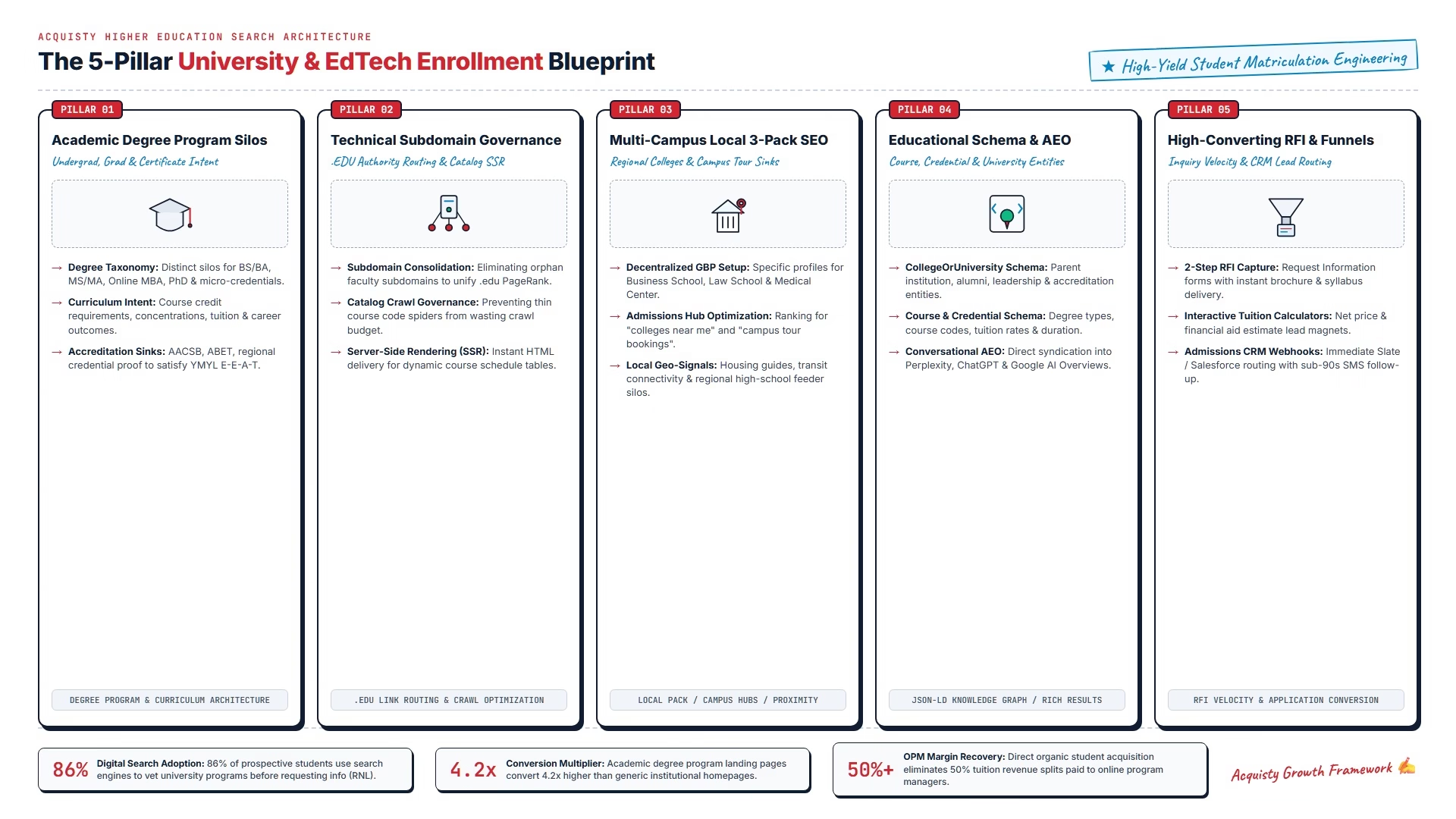
5. Higher Education Structured Data: Deploying CollegeOrUniversity, Course & Credential Schema
In modern search indexing and conversational AI discovery, structured data is the semantic bridge between raw web content and Google’s Knowledge Graph. For educational institutions, Schema.org provides specialized vocabularies that allow search engines to parse academic degrees, course codes, tuition rates, and application requirements without ambiguity.
Every competitive higher education institution must deploy three primary JSON-LD schema frameworks:
1. CollegeOrUniversity Institutional Entity Schema
Applied to institutional homepages and primary college hubs to declare official accreditation credentials, executive leadership, alumni associations, and founding history:
{
“@context”: “https://schema.org”,
“@type”: “CollegeOrUniversity”,
“@id”: “https://acquisty.com/seo-for-education/#institution”,
“name”: “Aegis Institute of Technology”,
“url”: “https://exampleuniversity.edu”,
“logo”: “https://exampleuniversity.edu/assets/logo.png”,
“address”: {
“@type”: “PostalAddress”,
“streetAddress”: “700 Academic Boulevard”,
“addressLocality”: “Boston”,
“addressRegion”: “MA”,
“postalCode”: “02115”,
“addressCountry”: “US”
},
“foundingDate”: “1895”,
“hasCredential”: {
“@type”: “EducationalOccupationalCredential”,
“credentialCategory”: “Institutional Accreditation”,
“recognizedBy”: {
“@type”: “Organization”,
“name”: “New England Commission of Higher Education (NECHE)”
}
}
}
2. Course & Degree Program Schema
Deployed directly on specific degree and certificate landing pages to feed Google’s dedicated Course Rich Results carousel with tuition rates, credit hours, and delivery modes:
{
“@context”: “https://schema.org”,
“@type”: “Course”,
“name”: “Master of Science in Cybersecurity Engineering”,
“description”: “Comprehensive 30-credit graduate program focused on cloud security architecture, ethical hacking, and threat intelligence.”,
“provider”: {
“@type”: “CollegeOrUniversity”,
“name”: “Aegis Institute of Technology”,
“sameAs”: “https://exampleuniversity.edu”
},
“courseCode”: “CYBER-MS-600”,
“educationalCredentialAwarded”: “Master of Science”,
“hasCourseInstance”: {
“@type”: “CourseInstance”,
“courseMode”: [“Online”, “Blended”],
“courseWorkload”: “PT20H”,
“offers”: {
“@type”: “Offer”,
“price”: “28500”,
“priceCurrency”: “USD”
}
}
}
3. Campus Tour & Admissions Open House Event Schema
Deployed across admissions visit pages to earn Google Events snippet placement for virtual open houses and campus tour dates:
{
“@context”: “https://schema.org”,
“@type”: “EducationEvent”,
“name”: “Fall Graduate Studies Admissions Virtual Open House”,
“startDate”: “2026-11-15T18:00:00-05:00”,
“endDate”: “2026-11-15T20:00:00-05:00”,
“eventStatus”: “https://schema.org/EventScheduled”,
“eventAttendanceMode”: “https://schema.org/OnlineEventAttendanceMode”,
“location”: {
“@type”: “VirtualLocation”,
“url”: “https://exampleuniversity.edu/admissions/virtual-open-house/”
},
“organizer”: {
“@type”: “CollegeOrUniversity”,
“name”: “Aegis Institute of Technology”
}
}
Interested in learning how enterprise multi-location brands dominate local map packs and capture high-intent inquiries? Read our comprehensive blueprint on Real Estate SEO & Property Acquisition: The Complete Brokerage & Developer Digital Growth Blueprint.
6. High-Converting RFI & Application Funnels: Optimizing the Admissions Journey
Driving thousands of prospective students to your degree pages produces zero institutional value if your Request for Information (RFI) funnels create cognitive friction. Traditional university forms frequently demand 15 to 20 fields up front—including intended enrollment term, high school graduation year, physical street address, and high school GPA—before a student can view a simple program curriculum. Usability benchmarks reveal that every unnecessary field on an educational RFI form reduces completion rates by approximately 7% to 11%.
Modern higher education architectures optimize conversion through progressive profiling and rapid response engineering:
- The 2-Step Micro-RFI Funnel: Step one requests only the essential identifiers: First Name, Last Name, and Email Address to immediately deliver an automated, high-resolution Digital Program Syllabus PDF. Once the student has received immediate value, step two presents optional qualification fields: Phone Number (for SMS admissions updates), current degree level, and targeted start term.
- Interactive Net Price & Financial Aid Calculators: Affordability is the single greatest psychological barrier in higher education enrollment. Deploying intuitive, interactive Net Price Calculators embedded directly into academic degree pages allows students to calculate estimated out-of-pocket tuition after institutional merit aid in under 60 seconds, capturing high-intent prospects at the peak of their decision-making process.
- Admissions CRM Integration & Instant Outreach: In higher education recruitment, inquiry speed directly governs enrollment yield. Inbound inquiries must immediately synchronize with institutional CRM platforms (e.g., Slate by Technolutions, Salesforce Education Cloud) via real-time webhooks, triggering personalized SMS introductions from dedicated admissions counselors within 90 seconds.
To calculate the compounding return on investment that direct organic recruitment delivers compared to third-party lead brokers, utilize our proprietary Enterprise SEO ROI Calculator.
7. Student Recruitment Channels: Strategic Performance & ROI Comparison
University financial committees and marketing directors must evaluate how organic search engine optimization compares against traditional recruitment channels across net cost, inquiry quality, and long-term institutional equity:
| Recruitment Channel | Cost per Enrolled Student | Tuition Revenue Retention | Long-Term Asset Value | Student Academic Quality |
|---|---|---|---|---|
| Organic Higher Ed SEO | $450 – $1,100 (Amortized infrastructure) | 100% Retained by University | Permanent compounding .edu domain equity | Highest (Self-directed academic researchers) |
| Online Program Managers (OPMs) | $12,000 – $28,000+ (50% tuition share) | 40% – 55% Forfeited to Vendor | Zero (Vendor owns marketing assets & funnels) | Moderate (High sales pressure from call centers) |
| Paid Search PPC (Google / Meta Ads) | $2,400 – $6,500 (Auction media spend) | 100% Retained | Zero (Inquiries vanish when budget ceases) | Variable (High ad fatigue & unvetted inquiries) |
| College Fairs & Direct Mail Viewbooks | $3,200 – $5,800 (Travel, staffing & print) | 100% Retained | Zero (Physical collateral discarded annually) | Moderate to High (Traditional high school seniors) |
As demonstrated above, organic search delivers the highest return on institutional capital because it builds lasting authority on the university’s core domain. To examine institutional budgeting across competitive industries, explore our detailed analysis of how much enterprise SEO costs.
8. Programmatic Career Outcome Hubs: Demonstrating Tangible Degree ROI
In an era of rising tuition costs, prospective students and their parents demand proof of tangible economic return. Demonstrating verifiable career outcomes is no longer merely a marketing advantage; it is the central ranking signal evaluated by Google’s Helpful Content guidelines for educational institutions.
Universities scale programmatic career outcome hubs by integrating verified institutional data sources:
- Bureau of Labor Statistics (BLS) & Salary Integration: Ingesting official BLS career growth projections, median wage percentiles, and regional hiring demand directly into degree pages proves professional viability to prospective scholars.
- Alumni Employment Tracking: Displaying aggregated alumni hiring data—showcasing the top 20 Fortune 500 companies, research institutes, and healthcare networks employing graduates from that specific program—provides authentic social proof.
- Tuition Payback Modeling: Providing transparent payback period estimates based on median starting compensation vs total degree tuition eliminates financial hesitation for prospective graduate applicants.
- Gainful Employment & Financial Value Transparency Compliance: Under updated U.S. Department of Education regulations, institutions offering certificate and professional degree programs must publicly disclose debt-to-earnings ratios and earnings premium metrics. Forward-thinking universities transform these regulatory compliance mandates into high-converting organic assets by building transparent “Return on Education” dashboards that outperform competitor pages in both user trust and search engine authority.
- Corporate Tuition Assistance & Employer Partnerships: Over 54% of adult graduate learners receive partial or full tuition support through corporate employer educational assistance programs (IRC Section 127). Publishing dedicated partner company landing pages—demonstrating pre-approved direct billing arrangements, executive cohort discounts, and corporate sponsored capstones—unlocks high-value B2B institutional pipelines that drive steady cohorts of sponsored students.
Launching programmatic career hubs requires careful technical indexing protocols to prevent duplicate content flags. For operational guidance on indexing timelines, read our breakdown on how long SEO takes to show results.
9. Generative Engine Optimization (GEO) & AI Search Visibility for Higher Education
The rapid adoption of conversational AI engines—including Google AI Overviews, OpenAI SearchGPT, and Perplexity AI—has fundamentally transformed collegiate research. Prospective students frequently bypass traditional ten-blue-link results in favor of complex, multi-variable prompts: “What are the top accredited universities offering an online master’s in healthcare administration with asynchronous classes, no GRE requirement, and tuition under $30,000?”
To ensure your university’s academic programs are recommended directly in generative AI syntheses, institutions must deploy Answer Engine Optimization (AEO) and Generative Engine Optimization (GEO) strategies:
- High-Density Factual Summaries: LLM retrieval engines prioritize clear, structured data blocks. Placing concise “Program Fast Facts” tables at the top of degree pages (Total Credits, Tuition per Credit, Delivery Format, Accreditation, Prerequisite GPA) enables AI scrapers to extract accurate program attributes instantaneously.
- Cross-Web Consensus & Institutional Validation: Conversational AI models corroborate entity facts across third-party sources. Consistent institutional data across Wikipedia, Wikidata, U.S. News & World Report, Carnegie Classifications, and federal IPEDS databases cements your programs as authoritative recommendations.
- Conversational FAQ Structuring: Answering natural-language student questions directly on course pages (e.g., “Can I work full-time while completing this degree?” or “Are financial aid grants available for international students?”) allows LLMs to cite your university as a direct solution provider.
For a step-by-step checklist on preparing your digital properties for LLM indexing engines, explore our master guide on the complete on-page AEO checklist and our analysis on how businesses show up on ChatGPT.
10. Academic Digital PR, Research Syndication & Faculty Thought Leadership
Universities possess an unrivaled natural advantage in search engine optimization: world-class faculty conducting groundbreaking scientific, technological, and sociological research. However, many institutions isolate their research discoveries behind academic journals or bury press releases on obscure campus news pages that fail to pass link equity back to revenue-generating degree programs.
An enterprise academic digital PR strategy connects research discoveries directly with student recruitment:
- Translational Research Syndication: When faculty publish major journal findings, university media teams should publish accessible “translational research” summaries on the core domain. Pitching these insights to mainstream national news outlets, tech blogs, and industry publications generates unassailable, high-authority editorial backlinks.
- Internal Equity Routing: Academic news stories and research press releases must include contextual internal links back to the associated degree programs (e.g., a breakthrough AI research article linking directly to the Master of Science in Artificial Intelligence program page). This routes earned external PageRank directly into recruitment funnels.
- Faculty Media Expert Directories: Maintaining a searchable, structured “Faculty Expert Guide” equipped with Person schema connects journalists seeking expert commentary directly with your professors, earning continuous high-tier media mentions and top-tier backlinks.
To explore how enterprise institutions systematically build authoritative link equity across complex organizational ecosystems, read our in-depth study on B2B SEO and enterprise lead generation.
Frequently Asked Questions: Higher Education SEO & Student Enrollment