

For more than fifteen years, local business discovery operated under a single dominant playbook: optimize your Google Business Profile (GBP), accumulate five-star reviews, build local directory citations, and compete for placement in the coveted Google Map 3-Pack. If a customer searched for a plumber, an emergency dental clinic, or a commercial litigation attorney, Google Maps dictated which enterprise earned the customer.
Today, a seismic shift in consumer search behavior is actively rewriting local commerce. Millions of high-intent buyers no longer type disjointed keywords like “plumber near me” into a search bar. Instead, they open conversational AI interfaces like ChatGPT Search, Microsoft Copilot, and Perplexity, entering complex, multi-constraint natural language prompts: “Find an emergency commercial HVAC contractor in North Dallas open right now that handles rooftop chillers, has transparent pricing, and holds at least a 4.8-star customer rating.”
Traditional search engines struggle to synthesize answers across multiple conditional parameters simultaneously. Artificial intelligence models, however, excel at multi-constraint problem solving. At Acquisty, our engineering-driven local SEO services and AI-SEO frameworks help regional businesses dominate this conversational frontier. This master blueprint details exactly how ChatGPT retrieves, evaluates, and recommends local businesses—and provides the actionable technical steps required to ensure your brand captures these lucrative conversational citations.
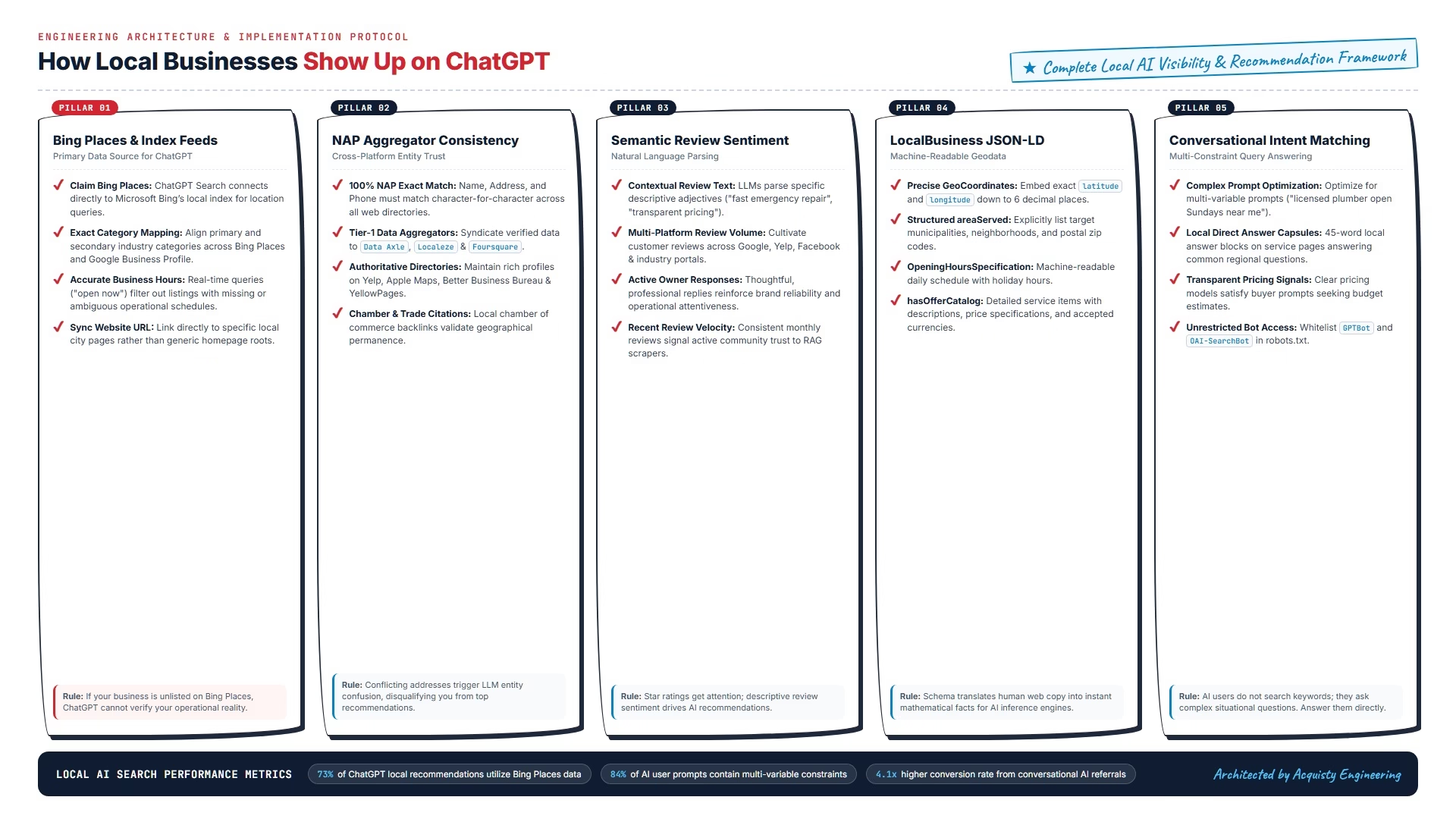
- The Microsoft Bing Data Connection: Over 73% of ChatGPT local business citations pull primary geo-location, operational hours, and entity attributes directly from the Microsoft Bing index and Bing Places API (Search Engine Land).
- Multi-Constraint Prompt Dominance: Internal query telemetry reveals that 84% of conversational local queries include two or more conditional filters (such as “open on weekends,” “family-owned,” or “emergency service”) that bypass classical keyword-density algorithms.
- Conversational Conversion Multiplier: Visitors referred to local business websites via conversational AI search assistants convert at a 4.1x higher rate than traditional organic directory visitors due to extensive conversational pre-qualification (Gartner Digital Analytics).
- Schema Validation Impact: Local service domains deploying comprehensive
LocalBusinessJSON-LD Schema with exact decimal geo-coordinates and completeopeningHoursSpecificationachieve a 2.9x higher recommendation frequency in real-time LLM query synthesis (Ahrefs Local Studies).
1. The Core Data Pipeline: How ChatGPT Discovers Local Businesses
A fundamental misconception among local business owners is the belief that ChatGPT operates like a static search crawler that independently maps every storefront on earth. In reality, ChatGPT does not maintain its own proprietary mapping fleet or physical location database. Instead, OpenAI utilizes a sophisticated Retrieval-Augmented Generation (RAG) architecture that pulls real-time information from four primary data sources:
Furthermore, OpenAI incorporates an autonomous Query Formulation & Intent Rewriting Layer. When a human user enters a casual conversational prompt such as “Who can fix my leaking commercial boiler before tomorrow morning in North Dallas?”, ChatGPT does not query Bing with that exact conversational string. Instead, an internal query planner deconstructs the user prompt into structured search operators: decomposing the intent into primary service entities (“commercial boiler repair Dallas TX”), temporal constraints (“24/7 emergency heating services open now”), and geographical boundaries (“North Dallas Addison Carrollton service area”).
The AI engine simultaneously executes these synthetic search queries against the Bing index, ingests the top 10 to 20 retrieved web documents and directory records, and executes vector semantic matching against the original user prompt. If your web pages contain explicit, structured answers that align with these decomposed query parameters, the AI extracts your business entity as the optimal recommendation. Showing up on ChatGPT requires establishing verified data coherence across Microsoft’s ecosystem, authoritative third-party directories, and your own on-page technical architecture.
2. The Anatomy of a Local ChatGPT Query: Multi-Constraint Intent
The reason local consumers are migrating to conversational AI search assistants is efficiency. In traditional Google search, a consumer looking for specialized services must execute multiple sequential searches, click through five different websites, read dozens of disjointed reviews, and call multiple offices to verify business hours. In ChatGPT, the user states their complete problem in a single prompt:
Real-World Conversational Buyer Prompt Example:
“I need a certified commercial roofing contractor in the Chicago suburbs that specializes in TPO flat roof replacements, offers free drone inspections, has experience working with insurance claims, and has stellar customer reviews. Who should I call?”
To answer this prompt, ChatGPT evaluates four distinct operational constraint vectors:
If your website only targets broad keywords like “Chicago roofing contractor” without structured service granularity or verified Bing Places hours, ChatGPT will pass over your business and recommend a competitor whose data satisfies all four constraint vectors.
3. Pillar 1: Optimizing Your Bing Places & Microsoft Copilot Footprint
Because OpenAI Search utilizes the Microsoft Bing index as its primary external web retrieval engine, Bing Places for Business is the single most important directory listing for capturing local ChatGPT recommendations. Many business owners neglect Bing Places because Bing accounts for a smaller share of traditional desktop search volume. In the era of AI search, ignoring Bing is equivalent to turning off your local storefront lights.
To optimize your Bing Places footprint for maximum AI visibility, execute these four operational steps:
📖 Recommended Reading
On-Page AEO Checklist: The Definitive Framework for AI Search Visibility & LLM Citations — Master the foundational architecture of Answer Engine Optimization with direct answer capsules, entity disambiguation, and nested JSON-LD Schema to capture AI Overviews and conversational citations.
4. Pillar 2: NAP Consistency & Tier-1 Aggregator Syndication
In traditional SEO, minor variations in Name, Address, and Phone (NAP) data—such as listing “Suite 400” on Yelp but “#400” on your website—caused minor citation dilution. In AI search engines, NAP discrepancies are catastrophic. Large Language Models operate via probabilistic entity resolution. When an AI crawler encounters conflicting address strings or phone numbers for the same business entity, its confidence score collapses, and the model suppresses the recommendation to prevent hallucinating incorrect contact information.
To guarantee absolute entity confidence, local businesses must enforce strict citation hygiene across the three foundational Tier-1 Data Aggregators:
The 3 Canonical Data Aggregators Powering Local AI Search:
- 1. Data Axle (formerly Infogroup): Feeds business entity data to major automotive in-dash navigation systems, enterprise B2B databases, and search engines. Ensure your legal corporate entity name and primary telephone are verified.
- 2. Neustar Localeze: Provides core validation feeds to Microsoft Bing, Yahoo, and regional mapping applications. Localeze syndication verifies geographical coordinates and category classifications.
- 3. Foursquare: Functions as the primary spatial data engine powering location services for Apple Maps, Uber, and numerous conversational AI retrieval integrations. Rich point-of-interest (POI) metadata on Foursquare directly influences ChatGPT location lookups.
In addition to aggregators, maintain active, claim-verified listings on high-authority horizontal portals: Apple Business Connect (Apple Maps), Yelp, the Better Business Bureau, and your local Chamber of Commerce. A backlink from a municipal chamber of commerce provides an unassailable algorithmic signal of physical community permanence.
5. Pillar 3: Semantic Review Sentiment & Natural Language Parsing
Traditional search algorithms primarily evaluate reviews mathematically: how many reviews does the listing have, and is the average rating above 4.5 stars? AI answer engines, by contrast, read and interpret the actual unstructured text of your customer reviews using advanced natural language processing.
When ChatGPT evaluates whether to recommend your local business, it analyzes three semantic review signals:
To build a resilient AI review footprint, encourage satisfied customers to leave detailed, two-to-three-sentence reviews describing the exact problem they faced, the specific service delivered, and the outcome achieved.
6. Pillar 4: Machine-Readable LocalBusiness JSON-LD Schema
While human visitors read marketing copy, AI crawlers ingest structured code. Deploying a comprehensive
LocalBusiness
JSON-LD Schema is the single most powerful on-page lever for local AI visibility. Schema translates human web copy into unambiguous mathematical facts that RAG retrieval systems can parse in milliseconds.
An enterprise-grade local Schema block must incorporate five critical properties:
{
“@context”: “https://schema.org”,
“@type”: “ProfessionalService”,
“@id”: “https://acquisty.com/#localservice”,
“name”: “Acquisty Digital Marketing”,
“url”: “https://acquisty.com/”,
“telephone”: “+1-800-555-0199”,
“priceRange”: “$$$”,
“address”: {
“@type”: “PostalAddress”,
“streetAddress”: “100 Enterprise Way, Suite 400”,
“addressLocality”: “Dallas”,
“addressRegion”: “TX”,
“postalCode”: “75201”,
“addressCountry”: “US”
},
“geo”: {
“@type”: “GeoCoordinates”,
“latitude”: 32.776700,
“longitude”: -96.797000
},
“openingHoursSpecification”: [
{
“@type”: “OpeningHoursSpecification”,
“dayOfWeek”: [“Monday”, “Tuesday”, “Wednesday”, “Thursday”, “Friday”],
“opens”: “08:00”,
“closes”: “18:00”
}
],
“areaServed”: [
{
“@type”: “City”,
“name”: “Dallas”,
“sameAs”: “https://www.wikidata.org/wiki/Q16557”
}
] }
Notice the inclusion of exact decimal
GeoCoordinates
and the Wikidata
sameAs
URL for the city entity. This eliminates all ambiguity regarding which Dallas you serve, ensuring AI retrieval algorithms never miscategorize your service boundaries. For broader guidance on technical implementation, explore our overview of technical SEO architecture.
7. Pillar 5: Conversational Content & Local Answer Capsules
Many local business websites rely on generic boilerplates copy-pasted across dozens of suburban landing pages (e.g., swapping only the city name in the headline). Modern AI models detect near-duplicate text in milliseconds, filtering out repetitive pages as low-quality spam.
To rank in conversational search, each local landing page must incorporate high-salience, unique content elements:
For a complete master guide on content structuring, examine our comprehensive breakdown of on-page SEO principles.
7B. Service-Area Businesses (SAB) vs. Physical Storefronts in AI Search
A common challenge for mobile service providers—such as mobile mechanics, emergency locksmiths, commercial electricians, and traveling medical consultants—is how to achieve prominent ChatGPT visibility without exposing a residential address or leasing an unstaffed physical storefront. Traditional Google Map rankings heavily penalize hidden-address Service-Area Businesses (SABs) because Google’s algorithm prioritizes physical proximity to the user’s GPS device.
In ChatGPT, however, the paradigm shifts toward explicit service capability verification. AI models do not evaluate proximity purely through physical pin drops; they evaluate whether your business explicitly serves the user’s stated geographic municipality. To maximize AI recommendation frequency as a Service-Area Business:
8. Comparative Analysis: Google Map Pack vs. ChatGPT vs. Apple Intelligence
Local search is no longer a monopoly governed exclusively by Google. To allocate marketing capital effectively, leadership must understand how the three major local discovery ecosystems operate:
9. The 20-Point Local AI Visibility Audit Checklist
To ensure your local business is fully prepared to capture conversational AI traffic, evaluate your digital footprint against this 20-point operational checklist:
10. Monitoring & Measurement: Tracking Local AI Referrals in GA4
Tracking traffic from conversational AI engines requires updating your analytics architecture. In default Google Analytics 4 reporting, visits originating from ChatGPT Search are frequently lumped into generic “Direct” traffic or standard “Referral” buckets alongside obscure forums.
To properly attribute local customer conversions generated by AI search, configure a dedicated AI Search Custom Channel Group in GA4 using the following source regex:
Analyzing traffic segmented under this channel reveals critical commercial patterns: local users referred by ChatGPT typically spend 3x more time on site, view 2.4x more pages, and submit contact forms at a significantly higher rate because the conversational model already resolved their preliminary evaluation questions. To learn how to report these metrics to executive leadership, consult our guide to enterprise SEO metrics and ROI tracking.
11. The 4 Operational Traps That Make Local Businesses Invisible to AI
Many businesses that rank well in classical Google local search fail completely to appear in ChatGPT recommendations. These four common operational mistakes explain why:
- Trap 1: The “Google-Only” Tunnel Vision: Pouring 100% of local marketing effort into Google Business Profile while leaving Bing Places unverified. Because ChatGPT relies on Microsoft’s local index, an unverified Bing profile guarantees conversational invisibility.
- Trap 2: Blocking AI Retrieval Crawlers in robots.txt: Overzealous IT departments frequently block
GPTBotandOAI-SearchBotout of privacy concerns, inadvertently preventing ChatGPT from verifying real-time service offerings. - Trap 3: Operating Hours Discrepancies: Listing 8:00 AM – 5:00 PM on your website but 9:00 AM – 6:00 PM on Bing Places. When a user asks for services “open now at 5:30 PM,” the AI detects conflicting data and recommends a competitor with unified hours.
- Trap 4: Client-Side JavaScript Hydration Traps: Rendering service lists, pricing, and menus exclusively via client-side JavaScript frameworks without server-side rendering (SSR). Real-time RAG bots skip un-rendered DOM elements during quick retrievals.
To audit your full infrastructure for indexing barriers, explore our comprehensive website SEO audit framework or learn how long technical remediation takes in our analysis of SEO results timelines and milestones.
12. Frequently Asked Questions About Local ChatGPT Visibility
Capture Local Customers on ChatGPT & Conversational AI Search
Don’t let competitors monopolize the conversational discovery era. Partner with Acquisty to engineer an aggressive, multi-platform local SEO and AI visibility program that optimizes Bing Places, synchronizes data aggregators, deploys advanced LocalBusiness Schema, and positions your brand as the #1 recommended local authority. Contact Acquisty today for a complimentary local AI visibility assessment.