


For more than two decades, digital marketers and business owners have debated the exact mechanics of Google’s search algorithms. Industry folklore often claims that Google uses over 200 distinct ranking factors, leading many founders and marketing managers down an exhausting rabbit hole of minor technical tweaks, keyword density formulas, and micro-optimizations that deliver negligible business impact.
In reality, search engine optimization is far less mystical than the industry makes it seem. Google’s overarching corporate mission has never changed: to deliver the most relevant, reliable, and user-satisfying answer to a searcher’s query in the shortest possible time. While Google’s machine learning systems evaluate hundreds of subtle data points, over 90% of your website’s organic visibility is determined by four foundational pillars: high-quality content that matches search intent, authoritative external backlinks, robust technical website health, and an exceptional user experience.
When your website executes these four pillars with excellence, organic rankings do not just rise—they compound. High rankings generate consistent, qualified inbound traffic from decision-makers who are actively searching for your solutions, creating an automated lead generation engine that scales revenue without requiring ongoing paid advertising spend.
In this comprehensive, uncomplicated master guide, we demystify the most important Google SEO ranking factors in plain English: how search engines actually evaluate websites, which signals truly move the needle for revenue, the common ranking myths that waste marketing budgets, and an actionable 30-day roadmap to elevate your search performance.
- Top 3 Organic Search Results Capture 68.7% of All Clicks: Comprehensive CTR analysis published by FirstPageSage reveals that the top three organic search results claim over 68.7% of all click volume, with the #1 position capturing nearly 39.8% of searchers. Moving from position #5 to position #1 can quadruple your inbound lead volume.
- Core Web Vitals Compliance Reduces Bounce Rates by 24%: Official Chromium ecosystem research published by Google Web Dev demonstrates that websites meeting Google’s Core Web Vitals performance thresholds experience a 24% reduction in abandonment rates and up to a 31% increase in mobile ecommerce conversion rates.
- Position #1 Has 3.8x More Referring Domains Than Lower Results: An empirical study analyzing 11.8 million Google search results conducted by Backlinko confirmed that the single strongest correlation with page-one rankings is the total number of unique, authoritative referring domains pointing to the URL.
- Information Gain & E-E-A-T Content Displays 4x Greater Ranking Stability: Search analytics published by Search Engine Journal demonstrates that websites offering original practitioner data, case studies, and unique information gain maintain 4x higher ranking stability during Google core algorithmic updates compared to derivative, generic content.
- Full-Funnel Organic Strategy Generates 200% Higher Pipeline ARR: Cross-industry marketing benchmarks compiled by Gartner reveal that enterprise B2B organizations balancing technical crawl health, high-intent content, and digital PR generate over 200% more annual recurring revenue (ARR) from inbound organic channels than companies relying on single-tactic SEO.
Demystifying the “200+ Ranking Factors” Myth
If you search the web for SEO advice, you will find endless articles listing “200+ Google Ranking Factors.” These lists contain everything from domain registration length and keyword hyphens to H3 header counts. Trying to optimize a commercial website against 200 different items is not only overwhelming—it is strategically flawed.
Google’s search engineers do not sit in a room manually adjusting 200 individual dials. Instead, Google utilizes sophisticated, machine-learning ranking engines—such as RankBrain, BERT, MUM, and the Helpful Content System—that evaluate web pages holistically. These systems analyze patterns of relevance, user satisfaction, and authority across four foundational pillars:
| Core Ranking Pillar | Algorithmic Objective | Key Evaluation Signals | Impact Weight |
|---|---|---|---|
| 1. Content & Intent | Satisfies what the searcher actually needs | Search intent alignment, E-E-A-T, topical depth, entity relationships | Critical (40%) |
| 2. Backlinks & Authority | Validates trust and external industry reputation | Unique referring domains, topical relevance of links, natural anchor text | Critical (30%) |
| 3. Technical Infrastructure | Ensures flawless crawling, indexation & speed | Core Web Vitals, mobile-first indexation, clean crawl paths, HTTPS | High (15%) |
| 4. User Experience (UX) | Confirms real human engagement & satisfaction | Engaged dwell time, low bounce rate, zero pogo-sticking, clear layout | High (15%) |
When you focus your marketing resources on these four core pillars rather than obsessing over hundreds of minor checklist items, SEO transforms from a confusing technical burden into a clear, predictable driver of commercial revenue.
Visual Architecture: The 4 Core Pillars of Google SEO Ranking Factors
To visualize how these four interconnected pillars work together to elevate your website’s organic visibility, review the structural framework below:
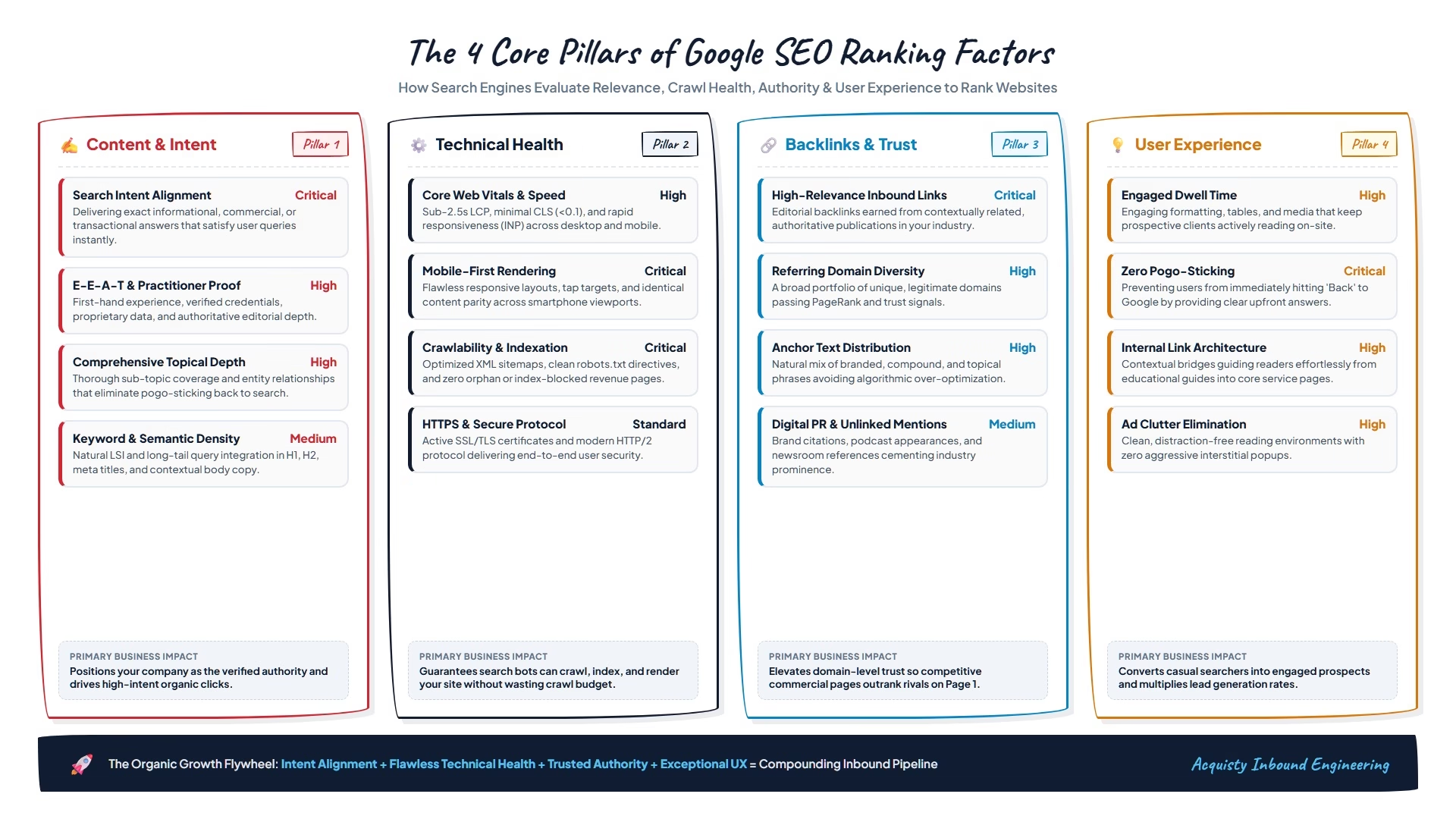
Pillar 1: Content Relevance & Search Intent Alignment
Content remains the foundational currency of search engines. If your page does not comprehensively answer what the searcher is trying to accomplish, no amount of technical speed or backlink acquisition will keep you ranked at the top of Google. Here are the core factors governing content relevance:
1. Precise Search Intent Matching:
Search intent is the single most critical on-page ranking factor. Every search query falls into one of three primary intent categories:
- Informational Intent: The user wants to learn something (e.g., “what is technical SEO”). They need a clear, educational walkthrough, not a sales pitch.
- Commercial Investigation Intent: The user is evaluating solutions or comparing vendors (e.g., “best enterprise SEO software comparison”). They need objective comparison tables, feature breakdowns, and pros and cons.
- Transactional Intent: The user is ready to hire or purchase (e.g., “hire SEO agency in London”). They want transparent service packages, customer proof, and an effortless consultation booking form.
If you publish a sales page for an informational query, or a vague blog post for a transactional query, searchers will immediately bounce, signaling to Google that your page failed to satisfy intent.
2. E-E-A-T (Experience, Expertise, Authoritativeness & Trustworthiness):
Google’s Search Quality Evaluator Guidelines place enormous emphasis on E-E-A-T. Search engines evaluate whether content is authored by real practitioners with first-hand experience rather than anonymous content farms or generic AI generators. You establish E-E-A-T by displaying clear author bios with verified industry credentials, sharing proprietary company data benchmarks, including real client case studies, and transparently detailing your methodology.
3. Comprehensive Topical Coverage & Semantic Entities:
Modern search engines do not look for isolated keywords repeated multiple times. Google’s Knowledge Graph and Natural Language Processing (NLP) models look for semantic entities—the related concepts, questions, and terminology that naturally belong within an authoritative discussion of a topic. An article about website speed must naturally discuss caching, CDNs, server response times, and Core Web Vitals to demonstrate true topical authority.
4. Original Information Gain:
With the explosion of automated AI content flooding the web, Google holds a specific patent on Information Gain. This system measures whether your article provides new information, original perspectives, or unique research beyond what existing top-ranking results already state. If your article merely rehashes the top three articles on Google, it offers zero information gain and is vulnerable to algorithmic demotion.
How to Conduct a 4-Step Search Intent Audit:
To ensure your existing pages align with real search demand, follow this simple practical audit:
- Google Your Target Keyphrase: Open an incognito browser window and analyze the top 5 ranking results. Are they long-form how-to guides, product comparison tables, or direct service pages?
- Identify the Dominant Format: If all top results are numbered step-by-step guides, do not attempt to rank an opinion editorial or a 300-word product description. Match the format searchers prefer.
- Locate Content Gaps in Competitor Articles: What important sub-questions did competitors fail to answer? What outdated statistics or generic advice did they include?
- Inject Proprietary Practitioner Insights: Add original case studies, concrete client metrics, and clear comparison charts that provide tangible value competitors cannot copy.
To build an editorial engine that satisfies search intent and drives qualified business inquiries, discover our comprehensive content marketing services.
Pillar 2: Technical Health & Crawl Infrastructure
Technical SEO provides the foundational pipework through which search engines discover, crawl, and render your website. If your technical architecture is broken, search bots cannot properly index your high-value pages, rendering your content investments invisible:
1. Mobile-First Indexing & Responsiveness:
Google exclusively indexes and ranks websites based on how they render on a mobile smartphone viewport. If your desktop website is pristine but your mobile version has hidden content, slow-loading assets, or overlapping buttons, your rankings will suffer site-wide. Ensure your site uses responsive design with identical content, structured data, and navigation across all screen sizes.
2. Core Web Vitals (Real-World User Speed):
Google evaluates real-world loading speed and visual stability through three standardized Core Web Vitals metrics:
- Largest Contentful Paint (LCP): Measures perceived loading speed. Your main content should render in under 2.5 seconds.
- Interaction to Next Paint (INP): Measures responsiveness to user taps and clicks. Pages should respond within 200 milliseconds.
- Cumulative Layout Shift (CLS): Measures visual stability. Content should not jump around as images load; CLS score must stay below 0.1.
Fast websites not only rank higher—they dramatically reduce customer abandonment rates and increase sales conversions.
3. Crawlability & Indexation Governance:
Search engine crawlers operate with finite computing resources, known as a “crawl budget.” Optimize your crawl health by submitting clean XML sitemaps, avoiding redirect chains (such as Page A → Page B → Page C), eliminating broken 404 links, and managing duplicate URL parameters using canonical tags.
4. HTTPS & Protocol Security:
Website security is a confirmed baseline ranking factor. Serving your entire domain over encrypted HTTPS with an active SSL certificate protects user data and ensures browsers do not display intimidating “Not Secure” warning banners that destroy prospect trust.
To identify and resolve hidden technical crawl bottlenecks across your domain, explore our specialized technical SEO services.
📖 Recommended Reading
Website SEO Audit: The Step-by-Step Guide to Finding & Fixing Search Issues That Hurt Your Traffic — Learn how to run a complete diagnostic audit on your website to uncover crawl errors, improve site speed, boost organic rankings, and turn lost visitors into customers.
Pillar 3: Domain Authority, Backlinks & Brand Signals
Backlinks remain the fundamental bedrock of Google’s ranking algorithm, originating from the original PageRank mathematical model developed by Google’s founders. A backlink from an external website acts as a public vote of confidence in your content’s accuracy and credibility. However, modern link evaluation is entirely focused on quality and relevance over raw quantity:
1. Topical Relevance of Referring Domains:
A backlink from an authoritative, contextually related industry publication (such as an established B2B trade journal linking to a SaaS software provider) carries exponentially more ranking weight than hundreds of random links from irrelevant lifestyle blogs or web directories. Google evaluates whether the linking domain and the linked page share topical affinity.
2. Unique Referring Domains vs. Total Links:
Earning 50 links from the same website delivers diminishing returns. Google places far greater value on the breadth of unique referring domains. Ten high-authority links from ten distinct, reputable websites will elevate your organic visibility far more than 100 links originating from a single domain.
3. Natural Anchor Text Distribution:
Anchor text—the clickable words that contain the hyperlink—provides search engines with critical contextual clues about the destination page. However, aggressive over-optimization (such as building thousands of links using exact-match commercial keywords like “best marketing agency”) triggers algorithmic spam penalties. An authentic, natural link profile consists primarily of branded anchors (your company name), naked URLs (https://acquisty.com), and descriptive topical phrases.
4. Digital PR, Brand Citations & Unlinked Mentions:
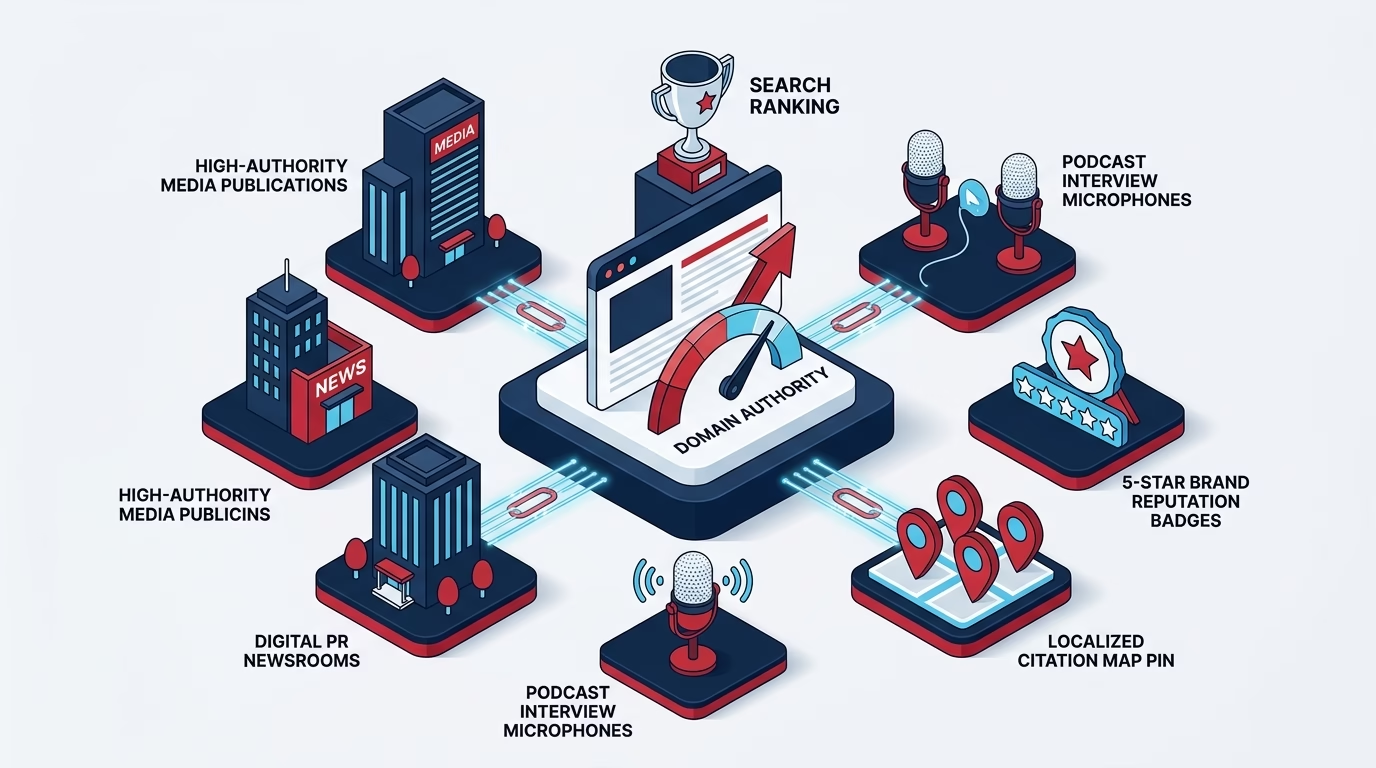
Google’s advanced entity-recognition algorithms identify brand mentions even when an explicit hyperlink is omitted. Press coverage in major news outlets, podcast interviews, conference keynote references, and executive industry quotes establish your brand as a recognized entity within Google’s Knowledge Graph, strengthening site-wide organic authority.
4 Proven White-Hat Link Building Strategies for Growing Businesses:
Rather than purchasing spammy backlinks that put your domain at risk, focus your outreach on these high-ROI, editorial strategies:
- Proprietary Research & Industry Surveys: Conduct an annual survey of customers or industry leaders. Publishing original data naturally attracts citations and backlinks from journalists, bloggers, and industry analysts searching for statistics.
- Digital PR & Expert Commentary: Connect with journalists via platforms like HARO, Featured, and Connectively. Providing insightful, executive-level quotes on breaking industry news regularly earns high-authority editorial mentions.
- Comprehensive Pillar Asset Creation: Create definitive, free educational tools, calculators, or master guides that become the definitive resource in your niche. High-utility assets earn backlinks passively over time.
- Unlinked Brand Mention Outreach: Monitor the web for mentions of your company name or executive team using tools like Google Alerts or Mention. Reach out with a courteous thank-you note and request that they convert the text mention into an active hyperlink.
To master the art of earning high-authority editorial links that elevate your domain above competitors, review our detailed guide on what off-page SEO is and how to build backlinks step-by-step.
Pillar 4: User Experience & Interaction Signals
Even if a page has great content and strong backlinks, if real visitors find the browsing experience frustrating or clunky, search algorithms will eventually downgrade its position. Google measures user interaction to confirm whether searchers are genuinely satisfied by your website:
1. Eliminating “Pogo-Sticking”:
Pogo-sticking is one of the most detrimental behavioral patterns in SEO. It occurs when a user clicks your search result, spends three seconds trying to read your page, realizes it is cluttered with aggressive pop-ups or does not answer their question, and immediately hits the ‘Back’ button to click a competitor’s link. When hundreds of users repeat this action, Google’s algorithms conclude that your page is failing searchers, causing rankings to drop.
2. Engaged Dwell Time & Scroll Velocity:
When a searcher clicks your page and spends three to five minutes reading, scrolling through comparison tables, and clicking internal links, Google’s machine learning systems receive strong positive signals that your content delivered immense value. Format your articles with short paragraphs (2–3 sentences max), clear subheadings, bold takeaways, and visual diagrams to encourage prolonged engagement.
3. Intuitive Internal Link Navigation:
A well-structured website guides visitors logically from introductory educational articles into detailed case studies and service booking pages. Strategic internal linking not only distributes PageRank equity throughout your domain, but it also keeps prospective buyers engaged on your website across multiple pageviews, accelerating the customer journey.
4. Elimination of Visual Clutter & Aggressive Interstitials:
Websites that barrage visitors with full-screen pop-ups, autoplay videos, and obstructive newsletter overlays provide a terrible user experience. Google penalizes intrusive interstitials, particularly on mobile devices. Prioritize a clean, distraction-free reading environment that puts the user’s needs first.
To learn how on-page optimization balances keyword targeting with reader engagement, read our complete guide to on-page SEO best practices.
Modern AI & Semantic Signals: How Search Has Evolved
In recent years, Google has undergone an algorithmic evolution driven by machine learning and natural language processing. Understanding how these modern AI systems operate prevents you from relying on outdated 2015 SEO tactics:
Rather than trying to trick these sophisticated neural networks with keyword repetition, modern businesses succeed by structuring clear, factual, and deeply educational content that both human buyers and AI search engines can easily understand.
The Strategic Ranking Priority Matrix for Business Leaders
When resources and marketing hours are finite, how should an executive prioritize SEO initiatives? Use this practical impact-versus-effort matrix to allocate budget where it generates the fastest commercial return:
| Initiative Phase | Key Action Items | Time Horizon | Commercial Payoff |
|---|---|---|---|
| Phase 1: Quick Wins | Fix broken 404 links, compress large images, align title tags with commercial search intent, eliminate crawl blocking | Days 1 – 14 | Immediate recovery of suppressed pages & bounce reduction |
| Phase 2: Content Optimization | Refresh top 10 revenue pages with E-E-A-T proof, build contextual internal link bridges, create in-depth FAQ schema | Days 15 – 45 | Rankings jump into top 3 positions for high-intent queries |
| Phase 3: Authority Flywheel | Publish proprietary data studies, execute targeted Digital PR, reclaim unlinked brand mentions | Days 45 – 90+ | Permanent domain authority lift that insulates against algorithm shifts |
7 Costly SEO Ranking Myths That Waste Budget & Hurt Rankings
Protect your marketing budget and focus your team on high-ROI initiatives by eliminating these seven prevalent SEO myths:
Myth 1: “You Need Thousands of Backlinks to Rank on Page One.”
The Reality: Quality overwhelmingly beats quantity. A handful of highly relevant, trusted editorial links from industry leaders will outrank competitors who purchased thousands of low-quality links on private blog networks.
Myth 2: “Exact Keyword Density Must Be 2.5%.”
The Reality: Search engines have not relied on rigid keyword density formulas for over a decade. Repeating your target keyword unnaturally makes your prose unreadable, repels prospective clients, and triggers spam filters. Write naturally for human decision-makers.
Myth 3: “Publishing 50 Generic AI Articles a Week Is the Fastest Path to Growth.”
The Reality: Flooding your website with automated, unedited AI content offers zero information gain and often results in catastrophic traffic drops during Google core updates. One deeply researched, high-intent master guide that solves customer problems generates far more pipeline than 50 generic AI summaries.
Myth 4: “Meta Keywords Still Help Search Engines Understand Your Page.”
The Reality: Google officially deprecated the meta keywords tag in 2009. Spending time adding meta keywords to your pages provides zero ranking value.
Myth 5: “Technical SEO Only Matters for Massive eCommerce Websites.”
The Reality: Slow loading times, mobile layout shift, and crawl indexation errors hurt small B2B service websites just as severely as multi-million SKU stores. A fast, technically sound website converts visitors into leads at significantly higher rates.
Myth 6: “Ranking #1 on Google Guarantees Business Success.”
The Reality: Ranking for low-intent, vanity keywords that have zero commercial relevance does not pay the bills. The objective of SEO is not just traffic—it is qualified leads, customer inquiries, and measurable revenue growth.
Myth 7: “SEO Is a One-Time Project You Complete and Forget.”
The Reality: SEO is an ongoing business discipline. Competitors publish new content, algorithms evolve, and content naturally decays over time. Consistent monitoring, updating, and internal linking compound your authority year after year.
To learn how strategic content writing creates compounding customer acquisition, explore our complete guide on what content writing is and how to build a business strategy.
The 30-Day Ranking Factor Optimization Action Plan
If your website’s organic traffic has stagnated, execute this prioritized four-week sprint to resolve ranking bottlenecks and accelerate your organic growth:
Week 1: Technical & Mobile Foundation Audit
Begin by auditing your technical infrastructure. Inspect Google Search Console for crawl errors, excluded pages, and Core Web Vitals warnings. Run your primary commercial landing pages through PageSpeed Insights and address slow server response times, uncompressed images, and render-blocking scripts. Ensure all pages load cleanly over HTTPS and that mobile viewports feature responsive, distraction-free typography.
Week 2: Content Relevance & Search Intent Audit
Identify your top 10 highest-value commercial service pages and key blog guides. Review them against user search intent: does the page deliver an immediate, comprehensive solution? Update outdated statistics, infuse first-hand case studies and practitioner insights (E-E-A-T), and structure headings with clear, descriptive sub-topics. Replace dense walls of text with responsive tables, checklists, and bulleted takeaways.
Week 3: Strategic Internal Linking & Architecture
Audit your internal linking structure. Ensure that your informational blog guides contextually link to your core service and conversion pages. Eliminate orphan pages (pages with zero inbound internal links) and ensure descriptive, natural anchor text connects related topic clusters across your domain.
Week 4: Authority Building & Digital PR Outreach
Develop an authoritative, research-backed digital asset—such as an industry survey, benchmark study, or proprietary data report. Reach out to respected trade publications, industry podcasts, and journalists covering your sector. Earning even 3 to 5 high-authority editorial mentions and backlinks will provide the domain trust needed to propel your commercial pages into top Google positions.
To scale your organic pipeline with an enterprise search partner, explore our comprehensive search engine optimization services.