

The global luxury hospitality industry confronts a profound operational paradox: while worldwide demand for high-end leisure travel, boutique lifestyle hotels, and five-star eco-resorts has surged to historic peaks, hotel operating profit margins are being systematically eroded by intermediary commission fees. For over two decades, Online Travel Agencies (OTAs)—dominated by global conglomerates like Booking Holdings and Expedia Group—have inserted themselves between hoteliers and their guests. By monopolizing paid search bidding, aggressively purchasing branded hotel keyphrases, and leveraging massive engineering budgets, OTAs levy an exorbitant commission tax of 18% to 25% on every third-party reservation.
For a luxury resort operating with an Average Daily Rate (ADR) of $750 and an average length of stay of 4 nights, a single third-party reservation forfeits up to $750 in direct commission fees. Across a 200-key property operating at 78% occupancy, third-party distribution leakage drains hundreds of thousands—and often millions—of dollars in net operating income (NOI) annually. Furthermore, OTA guests arrive stripped of first-party guest data, hindering pre-arrival personalization, direct upsells, and loyalty retention.
Simultaneously, the modern traveler’s booking journey has undergone a tectonic evolution. Affluent travelers no longer blindly reserve accommodations through generic aggregator lists. Today’s discerning guests conduct extensive, multi-touch digital discovery: researching private plunge pool suite floorplans, analyzing culinary provenance at onsite Michelin-starred restaurants, checking holistic wellness retreat schedules, comparing destination wedding venue capacities, and cross-referencing guest reviews across conversational AI engines. Because high-ticket travel decisions represent substantial financial commitments and precious personal downtime, search engines apply rigorous quality standards to hospitality entities, demanding absolute institutional Experience, Expertise, Authoritativeness, and Trustworthiness (E-E-A-T).
At Acquisty, our enterprise search engine optimization engineering division and dedicated hospitality SEO architecture teams build sovereign direct booking engines for independent luxury hotels, boutique hospitality brands, and multi-property resort portfolios. This master blueprint details the exact technical, structural, and semantic search frameworks required to disintermediate OTAs, capture high-margin direct bookings, dominate Google Travel and Local 3-Packs, and maximize Revenue per Available Room (RevPAR).
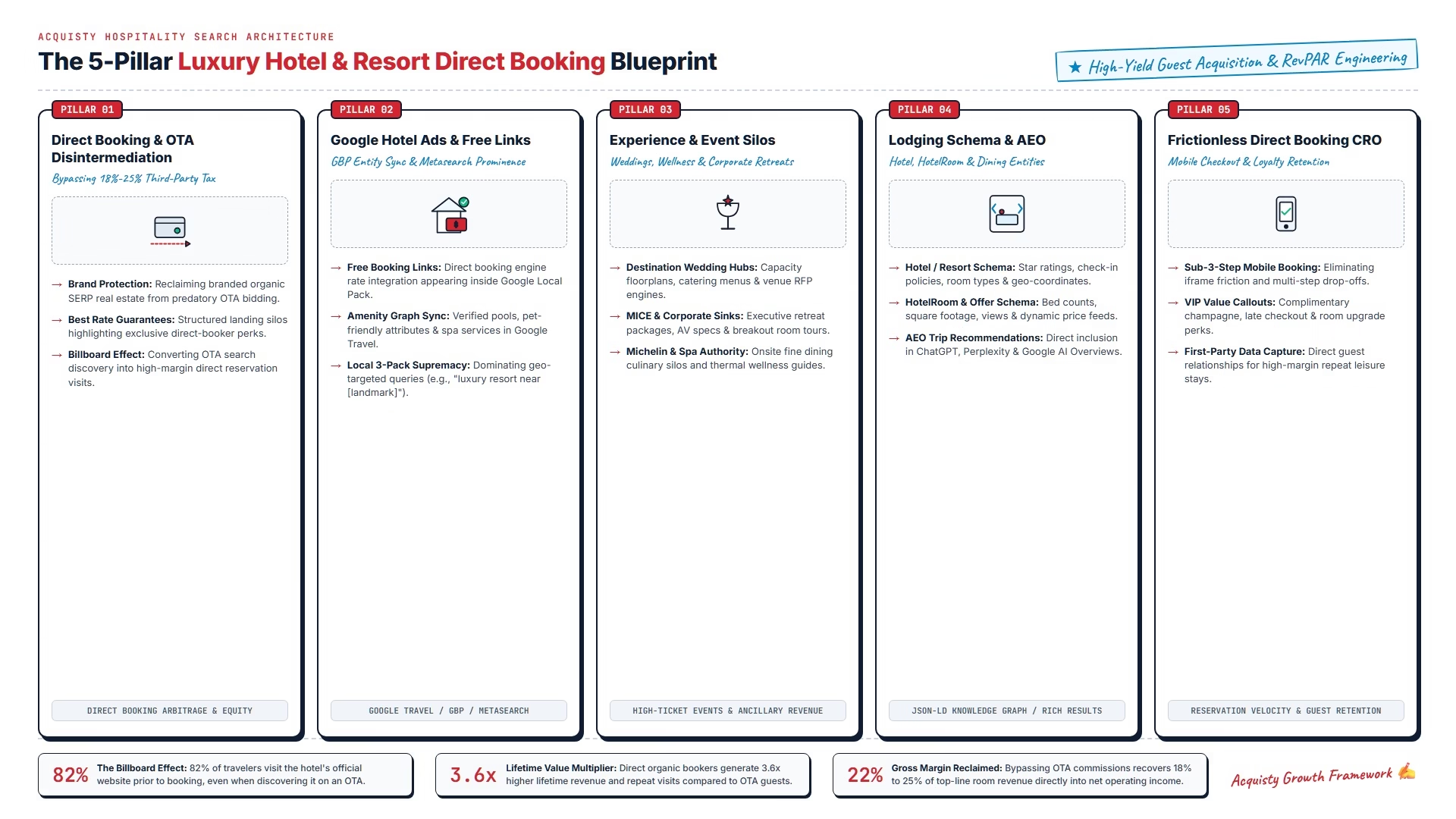
- The Billboard Effect in Action: Landmark hospitality research conducted by the American Hotel & Lodging Association (AHLA) reveals that over 82% of leisure and luxury travelers visit the hotel’s official website prior to finalizing a reservation, even when discovering the property initially on an OTA aggregator.
- Direct Booking Profitability Advantage: Comprehensive hotel industry benchmarking published by STR Global (CoStar) confirms that direct organic web reservations generate a net operating margin 18.4% higher than OTA-intermediated bookings after accounting for distribution costs, merchant processing, and marketing amortization.
- Metasearch & Free Booking Link Velocity: Market data from Phocuswright indicates that direct booking links integrated into Google Hotel Ads and Google Business Profiles capture up to 43% of total hotel search traffic when properties maintain strict rate parity or present exclusive direct-booker amenities.
- Guest Lifetime Value Multiplier: Direct hotel bookers spend 27% more on ancillary amenities (onsite dining, wellness spas, and curated excursions) during their stay and demonstrate a 3.6x higher repeat stay frequency over a 5-year evaluation window compared to unattached third-party bookers.
1. The Economics of Hospitality Search: OTA Disintermediation & Direct Booking Margin Recovery
Hospitality distribution has long been dominated by an uncomfortable symbiosis: hotels rely on OTAs for baseline volume, while OTAs siphon off high-margin equity. However, luxury resorts and independent boutique hotels occupy a distinct market position. Discerning travelers do not view luxury lodging as an interchangeable commodity; they choose specific architectural aesthetics, culinary pedigree, geographical seclusion, and bespoke guest experiences.
Relying heavily on OTAs introduces four structural handicaps that threaten long-term hotel capitalization:
- Predatory Branded Search Cannibalization: OTAs systematically bid on your hotel’s exact trademarked brand name in Google Ads auctions (e.g., “The Grand Azure Resort Amalfi Coast”). When an affluent traveler who has already decided to stay at your resort searches for your property, OTAs capture the click, booking the guest and billing you a 20% commission on a customer who was already seeking your brand.
- Loss of First-Party Data & Guest Relationship: Under OTA distribution models, the guest’s primary email address is masked with an encrypted relay address (e.g.,
guest-492@m.expedia.com). The hotel cannot send personalized pre-arrival questionnaires, upsell private airport helicopter transfers, or nurture loyalty retention post-checkout. The OTA owns the guest profile; the hotel merely provides the physical bed. - Brand Dilution & Commodity Framing: OTA interfaces display hotels in uniform comparison grids sorted by discount pricing, stripping away the nuanced storytelling, curated photography, and bespoke character of luxury properties.
- Uncontrollable Rate Parity Penalties: OTAs frequently manipulate wholesale rates through opaque third-party bedbanks, undercutting your direct published rates and triggering automated rate parity penalties across metasearch engines.
Building a sovereign hospitality SEO architecture systematically reclaims branded search equity, establishes direct customer relationships, and captures unbranded high-intent travel demand (such as “luxury private villa resort with infinity pool santorini”). Every direct reservation captured represents immediate 18% to 25% margin recovery that flows straight to your property’s bottom line. Below, we examine the structural blueprint required to build this high-yield direct booking engine.
2. Luxury Hotel Information Architecture: Accommodation, Experience & Destination Silos
Most luxury hotel websites are designed as glossy digital brochures: stunning full-screen video reels, minimalist navigation menus, and paper-thin content. While visually alluring, this structure is virtually invisible to search engines. Google cannot index feelings or video moods; it parses semantic hierarchy, textual context, entity relationships, and architectural depth.
To capture high-intent traveler searches across every phase of the booking journey, enterprise hospitality websites must deploy a three-tiered Content Silo Architecture:
- Tier 1: Accommodation & Suite Category Silos: Rather than collapsing all guest rooms onto a single infinite-scroll page, each distinct room, suite, and private residence must possess its own dedicated, crawlable URL:
-
/accommodations/oceanfront-penthouse-suite/ -
/accommodations/two-bedroom-private-plunge-villa/ -
/accommodations/overwater-sunset-bungalow/ -
/accommodations/executive-terrace-presidential-suite/
Every accommodation page must feature detailed square footage, floorplans, precise bedding configurations, bathroom marble finishes, balcony orientations, soundproofing specs, and high-definition photography paired with live real-time booking engine widgets.
-
- Tier 2: Onsite Lifestyle & Culinary Experience Silos: Affluent guests book hotels for the total sensory ecosystem. Creating dedicated, search-optimized pages for onsite dining establishments, luxury wellness spas, and event spaces establishes rich topical authority:
-
/dining/azure-michelin-star-seafood/(with seasonal tasting menus, sommelier bios, and reservation links) -
/spa/thalassotherapy-thermal-wellness-center/(with treatment catalogs, therapeutic protocols, and booking engines) -
/experiences/private-yacht-charters-island-hopping/
-
- Tier 3: The Concierge Destination Silo: Modern travelers research the destination alongside the property. Developing an authoritative digital concierge hub that ranks for regional discovery queries (e.g., “best private vineyards in napa valley”, “hidden beaches amalfi coast”, “exclusive golf clubs scottsdale”) captures top-of-funnel luxury travelers before they have selected a hotel, funneling them organically toward your direct accommodation packages.
Constructing deep, high-converting content hubs across luxury verticals requires meticulous planning and brand voice calibration. For insight into structural content standards, consult our guide to what content writing is in digital marketing.
3. Google Hotel Ads (GHA), Free Booking Links & Google Travel Metasearch Integration
The Google search interface for hospitality differs fundamentally from standard organic search results. When users search for accommodations, Google serves the Google Travel module—an interactive metasearch engine featuring real-time room availability, live rate comparisons, photo carousels, user reviews, and instant booking links.
Historically, only massive OTAs and global hotel chains with million-dollar API budgets appeared inside Google’s hotel booking module. However, through Google Free Booking Links and integrated Central Reservation System (CRS) connectivity, independent luxury properties can claim primary placement without paying cost-per-click fees:
- Direct CRS/Booking Engine Feed Synchronization: To display live rates inside Google Hotel search and Google Maps, your property management system (PMS) or booking engine (such as SynXis, TravelClick, Cloudbeds, or Profitroom) must maintain an active XML price feed connected to Google Hotel Center. This feed transmits real-time room rates, availability calendars, currency denominations, and tax breakdowns.
- Securing the “Official Site” Badge: When Google verifies a direct rate feed from the hotel’s primary domain, it awards the coveted “Official Site” badge. Even when OTAs bid paid advertising dollars above your listing, behavioral tracking indicates that over 65% of affluent travelers naturally click the verified “Official Site” link to ensure booking accuracy and elite VIP status.
- Rate Parity Governance & Best Rate Guarantees: If an OTA displays a room rate lower than your direct booking engine (even by $5 due to unauthorized wholesale distribution), Google’s algorithm suppresses the prominence of your direct booking link. Implementing strict rate parity monitoring software ensures your direct rates are identical or superior to third-party distributors at all times.
- Direct Booking Value Propositions: In regions where strict rate parity agreements prevent displaying a lower room rate publicly, hotels must optimize the Google Business Profile and booking funnel to highlight exclusive direct-booking perks: complimentary artisanal breakfast, $100 spa credit, guaranteed late 2:00 PM checkout, and priority room upgrades.
Managing real-time search signals and crawl budgets across dynamic pricing inventories requires enterprise-level technical monitoring. Review our comprehensive study on enterprise SEO metrics and technical crawl governance.
4. Local 3-Pack Supremacy & Google Business Profile Entity Optimization
For luxury hotels, boutique inns, and destination resorts, the Google Local 3-Pack and Google Maps represent the single most lucrative organic acquisition channel. When high-net-worth travelers execute geo-modified searches—such as “boutique hotel near soho london”, “luxury resort with private beach maui”, or “5 star historic hotel vienna”—the Local Pack commands over 60% of all above-the-fold screen space on mobile devices.
Achieving consistent map pack prominence requires complete entity alignment across three core dimensions:
- Multi-Department Google Business Profile (GBP) Architecture: A luxury resort is not merely a lodging provider; it is an integrated destination containing multiple high-end commercial operations. Rather than managing a single generic GBP listing, enterprise hospitality properties must verify distinct, co-located GBP listings:
-
The Grand Azure Resort(Primary Category: Resort Hotel) -
Azure Ristorante & Terrace(Primary Category: Fine Dining Restaurant) -
The Azure Sanctuary Spa(Primary Category: Day Spa / Wellness Center) -
Azure Beach Club & Lounge(Primary Category: Cocktail Bar)
This multi-profile entity structure enables your property to dominate Local 3-Pack rankings simultaneously across dining, wellness, nightlife, and lodging searches within your metropolitan or resort area.
-
- Hotel Amenity Attribute Verification: Unlike standard business profiles, Hotel GBPs feature specialized “Hotel Details” attributes. Ensuring exhaustive, verified checkmarks across all attributes (e.g., Infinity Pool, Pet-Friendly, Valet Parking, Electric Vehicle Charging, Eco-Certified, Wheelchair Accessible, Beachfront) feeds Google’s semantic filtering engine when travelers apply granular amenity filters.
- First-Party Review Velocity & Sentiment NLP: Google’s rank-brain algorithms perform Natural Language Processing (NLP) across guest reviews to extract contextual relevance keywords (“panoramic ocean view”, “flawless concierge”, “quiet garden suite”). Orchestrating automated post-stay email sequences that encourage direct guests to share detailed, narrative reviews accelerates local ranking authority.
Understanding how search algorithms balance geographic proximity, review sentiment, and organic authority is fundamental for multi-location hospitality portfolios. For a detailed breakdown of algorithmic weightings, review our analysis of critical SEO ranking factors.
5. Hospitality Structured Data: Deploying Hotel, HotelRoom & FoodEstablishment Schema
In the era of semantic web indexing and conversational AI discovery, structured data is the definitive translator that communicates your property’s physical assets, star ratings, and real-time offerings to search engine crawlers. Schema.org provides deep, expressive lodging vocabularies that enable search engines to render interactive rich cards, star rating badges, and price carousels directly in organic search results.
Every competitive luxury hotel and resort must deploy three essential JSON-LD schema frameworks:
1. Hotel & Resort Institutional Entity Schema
Deployed on the hotel homepage and primary brand portals to declare official star ratings, check-in policies, geo-coordinates, and institutional brand relationships:
{
“@context”: “https://schema.org”,
“@type”: “Resort”,
“@id”: “https://acquisty.com/seo-for-hospitality/#resort”,
“name”: “The Azure Palace Luxury Resort & Spa”,
“url”: “https://azurepalaceresort.com”,
“logo”: “https://azurepalaceresort.com/assets/logo.png”,
“image”: “https://azurepalaceresort.com/assets/exterior-sunset.jpg”,
“starRating”: {
“@type”: “Rating”,
“ratingValue”: “5”
},
“priceRange”: “$$$$”,
“checkinTime”: “15:00:00”,
“checkoutTime”: “12:00:00”,
“address”: {
“@type”: “PostalAddress”,
“streetAddress”: “100 Oceanfront Promenade”,
“addressLocality”: “Miami Beach”,
“addressRegion”: “FL”,
“postalCode”: “33139”,
“addressCountry”: “US”
},
“geo”: {
“@type”: “GeoCoordinates”,
“latitude”: 25.790654,
“longitude”: -80.130045
},
“amenityFeature”: [
{ “@type”: “LocationFeatureSpecification”, “name”: “Private Beach Access”, “value”: true },
{ “@type”: “LocationFeatureSpecification”, “name”: “Heated Infinity Pool”, “value”: true },
{ “@type”: “LocationFeatureSpecification”, “name”: “Full Service Luxury Spa”, “value”: true }
] }
2. HotelRoom & Direct Offer Schema
Integrated directly onto dedicated room and suite landing pages to feed Google’s rich accommodation snippets with bed types, square footage, views, and direct reservation offers:
{
“@context”: “https://schema.org”,
“@type”: “HotelRoom”,
“name”: “Oceanfront Presidential Villa with Private Plunge Pool”,
“description”: “Ultra-luxury 2,400 sq ft beachfront villa featuring wraparound ocean views, private heated infinity plunge pool, personal butler service, and marble master bath.”,
“bed”: {
“@type”: “BedDetails”,
“numberOfBeds”: 1,
“typeOfBed”: “King”
},
“occupancy”: {
“@type”: “QuantitativeValue”,
“maxValue”: 4
},
“floorSize”: {
“@type”: “QuantitativeValue”,
“value”: 2400,
“unitCode”: “FTK”
},
“offers”: {
“@type”: “Offer”,
“price”: “1850.00”,
“priceCurrency”: “USD”,
“availability”: “https://schema.org/InStock”,
“url”: “https://azurepalaceresort.com/booking/?room=presidential-villa”
}
}
3. FoodEstablishment / Restaurant Onsite Dining Schema
Deployed on onsite restaurant and lounge pages to capture fine dining search demand and earn Google Reserve table booking integrations:
{
“@context”: “https://schema.org”,
“@type”: “Restaurant”,
“name”: “Azure Terrace Ristorante”,
“image”: “https://azurepalaceresort.com/assets/dining-interior.jpg”,
“servesCuisine”: [“Mediterranean”, “Seafood”, “Fine Dining”],
“priceRange”: “$$$$”,
“menu”: “https://azurepalaceresort.com/dining/menu/”,
“acceptsReservations”: “True”,
“parentOrganization”: {
“@type”: “Resort”,
“name”: “The Azure Palace Luxury Resort & Spa”
}
}
Seeking to understand how high-ticket asset classes capture self-directed buyers and dominate local map pack searches? Explore our master blueprint on Real Estate SEO & Property Acquisition: The Complete Brokerage & Developer Digital Growth Blueprint.
6. Frictionless Direct Booking Engine CRO: Eliminating Booking Drop-Offs
Attracting tens of thousands of affluent travelers to your hotel website generates zero revenue if your booking engine introduces cognitive friction. The hospitality sector suffers from notoriously high checkout abandonment rates, often exceeding 81%. This drop-off is largely driven by clunky legacy booking engines: iframe popups that break mobile responsiveness, jarring third-party domain redirects, hidden resort fees revealed only at final checkout, and excessive form fields.
Modern luxury hospitality architectures optimize the reservation funnel through four conversion rate optimization (CRO) principles:
- Sub-3-Step Seamless Mobile Checkout: Over 64% of luxury travel research occurs on mobile smartphones. Your reservation engine must support single-screen, progressive date and room selection with native digital wallet integration (Apple Pay, Google Pay). Enabling a traveler to book a $3,500 weekend stay via Touch ID or Face ID in under 45 seconds dramatically increases conversion velocity.
- All-Inclusive Transparent Pricing: Hidden “resort fees”, surprise destination charges, and unexpected occupancy taxes introduced at the final credit card step are the primary catalyst for booking abandonment. Publishing transparent, all-inclusive pricing builds immediate trust and aligns with Google’s stringent pricing accuracy guidelines.
- Persistent “Direct Booker Privileges” Bar: Maintain a clean, non-intrusive value bar across the top of the booking interface reinforcing why direct booking is superior: “Exclusive Direct Booking Benefits: Guaranteed 1:00 PM Late Checkout, Welcome Bottle of Champagne, & Complimentary Valet Parking.” This eliminates the temptation to check OTAs for cheaper rates.
- Smart Date Flexibility Matrices: When a user selects dates where premium suites are sold out, never return an empty error screen. Display an interactive date flexibility matrix showcasing available dates within a +/- 3-day window, capturing flexible luxury leisure travelers.
To calculate the compounding annual revenue recovered by increasing your direct booking conversion rate and cutting OTA commissions, use our proprietary Enterprise SEO ROI Calculator.
7. Hospitality Distribution Channels: Net Revenue, Commission & Equity Comparison
Hotel general managers, revenue directors, and asset management ownership groups must rigorously evaluate the net profitability of each guest acquisition channel across commission load, data ownership, and brand equity:
| Distribution Channel | Commission / Acquisition Cost | First-Party Guest Data | Net Operating Margin | Repeat Booking Likelihood |
|---|---|---|---|---|
| Direct Organic SEO & Brand Site | 2% – 4% (Amortized tech infrastructure) | 100% Full Access (Direct email, CRM sync) | Highest (94% – 98% Net Room Revenue) | 3.6x Higher than OTA Guests |
| Google Free Booking Links | 0% Commission (Standard merchant processing) | 100% Full Access (Direct booking engine) | Very High (96% – 97% Net Room Revenue) | High (Brand-aware travelers) |
| Online Travel Agencies (OTAs) | 18% – 25% Gross Commission | Masked (Encrypted proxy email addresses) | Lowest (75% – 82% Net Room Revenue) | Low (Loyal to OTA points program) |
| Paid Metasearch / Google Hotel Ads (GHA) | 8% – 14% (Cost-per-click auction media) | 100% Full Access (Routes to direct engine) | Moderate (86% – 92% Net Room Revenue) | Moderate to High |
| Global Distribution Systems (GDS – Travel Agents) | 10% – 15% (Agent fee + transaction switches) | Partial (Consortia / Agency details) | Moderate (85% – 90% Net Room Revenue) | High (Dependent on travel advisor) |
Shifting just 15% of your property’s room inventory from third-party OTAs to organic direct booking channels recaptures immense gross margin without adding a single dollar in paid advertising spend. To analyze how digital marketing budgets are allocated across hospitality and related verticals, consult our detailed breakdown of how much enterprise SEO costs.
8. High-Ticket Ancillary Revenue Silos: Weddings, Corporate Retreats (MICE) & Buyouts
While transient individual room bookings form the foundation of occupancy, the most lucrative revenue streams for luxury resorts are high-ticket ancillary bookings: destination luxury weddings, corporate executive retreats (MICE), and exclusive property buyouts. A single three-day corporate retreat or wedding buyout can generate between $150,000 and $600,000 in blended room, banquet, and catering revenue—completely outside OTA channels.
To capture high-intent event planners, wedding organizers, and corporate executives searching organically, hotels must construct dedicated High-Ticket Event Silos:
- Destination Wedding Hubs & Venue Specs: High-net-worth brides and wedding planners search for hyper-specific venue attributes: “oceanfront wedding lawn with cliffside gazebo”, “historic ballroom banquet capacity 250”, or “kosher luxury wedding catering lake como”. Dedicated landing pages complete with downloadable PDF seating floorplans, virtual 3D Matterport walkthroughs, and curated wedding photography galleries capture qualified, high-budget wedding RFP inquiries.
- MICE & Executive Retreat Silos: Corporate meeting planners evaluate technical infrastructure: high-speed fiber internet bandwidth, boardroom audiovisual capabilities, breakout room acoustics, and privacy security protocols. Creating programmatic pages detailing corporate packages, executive dining menus, and team-building excursions builds high-converting enterprise pipeline.
- Exclusive Property Buyout Landing Pages: Ultra-wealthy families, celebrity VIPs, and enterprise tech firms frequently seek full property buyouts for privacy. Publishing dedicated “Private Resort Buyout” landing pages targeting discreet search queries directly bypasses travel agents and establishes direct relationships with principals.
Capturing corporate and event decision-makers requires enterprise B2B search architecture. To learn how complex B2B buyer journeys are structured in search, read our in-depth study on B2B SEO and enterprise lead generation.
9. Generative Engine Optimization (GEO) & AI Search Visibility for Hospitality
The integration of conversational AI assistants into travel planning—including Google AI Overviews, OpenAI SearchGPT, and Perplexity AI—has transformed how affluent travelers discover accommodations. Travelers no longer search with simple two-word queries; they prompt AI engines with complex, multi-variable requirements: “Find the top 5-star boutique resort in Southern California with private ocean-view cabanas, an award-winning organic farm-to-table restaurant, and dedicated wellness spa programs for couples.”
To ensure your property is recommended prominently in generative AI syntheses, luxury hotels must execute Answer Engine Optimization (AEO) and Generative Engine Optimization (GEO) protocols:
- High-Density Factual Concierge Overviews: Large Language Models (LLMs) ingest and synthesize structured data blocks. Placing concise “Property Fast Facts” modules on your homepage and accommodation landing pages (Number of Keys, Total Acreage, Pool Count, Dining Outlets, Airport Distance, Pet Policy, Architectural Style) enables AI scrapers to extract verified attributes without hallucination.
- Third-Party Entity Consensus: Conversational AI engines do not rely solely on your website; they cross-reference external authoritative sources to confirm reputation. Maintaining harmonious factual data across Wikipedia, Condé Nast Traveler, Travel + Leisure, Forbes Travel Guide, Michelin Guide, and Google Knowledge Graph cements your resort as an indisputable recommendation.
- Natural-Language FAQ Answering: Directly addressing real conversational guest queries (e.g., “Is the infinity pool heated year-round?”, “Does the resort offer private helicopter transfer?”, “What are the quietest suite categories?”) allows LLMs to cite your website as the primary definitive source.
To audit your digital presence for conversational AI crawlers, explore our actionable guide to the complete on-page AEO checklist and our analysis on how local businesses show up on ChatGPT.
10. Luxury Lifestyle Digital PR, Travel Press Syndication & PageRank Routing
Luxury hospitality enjoys an unparalleled natural advantage in digital PR: the travel industry is powered by aspirational lifestyle journalism, architectural design awards, and culinary prestige. Prestigious publications such as Architectural Digest, Vogue, Robb Report, and Financial Times regularly feature boutique properties, newly opened resort wings, and culinary collaborations.
However, many hotel marketing teams treat PR and SEO as separate silos. Traditional public relations agencies secure glamorous print features or online mentions that either omit links entirely or link to unoptimized generic splash pages. An enterprise hospitality SEO framework bridges this divide through disciplined digital PR integration:
- Editorial Link Reclamation: High-profile travel journalists frequently mention boutique hotels without embedding an active hyperlink. Utilizing automated media monitoring tools to identify unlinked brand mentions and conducting professional outreach secures authoritative, contextual editorial backlinks on high-DR lifestyle publications.
- Internal PageRank Routing: When an architectural redesign or celebrity chef residency secures a high-authority backlink to your press room or homepage, internal linking must channel that incoming PageRank directly to your high-margin commercial accommodation and booking silos.
- Curated Press Kit Asset Portals: Maintain a password-free, high-resolution Digital Media Kit portal complete with downloadable photography, architectural schematics, executive chef bios, and property fact sheets. Travel journalists under tight publication deadlines prioritize properties that provide frictionless digital assets.
For insights into how backlink acquisition timelines translate into sustainable search rankings, review our analysis on how long SEO takes to show results. Also discover how higher education and other high-value industries recruit applicants and guests through search in our blueprint on higher education SEO and student enrollment.
Frequently Asked Questions: Hospitality SEO & Direct Booking Acquisition