


In the high-stakes arena of enterprise professional services, corporate consulting, IT modernization, and industrial B2B commerce, closing a single client contract represents tens of thousands—often hundreds of thousands or millions—of dollars in Average Contract Value (ACV). Yet, the conventional playbooks deployed to acquire these lucrative enterprise partnerships are collapsing under economic and operational friction. Outbound cold calling connect rates have plummeted below 2%, executive inboxes are armored with AI spam filters, and high-frequency LinkedIn messaging has experienced severe diminishing returns.
Simultaneously, enterprise marketing executives who invest in traditional search engine optimization find themselves deeply disillusioned. Generic agencies routinely optimize for superficial vanity metrics: driving hundreds of thousands of blog visits for elementary glossary terms (e.g., “what is management consulting”) that attract entry-level researchers and students, while generating zero qualified Request for Proposals (RFPs) or boardroom sales conversations. High-ticket B2B transactions are not impulse consumer purchases; they are complex, multi-month consensus decisions navigated by cross-functional buying committees.
At Acquisty, our engineering-driven search engine optimization practice and specialized SEO for B2B services architects build revenue-generating search engines for high-ticket service firms. This master blueprint details the complete end-to-end framework required to deconstruct multi-stakeholder search journeys, deploy account-based SEO architecture, establish unassailable executive authority, and convert organic search traffic into seven-figure enterprise pipeline.
- Digital Self-Directed Procurement: According to empirical research by Gartner Research, over 75% of B2B enterprise buyers prefer a completely rep-free digital buying experience, conducting exhaustive search engine and digital research before ever contacting a service vendor.
- Buying Committee Expansion: Modern B2B procurement decisions involve an average of 6 to 10 cross-functional decision-makers (CFO, CTO, COO, Legal, Procurement), each independently reviewing 4 to 5 digital content assets to de-risk vendor selection (Forrester Enterprise Buying Study).
- Organic SQL Win Rate Superiority: Inbound enterprise sales leads generated via targeted organic search exhibit a 22.4% to 31.8% close rate to signed contracts—over 4x higher than cold outbound outreach and 2.5x higher than paid search ads (Demand Gen Report).
- Contract ACV Multiple: Enterprise service agreements originating from organic search topical authority demonstrate a 3.2x higher Average Contract Value (ACV) compared to paid acquisition channels, driven by established pre-sale trust and perceived market leadership.
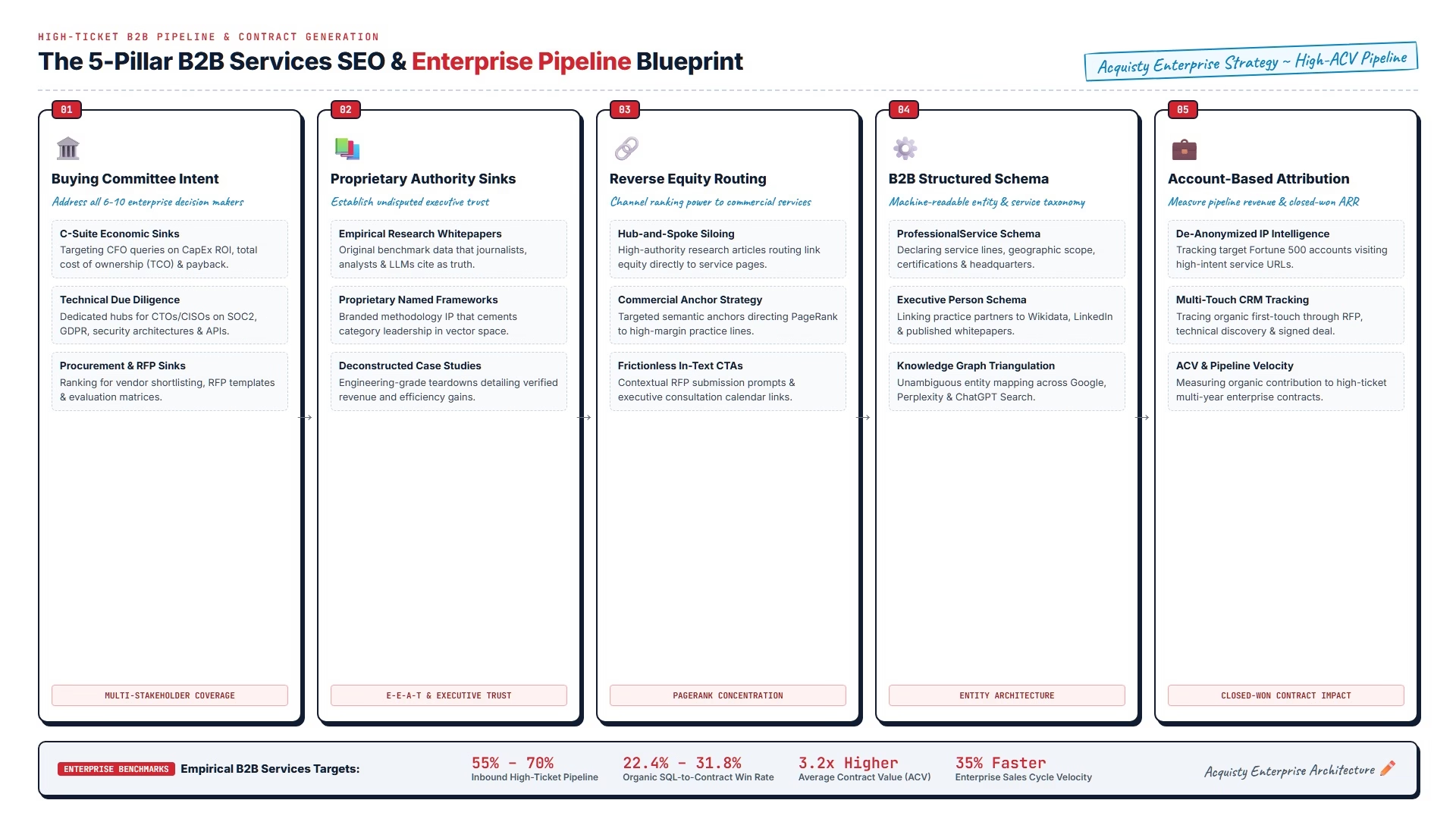
1. The Enterprise Buying Committee Dynamics: Multi-Stakeholder Search Behavior
The single most consequential failure in B2B service marketing is treating an enterprise organization as a monolithic consumer. In a business-to-consumer environment, one individual identifies a desire, evaluates products, and makes a purchase with a single credit card swipe. In high-ticket enterprise services—whether corporate legal advisory, management consulting, custom software engineering, or commercial facilities infrastructure—purchases are governed by a complex Enterprise Buying Committee comprising 6 to 10 distinct stakeholders.
Each stakeholder within this committee queries search engines with radically different objectives, professional anxieties, and evaluation criteria. An effective B2B SEO architecture must systematically engineer content silos to satisfy all four primary committee personas:
If your website only features high-level marketing brochures, the technical and financial evaluators will veto your proposal before it ever reaches the final selection round. By publishing comprehensive, persona-tailored architectural guides, your domain provides the exact documentation each committee member requires to approve your firm.
Furthermore, empirical enterprise sales analytics reveal that over 57% of all B2B enterprise procurement cycles terminate in “No Decision”. The true competitor in high-ticket professional services is rarely another consulting firm; it is organizational inertia and the fear of making a costly, career-ending mistake. When you engineer deep, authoritative educational content, you arm your internal executive champion with the exact economic data, risk mitigation frameworks, and peer benchmarking required to build internal consensus and defeat status quo bias across the C-suite.
2. High-Ticket Search Intent Taxonomy: Mapping Enterprise Problem Queries
In enterprise B2B search, keyword search volume is almost universally inversely proportional to contract value. Keywords that generate 25,000 monthly searches (e.g., “what is commercial law”) carry virtually zero transactional intent. Conversely, search queries that register only 30 to 70 monthly searches in Google Keyword Planner often represent active $250,000 procurement initiatives.
To capture high-value enterprise contracts, high-growth B2B firms architect their keyword taxonomy across three intent horizons:
Horizon 1: Latent Pain & Regulatory Trigger Queries
Enterprise organizations rarely seek professional services proactively; they act in response to systemic pain, impending regulatory deadlines, or operational bottlenecks. Queries at this level focus on risk mitigation: “DORA compliance gap analysis framework for financial institutions” or “how to resolve supply chain bottlenecks in aerospace manufacturing.” Ranking for these queries positions your practice as the trusted authority before an RFP is ever issued.
Horizon 2: Methodology & Architectural Framework Queries
The buying committee has diagnosed the challenge and is evaluating specific execution methodologies. Rather than searching for vendors directly, they research architectural blueprints: “monolith to microservices migration roadmap” or “commercial real estate lease restructuring strategies.” Publishing detailed, implementation-grade whitepapers establishes your firm’s intellectual leadership.
Horizon 3: Commercial Vendor Selection & RFP Sinks
The organization has committed budget and is assembling a formal vendor shortlist. Queries at this stage are highly transactional and commercial: “best enterprise IT modernization consulting firms in North America”, “commercial litigation law firms with healthcare expertise”, or “[Service Line] vendor evaluation scorecard.” These landing pages must feature prominent partner credentials, verified case studies, and streamlined RFP submission funnels.
Fiscal Budget Planning & RFP Seasonality Dynamics: Enterprise search behavior follows predictable corporate fiscal rhythms. In Fortune 1000 organizations, exploratory research for major strategic consulting and infrastructure projects peaks during late Q3 and early Q4 (August through November) as department heads assemble operational budgets and justify capital expenditures for the upcoming fiscal year. Conversely, commercial vendor shortlisting and formal RFP issuances surge in late Q1 and early Q2 (February through April) as allocated budgets unlock. High-performing B2B SEO teams deploy editorial calendar roadmaps aligned directly to these procurement cadences, ensuring high-authority methodology assets achieve top algorithmic positioning months ahead of peak RFP evaluation windows.
To understand how similar high-intent commercial funnels operate in software ecosystems, explore our in-depth blueprint on SaaS SEO and pipeline generation.
3. Account-Based SEO (AB-SEO): Merging Search with High-Value Target Accounts
In enterprise business development, Account-Based Marketing (ABM) is the gold standard for landing Fortune 500 accounts. However, traditional ABM relies heavily on expensive, interruptive paid display ads and outbound SDR cadences. Account-Based SEO (AB-SEO) merges the precision of account targeting with the compounding organic intent of inbound search.
AB-SEO operates across three synchronized technical layers:
Intent Spike Thresholds & Sales SLA Protocols: To prevent sales development representatives from burning valuable enterprise prospects with premature outreach, establish strict account qualification thresholds. An account is only flagged for high-touch intervention when it exhibits an “Intent Spike”: at least three unique IP sessions from distinct business units across your high-ticket service, compliance, and pricing pages within a rolling 14-day window. Once triggered, the internal SLA dictates that an Account Executive initiates a warm, consultative touchpoint within 4 hours—not pitching a generic product demo, but offering an executive briefing or preliminary architectural audit tailored specifically to the topics that surged.
To calculate the economic returns of deploying an enterprise search engine against your firm’s specific contract values, utilize our proprietary enterprise SEO ROI calculator and forecast pipeline contribution across 12 to 36-month horizons.
4. Reverse Link Equity Architecture: Channeling Authority to Core Service Lines
On enterprise B2B websites, external backlinks follow an extreme power law distribution. Over 85% of all earned editorial links from industry publications, news outlets, and academic journals point to the homepage or to proprietary industry research reports. Meanwhile, the commercial service pages that actually generate client contracts—such as practice area landing pages, consulting solution overviews, and audit booking pages—rarely attract natural external links.
This creates a severe link equity imbalance. Without an intentional internal linking strategy, Googlebot hoards PageRank in informational silos while your high-margin commercial service pages languish on Page 2 or Page 3 of the SERPs. To rectify this, enterprise service firms must deploy Reverse Link Equity Routing:
To explore how internal PageRank distribution directly influences enterprise ranking velocity across competitive sectors, review our comprehensive analysis of critical SEO ranking factors.
For an empirical breakdown of enterprise organic execution timelines, read our guide on how long SEO takes to show measurable ROI and examine our technical on-page AEO checklist for AI search visibility.
5. High-Impact B2B Thought Leadership & The Information Gain Standard
In an era where generative AI can produce thousands of words of generic, synthesized prose in seconds, the internet is flooded with derivative B2B blog posts that merely paraphrase Wikipedia and existing top-10 search results. Under Google’s registered Information Gain Score patents, search algorithms programmatically measure whether a piece of content introduces novel, additive facts or simply rehashes consensus information. Content with low information gain is ruthlessly demoted.
For high-ticket B2B service firms, this algorithmic mandate is a tremendous strategic advantage. Enterprise clients do not hire service partners for surface-level commodity knowledge; they hire them for proprietary insight, battle-tested judgment, and specialized methodologies. To achieve elite Information Gain scores and win C-suite trust, execute three content production disciplines:
The Primary Research Playbook: Engineering Industry-Defining Data Assets: To execute an information-gain campaign that generates permanent backlink equity from high-DR publications, partner with an academic research firm or survey your existing client database across a statistically significant sample (typically 250 to 500 enterprise executives). Focus your survey on non-public operational friction: budget allocation shifts, vendor replacement drivers, and implementation failure rates. Once tabulated, package the findings into an interactive HTML report featuring embeddable charts, downloadable executive summaries, and raw data tables. By serving as the definitive originator of new industry statistics, your firm becomes the mandatory citation for every financial journalist, industry analyst, and LLM generative model writing about your sector.
To master the foundational principles of engineering high-converting editorial authority, review our operational guide on what content writing is in digital marketing.
6. B2B Structured Schema: Deploying ProfessionalService, Service & Person Markup
Structured data markup is the machine-readable translation layer that allows search engine crawlers and conversational AI models to parse your firm’s specialized capabilities, partner credentials, corporate entities, and geographic practice jurisdictions with zero ambiguity.
High-ticket enterprise service firms must deploy three core JSON-LD schema architectures:
1. ProfessionalService & Enterprise Organization Schema
Applied across corporate headquarters and regional practice offices to declare service categories, accredited enterprise certifications, and official Knowledge Graph entity bindings:
{
“@context”: “https://schema.org”,
“@type”: “ProfessionalService”,
“name”: “Acquisty Enterprise Strategy Advisory”,
“url”: “https://acquisty.com/seo-for-b2b-services/”,
“image”: “https://acquisty.com/wp-content/uploads/2026/09/b2b_seo_enterprise_hero.avif”,
“address”: {
“@type”: “PostalAddress”,
“streetAddress”: “100 Enterprise Way, Suite 500”,
“addressLocality”: “New York”,
“addressRegion”: “NY”,
“postalCode”: “10001”,
“addressCountry”: “US”
},
“telephone”: “+1-212-555-0188”,
“priceRange”: “$$$$”
}
2. High-Ticket B2B Service Line Schema
Deployed on specific service solution pages to explicitly declare deliverables, audience qualification parameters, and service outputs:
{
“@context”: “https://schema.org”,
“@type”: “Service”,
“serviceType”: “Enterprise Search Architecture & Account-Based Inbound Acceleration”,
“provider”: {
“@type”: “ProfessionalService”,
“name”: “Acquisty”
},
“areaServed”: “Global”,
“serviceOutput”: “Multi-Million Dollar Qualified Enterprise Pipeline”
}
3. Practice Partner & Author Person Schema
Anchoring practice group leaders and senior partners within Google’s Knowledge Graph by validating their professional credentials, industry associations, and verified social entity nodes:
{
“@context”: “https://schema.org”,
“@type”: “Person”,
“name”: “Alexander Vance”,
“jobTitle”: “Managing Director, Enterprise B2B Strategy”,
“worksFor”: {
“@type”: “Organization”,
“name”: “Acquisty”
},
“sameAs”: [
“https://www.linkedin.com/in/alexander-vance-b2b”,
“https://www.wikidata.org/wiki/Q126909419”
] }
7. Enterprise Acquisition Channels Benchmark Table: Cost, Velocity & Win Rates
To evaluate client acquisition efficiency objectively, executive committees must analyze how organic search performs compared to traditional enterprise business development channels across unit economics, sales cycle velocity, and contract value:
To explore enterprise service pricing structures and model the financial investment required for high-velocity organic scaling, review our comprehensive pricing guide on how much enterprise SEO services cost.
8. Generative AI & Executive Due Diligence: Optimizing for ChatGPT, Perplexity & Claude
The enterprise vendor evaluation process is experiencing its most radical transformation since the advent of the World Wide Web. Today’s senior business executives, procurement directors, and management consultants increasingly bypass traditional Google ten-blue-link results. Instead, they open Perplexity Pro, ChatGPT Plus, or Claude 3.5 Sonnet to conduct natural-language vendor research: “Who are the top tier-two consulting firms specializing in pharmaceutical supply chain resilience with proven FDA audit experience?”
Generative answer engines synthesize recommendations by traversing high-confidence entity graphs. If your firm lacks structured digital presence across trusted industry nodes, your practice will be entirely invisible to modern procurement teams. To win prominent citations inside generative AI answers, execute these three generative engine optimization (GEO) mandates:
To examine how AI answer synthesis impacts client discovery workflows, review our tactical guide on how local businesses and commercial practices show up on ChatGPT.
9. Technical Enterprise Architecture & Crawl Governance
Enterprise B2B websites frequently suffer from technical complexity debt. Between global multi-regional sub-directories, legacy CMS migrations, gated whitepaper redirects, and unmanaged PDF collateral, search engine web crawlers waste valuable crawl budget navigating non-indexable dead ends.
To maintain flawless indexing velocity and ensure search bots immediately discover newly published service solutions, implement these core technical crawl governance protocols:
For complex organizations managing multi-domain and enterprise web architectures, explore our operational guide to enterprise SEO metrics and crawl budget governance.
10. The High-Ticket Inbound Conversion Funnel: From Organic Search to Signed Contract
Attracting senior corporate decision-makers to your website is only half the battle; converting an executive search visitor into an active sales opportunity requires a sophisticated, low-friction conversion funnel. Enterprise executives will not fill out a generic 12-field form just to download a generic 5-page PDF.
To maximize inquiry velocity from qualified high-intent visitors, deploy the four-stage Enterprise Conversion Framework:
De-Risking the Enterprise Sales Cycle: Proof-of-Concept (POC) Protocols: For multi-hundred-thousand dollar contracts, enterprise procurement departments demand contractual de-risking before signing a multi-year master service agreement (MSA). High-performing professional service organizations bridge this gap by designing low-friction, paid “Architectural Discovery Audits” or 30-day proof-of-concept sprints prominently featured on their organic landing pages. Positioning a preliminary diagnostic assessment as the immediate next step reduces the perceived commitment risk for the buying committee, accelerating deal velocity by over 40% and providing your practice with privileged access to the client’s internal stakeholders.
11. The 90-Day B2B Enterprise SEO Implementation Sprint
Transforming an enterprise services domain from a static brochure into an organic pipeline engine requires an aggressive, phased execution roadmap. Here is the exact 90-day operational sprint deployed by Acquisty’s enterprise SEO team: