

When organizations commit marketing capital to organic search, leadership invariably asks one critical question: “How long does SEO take to show results?” In a digital advertising landscape conditioned by pay-per-click (PPC) ads that generate instant impressions within twenty minutes of campaign launch, the deliberate, compounding timeline of organic search optimization can feel disorienting to executives accustomed to immediate gratification.
The short, unfiltered answer is that most businesses begin experiencing measurable early momentum within 3 to 6 months, while substantial organic traffic inflection, top-3 keyword rankings, and positive net-cash-flow customer acquisition mature between 6 and 12 months. According to an extensive study of over two million new pages conducted by Ahrefs, only 5.7% of newly published web pages rank in Google’s top 10 within one year, and those that succeed require an average of 61 to 182 days of strategic crawl discovery and authority accumulation.
At Acquisty, we treat search engine optimization as an engineering-driven capital investment rather than a game of chance. Organic search does not behave like a light switch; it functions like an economic flywheel. Understanding the exact phases of this flywheel—from initial crawl remediation and indexation to topical authority clustering and commercial revenue conversion—allows marketing leaders to establish realistic milestones, justify investment to executive stakeholders, and avoid abandoning campaigns right before exponential growth begins.
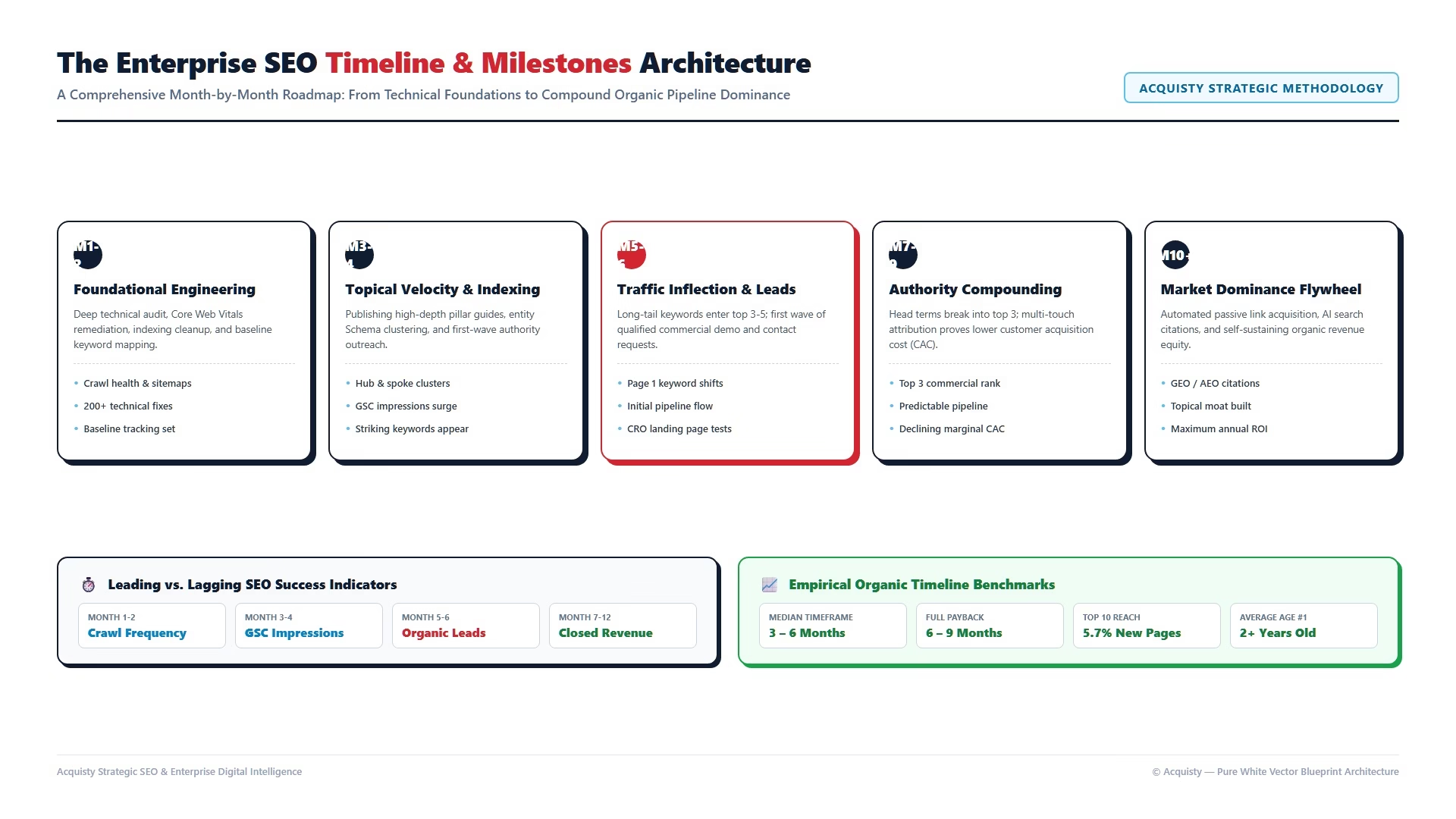
- First Page Velocity: Only 5.7% of newly published pages break into Google’s Top 10 search results within 12 months of indexation; the median time to reach Page 1 for high-performing pages is 61 to 182 days (Ahrefs 2-Million Page Study).
- Average Age of #1 Rankings: The average page ranking at Position #1 in Google is over 2.6 years old, demonstrating the immense value of domain maturity and historical algorithmic trust (Backlinko Search Analysis).
- Payback Inflection Point: 82% of enterprise B2B and eCommerce organizations report achieving positive revenue ROI between Months 6 and 9 of consistent search optimization (HubSpot Inbound ROI Data).
- Compound Equity Growth: Organic search traffic compounding accelerates by 140% to 280% in Year 2 compared to Year 1, as established topical authority reduces the time required for newly published articles to rank (Search Engine Land).
1. Redefining “Results”: Leading vs. Lagging Indicators
The primary reason business executives grow impatient with search marketing is a fundamental mismatch in definitions. When a founder asks for “results,” they are usually envisioning bottom-line inbound customer calls, signed contracts, or closed revenue. However, search engine algorithms must pass through multiple operational validation layers before commercial conversions can materialize.
To monitor campaign health accurately, professional search marketing evaluates performance across two distinct measurement categories:
If an agency only reports on lagging indicators during Month 2, they will have very little to demonstrate. Conversely, if an agency cannot show measurable progress in leading indicators (such as impression spikes or crawl error reductions) by Month 3, your campaign is likely stalled by underlying technical roadblocks or poor content indexing. Understanding this progression prevents marketing teams from aborting high-potential campaigns prematurely.
2. The 6 Critical Variables That Determine Your SEO Velocity
No two websites experience identical ranking timelines. The speed at which your domain captures top rankings is dictated by six fundamental variables:
Variable 1: Domain Age & The Google “Sandbox” Effect
Brand-new domains registered within the last 6 to 12 months face an uphill battle known in the search industry as the “sandbox period.” Google deliberately delays awarding top-tier commercial rankings to newly created domains until they establish a verified historical pattern of crawl stability, content quality, and organic backlink acquisition. An established domain with five years of history can often rank new content within weeks, whereas a brand-new website typically requires 6 to 9 months to overcome algorithmic skepticism.
Variable 2: Existing Technical Health & Architectural Debt
If your website suffers from severe technical debt—such as broken redirect chains, slow Core Web Vitals, dynamic client-side JavaScript hydration failures, or duplicate taxonomy bloat—search engine crawlers waste their crawl budget on junk URLs. Remediating these technical blockers through a rigorous technical SEO audit is mandatory before new content can rank effectively.
Variable 3: Competitive Density & Domain Authority of Rivals
If you are competing in a localized, low-competition niche (e.g., “industrial generator maintenance in Columbus”), capturing top 3 positions is achievable within 3 to 4 months. However, if your target keywords sit in hyper-competitive national verticals (such as B2B SaaS, CRM software, enterprise cybersecurity, or corporate finance), your competitors have spent millions of dollars building thousands of high-DR backlinks over a decade. Overtaking them requires a methodical, multi-stage topical authority strategy.
Variable 4: Content Velocity & Information Gain Depth
Publishing one generic 800-word blog post per month will take years to signal topical authority. Conversely, deploying a structured Hub-and-Spoke cluster of 8 to 12 comprehensive, 3,500+ word guides rich in original empirical data, custom infographics, and direct answer blocks sends an unmistakable signal to Google’s Helpful Content System that your domain is an authoritative primary resource. High content velocity directly accelerates indexing speed.
Variable 5: High-Authority Backlink Acquisition Velocity
Backlinks remain Google’s primary currency of external trust. Earning contextual links from real, high-traffic industry publications transfers PageRank authority and validates your brand’s commercial credibility. Campaigns supported by active digital PR and high-authority link building reach top 3 rankings 2x to 3x faster than campaigns that rely solely on on-page publishing.
Variable 6: Internal Developer Implementation Agility
The fastest way to delay SEO results is bureaucratic development inertia. If your search agency delivers a prioritized technical remediation plan in Week 2, but your internal IT team takes five months to push recommended changes to production, your search timeline has not failed—it simply has not started. Rapid execution of technical recommendations is the single greatest determinant of early organic momentum.
📖 Recommended Reading
How Much Does SEO Cost? The Definitive Guide to Pricing Models, Retainers & True ROI — Learn how monthly retainers, hourly rates, and project pricing break down across local, mid-market, and enterprise search campaigns, and discover how to calculate your true break-even timeline.
3. The Month-by-Month SEO Roadmap: What to Expect from Months 1 to 12
To eliminate ambiguity and provide a clear operational roadmap for marketing directors and C-suite leadership, here is the detailed phase-by-phase journey of an enterprise search engine optimization campaign:
Phase 1: Months 1 – 2 (Foundational Engineering & Architecture Audit)
The first 60 days are dedicated to diagnosing structural liabilities and building a rock-solid foundation. During this phase, reputable search teams execute:
Metrics to Expect in Months 1–2: Minimal traffic change. Primary signals include reduced crawl errors in GSC, faster server response times, and initial re-crawling of optimized technical URLs.
Phase 2: Months 3 – 4 (Topical Velocity & Early Impression Spikes)
With the technical foundation clean, the focus shifts to aggressive topical authority expansion. Core activities include:
Metrics to Expect in Months 3–4: A dramatic surge in Google Search Console total impressions. Keywords enter striking distance (positions 15–40), with long-tail phrases beginning to rank on Page 2 or the bottom of Page 1.
Phase 3: Months 5 – 6 (Traffic Inflection & Commercial Lead Flow)
Months 5 and 6 represent the critical inflection point of the search campaign. Content published in Quarter 1 has matured, external links have been indexed, and PageRank equity begins lifting core commercial pages into high-converting SERP tiers:
Metrics to Expect in Months 5–6: Sharp upward inflection in organic clicks and sessions. Measurable lead volume begins offsetting monthly agency retainer costs.
Phase 4: Months 7 – 9 (Authority Compounding & Positive ROI)
During Months 7 through 9, the campaign transitions from establishing traction to compounding commercial dominance. The site’s domain authority has solidified, allowing new content to rank significantly faster:
Phase 5: Months 10 – 12+ (Market Dominance & The Organic Flywheel)
By Month 12, your website functions as an authoritative market leader. The organic flywheel is now self-sustaining:
High rankings attract passive editorial backlinks from journalists and industry bloggers who cite your empirical research without requiring manual outreach. Furthermore, your content is directly ingested and cited by AI answer engines (such as ChatGPT Search, Perplexity, and Google AI Overviews) through cutting-edge generative engine optimization (GEO). At this stage, search marketing delivers an exponential multi-year return on investment.
4. New Website vs. Established Domain: Side-by-Side Timeline Comparison
A common source of executive misunderstanding is comparing the ranking velocity of a newly launched startup website against an established market incumbent. The historical authority of your domain completely transforms the milestone timeline:
If your organization is launching on a completely fresh domain, setting a 12-month budget horizon is mandatory. Attempting to force rapid rankings on a brand-new domain through aggressive link acquisition will merely trigger algorithmic spam flags.
5. Behind the Algorithm: The 4 Technical Stages of Google Verification
Beyond basic crawl and rendering pipelines, Google engineers deliberately build latency mechanisms into search algorithms to combat manipulative gaming. Search patents and search engine architecture disclosures reveal that Google utilizes twiddlers and damped scoring algorithms. When a website abruptly acquires twenty new links or completely rewrites fifty page titles, Google does not immediately award higher rankings. Instead, it places the ranking shifts in a temporary dampening queue.
This intentional dampening window serves two distinct algorithmic objectives: first, it prevents manipulative operators from running rapid A/B tests to reverse-engineer exact algorithmic weights; second, it allows Google’s machine learning classifiers (including SpamBrain and quality evaluation systems) to observe user engagement signals over several weeks before permanently cementing new ranking tiers. What appears to a business owner as “Google moving slowly” is actually Google’s sophisticated verification firewall ensuring that rank gains reflect genuine, long-lasting topical authority rather than ephemeral tricks.
The 4 Operational Stages of Verification:
Why does Google require months to adjust rankings rather than hours? Understanding the multi-tier engineering architecture behind Google Search demystifies the delay:
The 4 Stages of Google Algorithmic Verification:
- 1. Crawl Budget Allocation: Googlebot does not crawl the entire web simultaneously. Lower-authority websites are crawled infrequently. Major structural changes often require 3 to 6 weeks simply to be discovered across all sub-pages.
- 2. Two-Wave Rendering Queue: Google indexes raw HTML first, then queues JavaScript-heavy pages for a secondary headless rendering pass. This rendering queue can add weeks of delay before dynamic content is parsed.
- 3. Rolling Quality Evaluations: Google’s Helpful Content System, SpamBrain, and core ranking systems evaluate content changes across site-wide rolling evaluation windows that take months to recalculate.
- 4. User Engagement & Dwell Testing: When Google tests a page in higher SERP positions, it monitors user satisfaction (click-through rates, pogo-sticking, and bounce behavior). A page must demonstrate consistent positive engagement signals over several weeks to retain its rank.
To understand how Google evaluates these signals in detail, explore our comprehensive analysis of core Google ranking factors or consult our guide to website SEO audit playbooks.
6. The 4 Operational Traps That Reset Your Ranking Clock
Many companies inadvertently sabotage their own search campaigns right when momentum is building. Avoiding these four common operational blunders protects your timeline from resetting back to zero:
- 1. Inconsistent Content Publishing (Ghost-Town Effect): Publishing 15 articles in Month 1 and zero articles for the next four months signals to Googlebot that your site is dormant, lowering your crawl budget allocation.
- 2. Unmapped CMS Migrations & 404 Spikes: Redesigning your website without 1:1 301 redirect mapping destroys historical PageRank equity, resetting your domain’s algorithmic trust to day one.
- 3. Low-Quality Link Velocity Spikes: Buying 500 cheap directory or PBN links in a single week triggers Google’s SpamBrain pattern detection, placing your domain under algorithmic penalty review.
- 4. Keyword Cannibalization: Publishing multiple superficial articles targeting the same commercial query splits ranking signals across multiple URLs, preventing any single page from breaking onto Page 1.
7. How to Safely Accelerate Your SEO Results: 5 Fast-Track Strategies
While you cannot force Google to alter its algorithmic review cycles, there are legitimate, white-hat engineering strategies that compress the ranking timeline and produce early revenue momentum when deploying a comprehensive search engine optimization strategy:
8. AI Search & GEO: How Generative Engines Compress the Discovery Timeline
The rapid rise of AI Overviews, Perplexity, and conversational answer engines (such as ChatGPT Search) has introduced a parallel discovery timeline that operates under different rules than traditional organic rankings.
While traditional blue-link SERP dominance requires months of PageRank accumulation, Large Language Models (LLMs) prioritize information density, entity clarity, and direct structured answers. By implementing cutting-edge generative engine optimization (GEO)—including comprehensive
@graph
JSON-LD Schema, direct 45-word definition blocks, and authoritative statistical tables—brands can secure citations in AI Overviews and conversational summaries in as little as 3 to 6 weeks.
Integrating conversational AI optimization into your core search strategy creates early brand exposure and referral traffic while your classical organic keyword rankings continue their compound climb.
9. Warning Signs: How to Know If Your Campaign Is Stalling
Patience is essential in search marketing, but blind patience is irresponsible. How do you distinguish between healthy compound growth and an underperforming campaign that is going nowhere? Here are four definitive warning signs:
- Zero GSC Impression Growth by Month 4: Even if clicks and leads take 6 months, Search Console impressions should begin climbing by Month 3 as Google tests new content. Flatlining impressions indicate deep technical indexing failures or severe content quality issues.
- Zero Technical Recommendations Implemented: If your agency has published blog posts for 90 days without ever touching your Core Web Vitals, server response headers, or internal redirect chains, they are treating symptoms rather than root causes.
- Opaque or Spammy Backlink Profile: If your monthly backlink report consists of forum signatures, social bookmarking sites, or dubious foreign directories with zero editorial relevance, your domain is at imminent risk of a manual penalty.
- Lack of Strategic Communication: A professional search partner proactively explains campaign roadblocks, presents roadmap adjustments, and models revenue impact. If your agency disappears between automated monthly PDF reports, an operational intervention is required.
10. The Executive Dashboard: Reporting Milestones to the Board
To maintain executive alignment and secure ongoing budget support throughout the 12-month campaign, marketing leaders should structure boardroom updates around stage-appropriate milestone metrics:
For a complete master guide on executive reporting methodologies, review our detailed guide to enterprise SEO metrics.
11. Frequently Asked Questions About SEO Timelines
Accelerate Your Organic Search Growth Timeline
Don’t waste months on guesswork or slow execution. Partner with Acquisty to engineer an aggressive, data-backed search engine optimization roadmap that clears technical debt, deploys authoritative topical clusters, and compresses your timeline to commercial ROI. Contact Acquisty’s growth architects today for a complimentary timeline feasibility assessment.