

The modern software landscape has reached a defining inflection point. For over a decade, venture-backed enterprise SaaS companies scaled their customer acquisition by pouring millions into performance advertising channels: Google Search Ads, LinkedIn Sponsored Content, and outbound Sales Development Representative (SDR) sequencing. Today, that playbook is broken. Soaring cost-per-click (CPC) rates across high-intent software queries, severe ad-blindness among technical buyers, and deteriorating cold email deliverability have driven customer acquisition costs (CAC) to historic highs. For B2B software founders, CMOs, and growth leaders, relying solely on paid arbitrage is no longer a viable path to capital-efficient scaling.
The answer is not simply “more SEO” in the traditional sense. Conventional search marketing has failed software organizations by obsessing over superficial vanity metrics—monthly organic sessions, blog impressions, and rankings for top-of-funnel informational definitions (e.g., “what is workflow automation”). While these generic guides inflate Google Analytics traffic graphs, they generate virtually zero qualified sales opportunities, enterprise demos, or closed-won Annual Recurring Revenue (ARR). Modern software organizations require a fundamentally different methodology: pipeline-first SaaS SEO.
At Acquisty, our specialized search engine optimization practice and dedicated B2B SaaS SEO agency team engineer programmatic content silos, bottom-of-funnel comparison engines, and revenue attribution frameworks for high-growth software platforms. This master architectural blueprint details the complete system required to transform organic search into your most profitable, predictable, and compounding ARR generation engine.
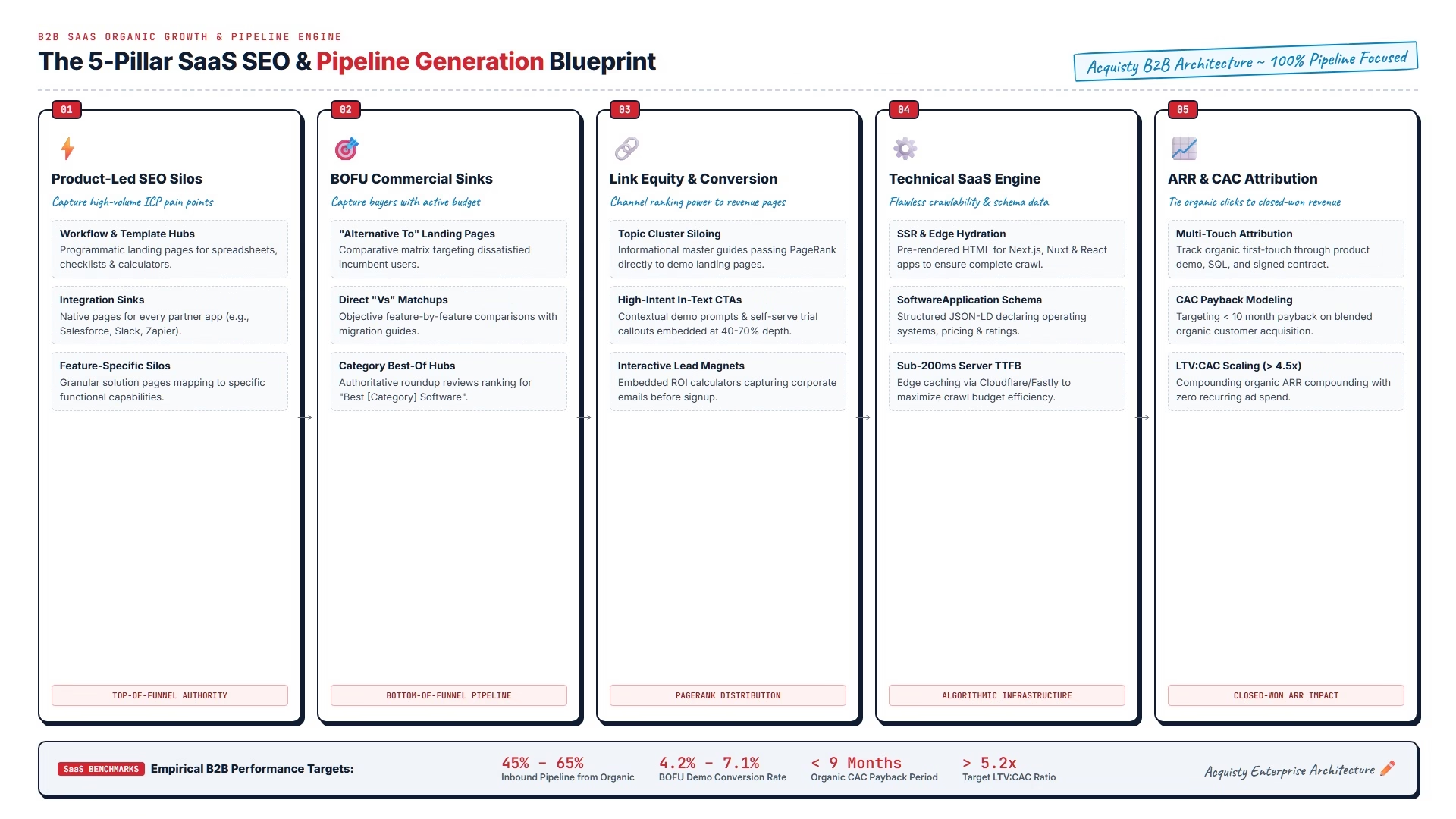
- Inbound ARR Contribution: According to the annual SaaS benchmarking reports by OpenView Partners and KeyBanc Capital Markets, top-quartile B2B software companies generate between 45% and 65% of their total inbound new ARR pipeline through organic search channels.
- CAC Payback Superiority: Organic search delivers a customer acquisition payback period of less than 9 months, compared to 18 to 24+ months for paid performance advertising channels (ProfitWell SaaS Intelligence).
- BOFU Conversion Velocity: Bottom-of-funnel comparison and alternative pages convert visitors into booked product demos and self-serve trials at 4.2% to 7.1%—over 8x higher than top-of-funnel informational blog posts (Forrester B2B Buying Research).
- Cohort Retention & LTV: Enterprise software buyers originating from organic search exhibit a 28% higher Net Revenue Retention (NRR) and a customer lifetime value-to-CAC ratio exceeding 5.2x over a 36-month horizon.
1. The SaaS Organic Growth Dilemma: Why Vanity Traffic Fails B2B Pipeline
Every week, software leadership teams stare at organic traffic dashboards that display impressive upward curves, yet sales pipelines remain bone-dry. The marketing department celebrates achieving 100,000 monthly organic visitors, while the VP of Sales laments that Sales Qualified Leads (SQLs) have missed quarterly targets by 40%. This phenomenon is the SaaS Vanity Traffic Trap, and it stems from a fundamental disconnect between search volume and commercial software purchasing behavior.
Traditional SEO agencies operate on an outdated consumer publishing model: identify keywords with the highest search volume, write 1,500-word superficial overviews, and claim success when the page ranks #1. In enterprise SaaS, however, high-volume keywords are overwhelmingly dominated by casual researchers, university students, and non-commercial searchers. Ranking first for “what is enterprise resource planning” might deliver 50,000 visitors, but not a single CTO with an active $150,000 procurement budget is typing that query into Google.
A pipeline-driven SaaS SEO engine inverts this dynamic entirely. Instead of optimizing for traffic volume, it optimizes for commercial revenue intent and buying committee alignment:
When your SEO strategy prioritizes pipeline velocity over superficial traffic graphs, a software platform with 15,000 highly targeted monthly visitors will consistently generate 5x more closed ARR than a competitor with 300,000 un-monetizable blog readers.
2. Product-Led SEO Architecture: Programmatic Sinks, Templates & Workflows
The fastest-growing software organizations in modern tech history—including Airtable, Canva, Zapier, Miro, and Notion—did not scale their ARR through traditional, manual editorial blogging. They scaled by engineering Product-Led SEO Architectures. Product-Led SEO is the programmatic practice of exposing your software’s core utility, workflows, and integrations directly to search engine crawlers and users through dynamic, templated landing pages.
By productizing search intent, prospective users do not just read an abstract article about solving a problem; they experience your software solving that exact problem within seconds of landing on your domain. Enterprise software platforms must deploy three primary programmatic SEO pillars:
Pillar A: Use-Case & Template Directories
Whether your software serves marketers, financial analysts, or software engineers, users frequently search for pre-built templates to bypass manual work (e.g., “sprint planning template”, “b2b sales commission model spreadsheet”, or “incident response runbook”). Rather than publishing static PDF downloads, create dedicated, indexable template landing pages. Each page provides an interactive, live web preview of the template inside your application, accompanied by a prominent “Use This Template in [App]” button that provisions an instant account.
This programmatic taxonomy captures high-velocity search queries while accelerating self-serve user onboarding with zero friction.
Pillar B: The Integration Ecosystem Engine
Modern software rarely operates in isolation; enterprise buyers evaluate tools based on how seamlessly they integrate into their existing technology stack. If your platform connects with Salesforce, Slack, HubSpot, Snowflake, and Jira, building a programmatic Integration Directory is essential. For every supported tool, generate dedicated landing pages targeting:
To understand how to evaluate the financial return of your organic growth engine and model customer acquisition payback, explore our interactive SaaS SEO ROI calculator and measure how organic ARR compounds over multi-year horizons.
3. Bottom-of-Funnel Commercial Intent Capture: “Vs”, “Alternative To”, and Migration Sinks
If you could only publish 20 URLs on your entire software website, every single one of them should be a Bottom-of-Funnel (BOFU) Commercial Intent Page. These URLs target buyers who have already recognized their core problem, secured departmental budget, assembled a vendor evaluation matrix, and are actively preparing to sign a software contract. In software search, commercial evaluation queries divide into three primary architectural archetypes:
To ensure commercial comparison pages convert at industry-leading benchmarks (4% to 7%+), avoid generic, biased marketing fluff. Modern enterprise buyers see through one-sided comparisons where your product receives green checkmarks across every row while the competitor receives red crosses. Follow the Acquisty Objective Comparison Standard:
- Acknowledge Competitor Strengths: Openly state where the competitor excels (e.g., legacy enterprise compliance, massive partner marketplaces) and clarify your ideal customer profile (e.g., fast-moving agile engineering teams). This intellectual honesty establishes immense credibility with technical evaluators.
- Embed Granular Feature Matrices: Provide granular, feature-by-feature comparisons backed by verified technical documentation, API capabilities, and pricing structure breakdowns.
- Include Verified Customer Review Quotes: Quote verified public reviews from G2, Capterra, or TrustRadius highlighting why customers switched from the competitor to your platform.
- Provide a Frictionless Trial/Demo Onramp: Feature an interactive live demo or interactive sandbox environment directly on the comparison page.
To master the technical fundamentals that power organic visibility, review our comprehensive analysis of how long SEO takes to show results and our engineering guide to the on-page AEO checklist for AI search visibility.
4. SaaS Keyword Taxonomy & Search Intent Mapping
Effective SaaS search engine optimization requires architecting content across three distinct layers of user intent. An enterprise buying committee never moves linearly from a single blog post to an annual enterprise contract. Different stakeholders within the target organization enter the search ecosystem at different stages of the procurement lifecycle.
Here is how high-growth software companies structure their three-tiered keyword taxonomy:
Layer 1: Top-of-Funnel (TOFU) Problem-Centric Intent
Searchers at this stage are experiencing operational friction or workflow bottlenecks, but have not yet categorized software as the necessary remedy. They search for diagnostic advice, procedural benchmarks, or troubleshooting instructions (e.g., “how to reduce customer churn in b2b saas” or “aws cloud cost optimization strategies”).
Strategic Role: Broad brand awareness, domain authority building, newsletter subscriber capture, and retargeting audience expansion. These assets must feature non-intrusive contextual hooks that guide the reader toward deeper solution-oriented assets.
Layer 2: Middle-of-Funnel (MOFU) Solution-Centric Intent
The prospect understands that software is required to resolve their operational bottleneck and is researching specific methodologies, software categories, and technological frameworks (e.g., “automated subscription billing software”, “cloud infrastructure monitoring tools”, or “b2b customer success platform features”).
Strategic Role: Category definition, framework education, and lead capture. This content must clearly demonstrate your product’s architectural point-of-view and feature interactive assets like calculators, templates, and downloadable frameworks.
Layer 3: Bottom-of-Funnel (BOFU) Vendor & Commercial Intent
The prospect is actively preparing to purchase. They search for vendor evaluation grids, pricing tiers, enterprise security certifications, and feature-by-feature comparisons (e.g., “[Competitor] alternatives”, “[Product A] vs [Product B]”, “[Product] enterprise pricing”, and “[Category] software with SOC2 compliance”).
Strategic Role: Direct pipeline conversion. These URLs must be streamlined, frictionless, and laser-focused on securing product demos, trial registrations, and sales conversations.
5. Link Equity Architecture: Channeling PageRank to High-Converting Product Pages
One of the most catastrophic architectural flaws observed across software websites is Internal Link Equity Trapping. In a typical SaaS domain, 80% to 90% of all external backlinks point either to the homepage or to top-of-funnel informational blog posts that naturally attract journalistic citations. Meanwhile, the pages that actually generate revenue—core product feature pages, integration hubs, and BOFU comparison landing pages—receive virtually zero internal link equity.
Without an intentional internal linking hierarchy, search engine crawlers treat your highest-converting commercial pages as low-priority orphan nodes, leaving them stranded on Page 2 or Page 3 of Google’s search results. To eliminate equity trapping, deploy a disciplined Hub-and-Spoke Semantic Silo Architecture:
To explore how internal link equity affects overall search visibility and organic crawl velocity, review our detailed guide to critical SEO ranking factors.
6. SaaS Structured Data: Deploying SoftwareApplication, Product & Pricing Schema
In an era where search engines increasingly rely on entity-based knowledge graphs and Large Language Models synthesize direct product recommendations, deploying structured JSON-LD schema markup is mandatory for SaaS platforms. Structured data translates your software’s functional capabilities, pricing models, verified review ratings, and technical requirements into unambiguous, machine-readable code.
Every enterprise B2B software domain should deploy three primary JSON-LD schema architectures:
1. SoftwareApplication Schema Markup
Applied to software product pages, homepage platforms, and core solution landing pages to declare technical operating systems, application categories, and verified aggregate ratings:
{
“@context”: “https://schema.org”,
“@type”: “SoftwareApplication”,
“name”: “Acquisty Pipeline Intelligence Platform”,
“operatingSystem”: “Web-based, Cloud, SaaS”,
“applicationCategory”: “BusinessApplication”,
“aggregateRating”: {
“@type”: “AggregateRating”,
“ratingValue”: “4.9”,
“reviewCount”: “284”
},
“offers”: {
“@type”: “Offer”,
“price”: “1200.00”,
“priceCurrency”: “USD”,
“priceValidUntil”: “2027-12-31”
}
}
2. Tiered PricingSpecification Schema
Deployed on dedicated SaaS pricing tables to define self-serve tiers, free trial availability, and annual billing discounts for rich search snippets:
{
“@context”: “https://schema.org”,
“@type”: “Product”,
“name”: “Enterprise Growth Tier”,
“description”: “Comprehensive B2B organic pipeline acceleration with dedicated account management and real-time CRM attribution.”,
“offers”: {
“@type”: “UnitPriceSpecification”,
“price”: “2500.00”,
“priceCurrency”: “USD”,
“unitCode”: “MON”,
“billingIncrement”: “P1M”
}
}
3. Organization & Wikidata Entity Schema
Anchoring your software platform within Google’s Knowledge Graph by linking your official corporate identity, executive leadership, Crunchbase profile, and authoritative G2/Gartner software taxonomy nodes:
{
“@context”: “https://schema.org”,
“@type”: “Organization”,
“name”: “Acquisty”,
“url”: “https://acquisty.com/”,
“logo”: “https://acquisty.com/wp-content/uploads/2024/logo.png”,
“sameAs”: [
“https://www.linkedin.com/company/acquisty”,
“https://www.crunchbase.com/organization/acquisty”
] }
7. SaaS Unit Economics & Organic Attribution: CAC Payback, LTV:CAC & Net Retention
The true power of an organic search engine lies in its profound impact on enterprise software unit economics. In venture capital and private equity governance, software valuations are heavily dictated by capital efficiency metrics: CAC Payback Period, LTV:CAC Ratio, and the Rule of 40 (the principle that a healthy SaaS company’s growth rate plus free cash flow margin should exceed 40%).
When software organizations rely entirely on paid search advertising, CAC increases linearly with revenue targets. If you spend $200 per demo on Google Ads and stop spending, your inbound demo pipeline drops to zero immediately. In contrast, high-performing organic SEO behaves as an operational capital expenditure (CapEx) that compounds: every master guide, product comparison, and template library built today continues delivering qualified demos 12, 24, and 36 months into the future with zero incremental ad spend.
To calculate how organic pipeline acceleration impacts your unit economics, evaluate three foundational financial formulas:
To run live financial modeling across your software’s specific economics, utilize our free suite of growth calculators, including the SaaS CAC:LTV Ratio calculator, the SaaS Rule of 40 calculator, and our Net Churn & NRR calculator.
8. Acquisition Channel Performance Matrix: Organic SEO vs. Paid Channels
To help growth marketing leaders and executive boards allocate acquisition budgets objectively, the following empirical comparison matrix contrasts Organic Pipeline SEO against Paid Search (Google Ads), Paid Social (LinkedIn Ads), and Outbound SDR Cold Outreach across five critical software unit economics criteria:
For a broader perspective on budget planning, evaluate our industry benchmarks on how much enterprise SEO services cost across different contract architectures.
9. AI Search Optimization (GEO/AEO) for Software: ChatGPT, Perplexity & Claude Visibility
The software evaluation journey is undergoing a seismic paradigm shift driven by generative AI models. Today’s software engineers, IT architects, and enterprise procurement officers are bypassing traditional Google SERP lists and asking conversational AI engines complex, multi-variable queries: “What is the best SOC2-compliant product analytics tool that integrates with Snowflake and supports sub-second SQL queries?” or “Compare Datadog vs Dynatrace for Kubernetes container monitoring.”
To ensure your software is actively synthesized, recommended, and cited as the premier vendor in ChatGPT Search, Perplexity Pro, Google AI Overviews, and Claude, your SEO architecture must execute three generative engine optimization (GEO) mandates:
To explore how local and regional commercial businesses win prominent recommendations inside generative AI platforms, review our practical guide to how local businesses show up on ChatGPT.
10. Technical SEO for JavaScript Frameworks: Next.js, Nuxt & Headless CMS
Modern software websites are rarely constructed on monolithic legacy CMS platforms. Engineering teams overwhelmingly favor modern JavaScript frameworks—React, Next.js, Nuxt.js, Vue, or SvelteKit—paired with headless CMS architectures (Contentful, Sanity, Strapi). While these frameworks offer exceptional developer velocity and interactive UI capabilities, they introduce severe technical SEO vulnerabilities if client-side rendering (CSR) is improperly configured.
When web pages rely entirely on client-side JavaScript execution, Googlebot’s Web Rendering Service (WRS) encounters a “two-wave indexing” bottleneck. The initial crawler parses an empty HTML shell, deferring the rendering of your content until compute resources become available. In fast-moving SaaS environments, this delay can cause newly deployed product landing pages or comparison guides to remain un-indexed for weeks.
To ensure 100% indexing velocity and zero rendering latency, execute these technical software SEO protocols:
For enterprise technology platforms managing complex multi-domain architectures, explore our detailed operational framework for enterprise SEO metrics and crawl governance.
11. The SaaS Organic Pipeline Playbook: 90-Day Implementation Roadmap
Transforming an enterprise software domain from a stagnant blog into a high-velocity organic pipeline machine requires a disciplined, multi-phase engineering sprint. Rather than attempting to publish dozens of generic articles at once, execute this 90-day sequential operational roadmap:
To understand how high-impact content writing integrates with broader technical search strategies, review our foundational guide on what content writing is in digital marketing.