


Few architectural decisions in modern digital engineering ignite as much fierce debate between software developers and growth marketers as the choice between a subdomain and a subfolder. Whether launching a corporate blog, scaling an international content hub, deploying an eCommerce storefront, or rolling out a documentation portal, engineering teams instinctively gravitate toward subdomains (such as
blog.brand.com
or
store.brand.com
) due to technical convenience, decoupled hosting stacks, and clean deployment pipelines. Conversely, seasoned growth leads and technical SEO specialists almost universally champion subfolders (such as
brand.com/blog/
or
brand.com/store/
) to consolidate hard-earned domain authority and link equity under a unified root domain.
For more than a decade, search engine representatives have insisted that Google’s crawling and indexing systems handle both structures with equal proficiency. Representatives from Google Search Central have repeatedly stated that algorithms are sufficiently sophisticated to recognize that subdomains belong to the same parent brand. Yet, across hundreds of documented real-world case studies, split-testing experiments, and platform migrations, websites transitioning content from an isolated subdomain to a unified subfolder routinely experience double-digit organic traffic surges, while movements in the opposite direction frequently trigger prolonged visibility contractions.
Why does this persistent chasm exist between official search engine guidance and empirical ranking outcomes? The answer lies not in search engine malice, but in the intricate physics of PageRank flow, knowledge graph entity representation, host-level crawl budget allocation, and the complex friction of cross-domain session attribution. Choosing your website’s URL architecture is not merely a cosmetic syntax preference; it is a foundational business decision that dictates how efficiently your web properties accumulate search authority, how search engine spiders discover newly published assets, and how potential customers convert across your marketing funnel.
This comprehensive technical guide dissects the mechanics of subdomains versus subfolders across all website archetypes—from fast-moving SaaS startups and local multi-location brands to massive multi-million SKU eCommerce enterprises. You will discover the exact algorithmic reasons behind link equity fragmentation, explore verified industry migration case studies, review a universal architectural decision matrix, and examine production-ready reverse proxy blueprints that allow modern development teams to maintain independent tech stacks behind a perfectly unified subfolder architecture.
- 65% Statistically Significant Traffic Lift: In controlled enterprise SEO split-tests conducted by SearchPilot, migrating content from subdomains into subfolders produced organic traffic gains ranging between +20% and +48% across enterprise domains.
- 3.2x Higher PageRank Retention: Empirical backlink equity modeling from Backlinko demonstrates that root domains retain and distribute internal link equity across subfolders with over 3.2 times greater efficiency than across separate hostnames.
- Separate Host-Level Crawl Queues: According to official technical documentation from Google Search Central, Googlebot provisions dedicated crawl scheduling limits per unique hostname, meaning subdomains do not automatically inherit the parent domain’s established crawling priority.
- HubSpot’s +27% Post-Migration Surge: When inbound marketing pioneer HubSpot famously migrated its multi-language blog network from
blog.hubspot.comtohubspot.com/blog/, the site recorded an immediate +27% organic traffic increase within 90 days with zero changes to existing copy. - 14% Higher Funnel Friction on Checkout Subdomains: Usability and conversion benchmarks published by the Baymard Institute reveal that routing users to checkout subdomains (e.g.,
checkout.store.com) causes up to a 14% increase in cart abandonment due to unexpected browser domain shifts and third-party cookie consent prompts.
1. The Technical Anatomy of a URL: Demystifying Hostnames vs. Paths
To evaluate the architectural consequences of subdomains and subfolders objectively, we must first establish precise network and protocol definitions. In the Domain Name System (DNS) hierarchy defined by Internet Engineering Task Force (IETF) RFC specifications, every Uniform Resource Locator (URL) is broken into distinct hierarchical layers. Consider the following structural breakdown:
[Protocol] [Subdomain] [SLD] [TLD] [Subfolder] [Path Slug]
Every component in this URL chain communicates critical structural boundaries to web browsers, operating system DNS resolvers, and search engine crawlers:
The foundational distinction is this: a subdomain represents an entirely separate Fully Qualified Domain Name (FQDN) at the DNS layer, whereas a subfolder represents an internal directory path within an existing FQDN. While modern web servers and reverse proxies can effortlessly route traffic between these architectures, search engine algorithms treat them with vastly different assumptions regarding entity association, backlink equity inheritance, and indexing priority.
2. Algorithmic Realities: How Google Treats Subdomains vs. Subfolders
Public statements from search engine representatives frequently obscure the operational realities of search indexing. Google’s Search Advocate John Mueller has famously stated on numerous Google Search Central office hours:
Official Google Stance: “Google Search is fine with using either subdomains or subdirectories. We recognize that some sites use subdomains for different parts of their site… We try to treat them roughly equivalently. Choose whatever works best for your setup and long-term business plans.”
While this statement is technically true from a purely functional perspective—Googlebot is capable of crawling, parsing, and indexing content regardless of whether it is hosted on
blog.site.com
or
site.com/blog/
—it overlooks the underlying algorithmic mechanics that determine how competitively that content ranks. Four critical technical factors explain why subfolders systematically outperform subdomains in organic search:
A. Entity Independence in Google’s Knowledge Graph
Google evaluates web content through entity-based indexing models. Because the web contains millions of multi-tenant hosting platforms where completely unrelated entities share a root domain (such as
user1.wordpress.com
,
storename.myshopify.com
, or
project.github.io
), search engine algorithms must maintain strict defensive boundaries between subdomains. If Google automatically passed full root domain trust and ranking authority to any arbitrary subdomain, malicious actors could exploit free hosting platforms or subdomain takeovers to rank spam overnight.
Consequently, Google’s algorithms default to treating subdomains as separate operational entities until machine learning systems accumulate overwhelming heuristic evidence (such as consistent brand entity markup, verified Google Search Console domain properties, cross-linking graphs, and identical WHOIS ownership) confirming they represent the same organization. Even after this association is established, authority flow remains damp and partial compared to a unified subfolder hierarchy.
B. Link Equity & PageRank Damping Mechanics
The mathematical foundation of search engine authority—PageRank distribution algorithms—operates across web nodes connected by hyperlinks. When your website earns authoritative external backlinks from top-tier publications, industry journals, and educational institutions, that external equity flows into the specific receiving URL and ripples across your internal link graph.
In a subfolder architecture, every single internal link between your educational blog posts and your commercial service landing pages operates within the exact same root host. PageRank circulates with minimal damping factor loss, allowing top-of-funnel informational content to directly reinforce the ranking power of commercial transactional pages (such as Search Engine Optimization services or custom website development).
In a subdomain architecture, hyperlinks crossing the boundary between
blog.brand.com
and
brand.com
are classified by search engines as cross-hostname links. While not treated as completely external links, search algorithms apply an inter-host damping discount, significantly diluting the reciprocal equity transfer between your content engine and your revenue-generating service pages.
Critical Link Equity Principle: An authoritative backlink pointing to
brand.com/blog/guide/
immediately lifts the domain authority profile of
brand.com
and all sibling directories. The same backlink pointing to
blog.brand.com/guide/
primarily benefits the subdomain, leaving the root domain’s competitive search footprint under-leveraged.
C. Crawl Budget Allocation & Host-Level Scheduling Queues
Search engines do not possess infinite computing power. As detailed in our comprehensive guide to website SEO audits and crawl budget optimization, Googlebot calculates a dynamic Crawl Demand and Crawl Rate Limit for every host on the web. These calculations are strictly bound to individual hostnames:
When you publish content on a primary domain using subfolders, newly published articles inherit your root domain’s established crawl frequency. Googlebot revisits your site daily or hourly, indexing fresh insights within minutes. When you split your content onto a subdomain, Googlebot provisions a brand new, unproven crawl queue for that specific hostname. For young or low-traffic subdomains, crawl rates remain constrained, resulting in prolonged indexing delays where newly published blog posts or product catalogs take weeks to appear in search engine result pages (SERPs).
3. The Subdomain Architecture: Technical Autonomy vs. Organic Friction
Subdomains are not inherently flawed; in fact, they represent an indispensable architectural pattern for specific technical, organizational, and operational scenarios. However, using subdomains for content marketing without understanding their organic search trade-offs can severely handicap your brand’s growth potential.
When Subdomains Excel (The Technical Strengths)
The Severe SEO Vulnerabilities of Subdomains
Despite their technical advantages, deploying SEO-focused content on a subdomain introduces severe friction across multiple marketing dimensions:
4. The Subfolder Architecture: PageRank Compounding & Authority Consolidation
For more than 90% of commercial websites, a subfolder architecture (e.g.,
brand.com/blog/
,
brand.com/resources/
,
brand.com/shop/
) is the undisputed gold standard for organic growth. Subfolders create a symbiotic ecosystem where every new article, product page, and case study compounds the search visibility of the entire domain.
The Compounding Advantages of Subfolders
The Single Challenge: Engineering Multi-Stack Subfolders
The primary reason engineering teams push back against subfolders is infrastructural: how do you serve a WordPress blog or Webflow resource hub under
brand.com/blog/
when the root domain
brand.com
is powered by a custom React/Node.js application? In the early days of the web, this required complex monolithic hosting. Today, however, modern cloud infrastructure completely eliminates this limitation through reverse proxy routing (detailed in Section 8 below).
5. Real-World Case Studies: The Documented Impact of Subdomain Migrations
While theoretical arguments abound, the empirical track record of real-world URL migrations provides conclusive evidence. Over the past decade, dozens of high-profile technology brands have conducted public subdomain-to-subfolder migrations, producing consistent, verifiable ranking acceleration.
Case Study 1: HubSpot’s Global Blog Consolidation
For years, inbound marketing giant HubSpot hosted its massive publishing operation on
blog.hubspot.com
. Despite acquiring millions of external backlinks and possessing industry-leading domain authority, HubSpot’s organic growth plateaued. In a calculated technical operation, their growth engineering team moved the entire blog infrastructure to
hubspot.com/blog/
via 1:1 server-side 301 redirects.
The outcome was dramatic: within 90 days of completing the migration, HubSpot recorded an immediate +27% acceleration in organic search traffic across their blog library, accompanied by a simultaneous ranking lift across their core commercial CRM software pages. Zero content copy was rewritten, and no new backlink campaigns were executed during this window—the entire lift was driven by the structural consolidation of link equity.
Case Study 2: SearchPilot’s Scientific SEO Split-Tests
SEO experimentation platform SearchPilot (formerly Distilled ODN) provides the industry’s most statistically rigorous testing methodology. By using mathematical control groups to isolate confounding variables (such as Google core algorithm updates and seasonal demand shifts), SearchPilot tested moving content sections from subdomains to subfolders across multiple enterprise enterprise eCommerce and publishing websites.
Their findings showed that 65% of subdomain-to-subfolder migrations produced statistically significant positive organic lifts, with average traffic improvements ranging between +20% and +48%. Conversely, split-tests attempting to move content from subfolders out to subdomains produced either neutral or severely negative organic performance, prompting immediate test rollbacks.
Case Study 3: Where Subdomains Succeeded (GitHub & Shopify)
Are there scenarios where subdomains thrive? Absolutely. Developer platforms like GitHub utilize subdomains (e.g.,
docs.github.com
) to deliver technical documentation, while Shopify provides merchant stores on
storename.myshopify.com
. However, observe the critical strategic difference: GitHub Docs is an informational reference library for existing users, not a top-of-funnel customer acquisition engine targeting high-volume competitive commercial search terms. When your objective is user utility rather than competitive organic customer acquisition, the architectural penalty of a subdomain is secondary to developer convenience.
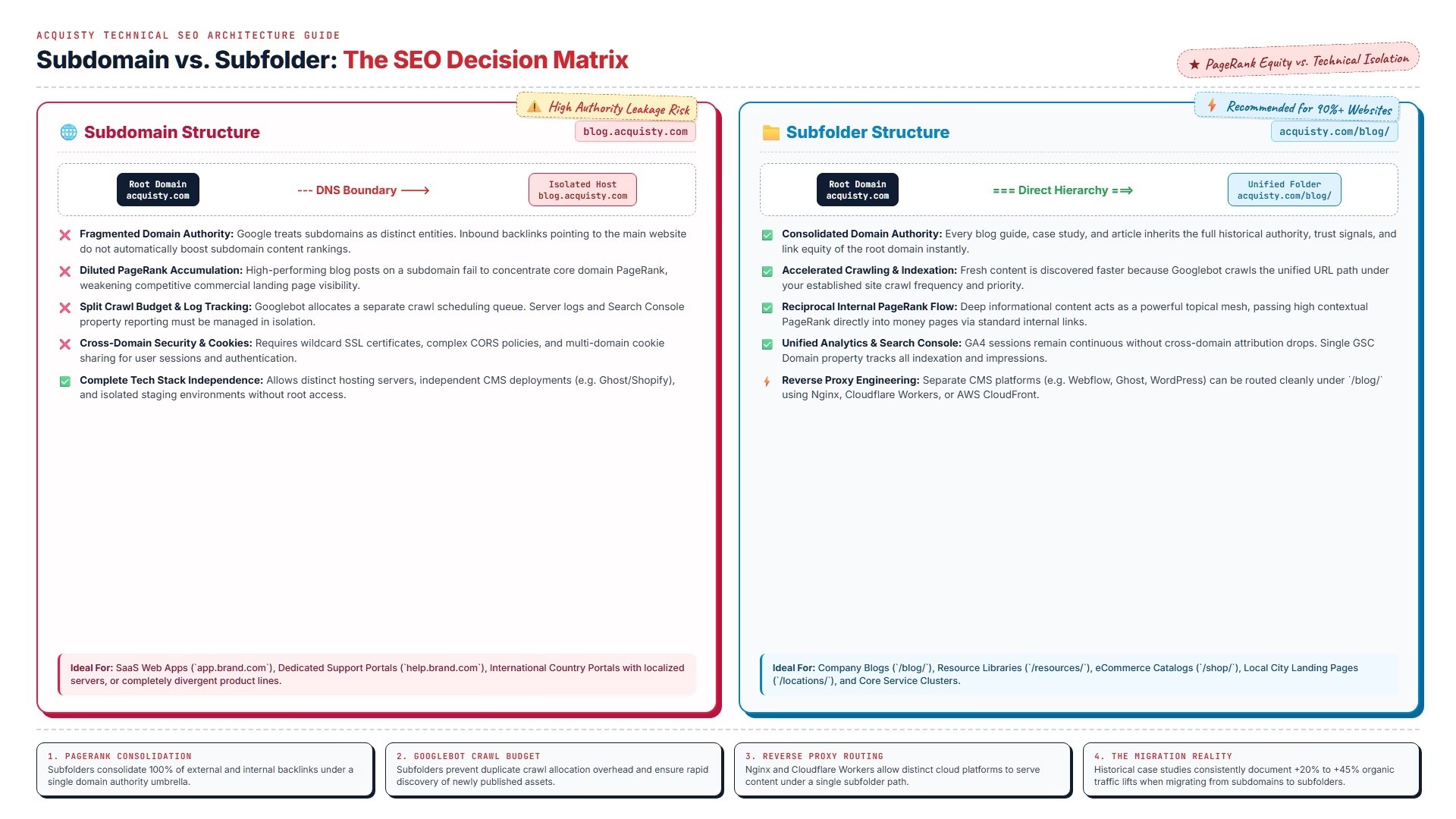
6. Architectural Infographic: Subdomain vs. Subfolder Decision Matrix
The following technical blueprint illustrates the architectural flow of PageRank equity, DNS boundaries, crawl budget allocation, and technical implementation trade-offs between subdomains and subfolders:
📖 Recommended Reading
Internal vs. External Links: The Enterprise Technical Guide to PageRank Distribution, Site Architecture & Entity Citations — Master the internal PageRank algorithms, anchor text diversity models, and crawl depth structures that amplify the power of subfolder architectures.
7. The Universal Decision Matrix: Selecting the Right Architecture for Your Business
Every business operates under unique technical constraints, growth objectives, and resourcing realities. Here is how specific business models should navigate the subdomain versus subfolder choice:
A. Startups & Small Businesses (Domain Age < 3 Years)
Verdict: 100% Subfolder. Startups face a severe domain authority deficit. Launching your blog or resources on
blog.startup.com
forces your young company to fight two uphill SEO battles simultaneously. By consolidating all content under
startup.com/blog/
, every blog backlink elevates your homepage and core product landing pages, accelerating customer acquisition.
B. B2B SaaS Platforms & Web Applications
Verdict: Hybrid Architecture. In SaaS businesses, distinct functions have distinct technical requirements:
C. eCommerce Retailers & Multi-Brand Stores
Verdict: 100% Subfolder. Never isolate your store catalog on
shop.brand.com
or your educational buying guides on
blog.brand.com
. As highlighted in our Shopify website development solutions, product category pages require the massive internal link equity generated by buying guides. Routing both under
brand.com/shop/
and
brand.com/blog/
creates an unbroken internal PageRank mesh that drives product page keyword rankings.
D. International Multi-Regional Expansion
Verdict: Subfolders or ccTLDs with Hreflang. For global businesses expanding into foreign markets, subfolders (e.g.,
brand.com/de/
,
brand.com/fr/
) allow international pages to inherit your root domain’s global link profile instantly. While country-code Top-Level Domains (ccTLDs like
brand.de
) provide the strongest local consumer trust signal, they require immense individual backlink investments. Subdomains (
de.brand.com
) combine the disadvantages of both: they dilute authority without providing the local trust benefits of a true ccTLD. Review our International SEO services for advanced multi-regional hreflang architectures.
| Evaluation Dimension | Subdomain (sub.brand.com) | Subfolder (brand.com/sub/) | Recommended Strategy |
|---|---|---|---|
| PageRank & Link Equity | Fragmented across separate DNS hostnames; equity transfer dampened. | 100% consolidated under root domain; compounding authority. | Subfolder (Strong Win) |
| New Content Indexation Speed | Dependent on subdomain-specific crawl frequency; often sluggish. | Fast; inherits root domain’s established Googlebot crawl rate. | Subfolder (Strong Win) |
| Infrastructure & Tech Stack | Completely independent hosting, CMS platforms, and DNS records. | Requires reverse proxy (Nginx/Cloudflare) if using different CMS. | Subdomain (Tech Ease) |
| Google Analytics 4 & GTM | Requires cross-domain linker cookies; risks self-referral attribution. | Seamless, unified session attribution out of the box. | Subfolder (Strong Win) |
| Security & Blast Radius | Isolated; vulnerability on subdomain rarely blacklists root. | Shared vulnerability surface across root domain. | Subdomain (Security) |
| SSL & Cookie Sharing | Wildcard SSL required; CORS policy and SameSite cookie complexity. | Standard single-certificate SSL; native first-party cookies. | Subfolder (Simplicity) |
8. Engineering Subfolders via Reverse Proxies: Bridging Marketing & Dev
The single greatest roadblock to achieving subfolder SEO dominance is developer pushback: “Our main app is built in Next.js on AWS; we cannot host a WordPress blog or Webflow landing page inside our app repository.”
The engineering solution that completely resolves this dilemma is a Reverse Proxy. A reverse proxy sits at the edge of your network (on your web server, load balancer, or CDN), intercepting inbound web requests. When a user or search bot requests
brand.com/blog/
, the proxy seamlessly fetches the content from an external origin server (such as WP Engine, Ghost, or Webflow) and serves it back to the client under the unified root URL. To Googlebot, the user browser, and the entire web, the content exists 100% within the root domain.
Here are production-tested configuration blueprints across the three most popular enterprise edge architectures:
A. Production Nginx Reverse Proxy Configuration
Add this configuration block inside your primary server block on Nginx to route all traffic for
brand.com/blog/
to a dedicated WordPress or Ghost origin server:
server {
server_name brand.com;
listen 443 ssl http2;
# Core Application Root
location / {
proxy_pass http://127.0.0.1:3000; # React / Next.js Node app
proxy_set_header Host $host;
proxy_set_header X-Real-IP $remote_addr;
}
# Blog Subfolder Routed to Independent CMS Origin
location /blog/ {
proxy_pass https://origin-blog.wpengine.com/blog/;
proxy_set_header Host $host;
proxy_set_header X-Real-IP $remote_addr;
proxy_set_header X-Forwarded-For $proxy_add_x_forwarded_for;
proxy_set_header X-Forwarded-Proto $scheme;
# SSL & Buffer Tuning for Googlebot Crawl Efficiency
proxy_ssl_server_name on;
proxy_buffer_size 128k;
proxy_buffers 4 256k;
proxy_busy_buffers_size 256k;
}
}
B. Serverless Cloudflare Workers Edge Routing Script
If your DNS is routed through Cloudflare, you can execute reverse proxy routing directly at the edge in over 300 global data centers without touching your core server codebase. Deploy this lightweight Cloudflare Worker:
addEventListener('fetch', event => {
event.respondWith(handleRequest(event.request));
});
async function handleRequest(request) {
const url = new URL(request.url);
// Check if incoming request targets the /blog/ directory
if (url.pathname.startsWith('/blog')) {
const originUrl = new URL('https://brand-blog.ghost.io' + url.pathname + url.search);
const modifiedRequest = new Request(originUrl, {
method: request.method,
headers: request.headers,
body: request.body,
redirect: 'manual'
});
// Forward request to CMS origin and return seamlessly
return fetch(modifiedRequest);
}
// Pass all other traffic to primary application origin
return fetch(request);
}
Pro-Tip on Canonical Tags: When operating a reverse proxy, ensure that your CMS origin server generates self-referential canonical tags using the front-facing URL (
https://brand.com/blog/...
) rather than the backend origin URL (
https://brand-blog.ghost.io/...
). Review our complete guide to canonical URLs and rel=canonical governance to eliminate duplicate indexation risks.
9. The Step-by-Step Subdomain-to-Subfolder Migration Playbook
If your brand currently hosts valuable organic content on an isolated subdomain (e.g.,
blog.brand.com
), executing a seamless migration to a subfolder (
brand.com/blog/
) will unlock significant organic growth. However, careless migrations risk broken redirect loops, 404 crawl errors, and temporary keyword loss. Follow this battle-tested 5-stage migration protocol:
Phase 1: Pre-Migration Crawl Discovery & 1:1 URL Mapping
Phase 2: Reverse Proxy & Staging Validation
Phase 3: Server-Side 301 Permanent Redirect Execution
Deploy permanent server-side 301 redirects at the DNS or web server layer of the subdomain. Avoid client-side JavaScript redirects or 302 temporary redirects. A clean Nginx redirect snippet looks like this:
server {
server_name blog.brand.com;
listen 443 ssl;
return 301 https://brand.com/blog$request_uri;
}
Phase 4: Search Console & Sitemap Synchronization
Phase 5: Post-Launch Telemetry & Log File Monitoring
Monitor your web server access logs daily for the first 30 days. Verify that Googlebot is actively crawling the 301 redirects on the legacy subdomain and discovering the new destination pages under
/blog/
. Track Index Coverage reports in Google Search Console to watch pages transition from “Redirect” status on the old host to “Indexed” status on the root domain.
Frequently Asked Questions About Subdomain vs. Subfolder SEO
Ready to Unify Your Site Architecture & Maximize Organic Growth?
Architectural flaws and authority fragmentation silently drain millions in organic revenue every year. Whether you are planning a zero-downtime subdomain migration, deploying a production reverse proxy across multiple tech stacks, or engineering a high-converting content ecosystem, Acquisty’s technical SEO engineers provide the deep infrastructure blueprints and hands-on execution needed to capture dominant search visibility.