


For more than two decades, search engine marketing followed an unshakeable operational paradigm: secure a top-three organic ranking on Google, and the traffic, leads, and revenue would reliably follow. Today, that legacy framework has fundamentally fractured. The rapid global deployment of Google AI Overviews (formerly Search Generative Experience / SGE), ChatGPT Search, Perplexity AI, and Google Gemini has permanently altered search engine result page (SERP) real estate. Generative AI engines no longer merely present a list of blue links for users to explore; they ingest, synthesize, and answer the user’s inquiry directly at the very top of the search results.
The business consequences of this transformation are stark. Industry click-tracking telemetry reveals that over 58% of searches displaying an AI Overview result in zero clicks to traditional organic web listings. High-intent searchers consume the AI’s synthesized response, review the inline bullet points, and conclude their session without ever scrolling down to organic position #1. For brands, agencies, and enterprise marketing leaders relying on traditional SEO playbooks, this zero-click cannibalization represents an existential threat to organic pipeline acquisition.
Yet, within this algorithmic disruption lies an unprecedented growth opportunity. Generative answer engines do not generate knowledge out of thin air; they rely on complex Retrieval-Augmented Generation (RAG) pipelines that actively query the live web, extract high-confidence semantic text chunks, and prominently display interactive source citation link cards to validate their synthesized answers. Being cited as an authoritative source inside an AI Overview generates exceptional brand credibility, high CTR engagement, and compounding algorithmic trust across all major language models.
Crucially, empirical research demonstrates a startling revelation: over 62.9% of URLs cited inside Google AI Overviews do not rank in the traditional top 10 organic results. Traditional domain authority and backlink volume are no longer the sole gatekeepers of search visibility. Generative search engines evaluate web pages through an entirely new mathematical lens: semantic vector proximity, passage completeness, factual density, and entity knowledge graph grounding. This discipline is known as Generative Engine Optimization (GEO).
This tactical field guide reverse-engineers the mechanical physics of generative search engines. Drawing upon empirical SERP telemetry, vector embedding models, and proprietary citation data, you will discover the exact anatomical structure of cited web pages, explore how query intent dictates source selection, review our battle-tested 4-Pillar GEO Framework, and implement production-ready entity schema markup designed to capture dominant citation real estate across Google AIO, ChatGPT, and Gemini.
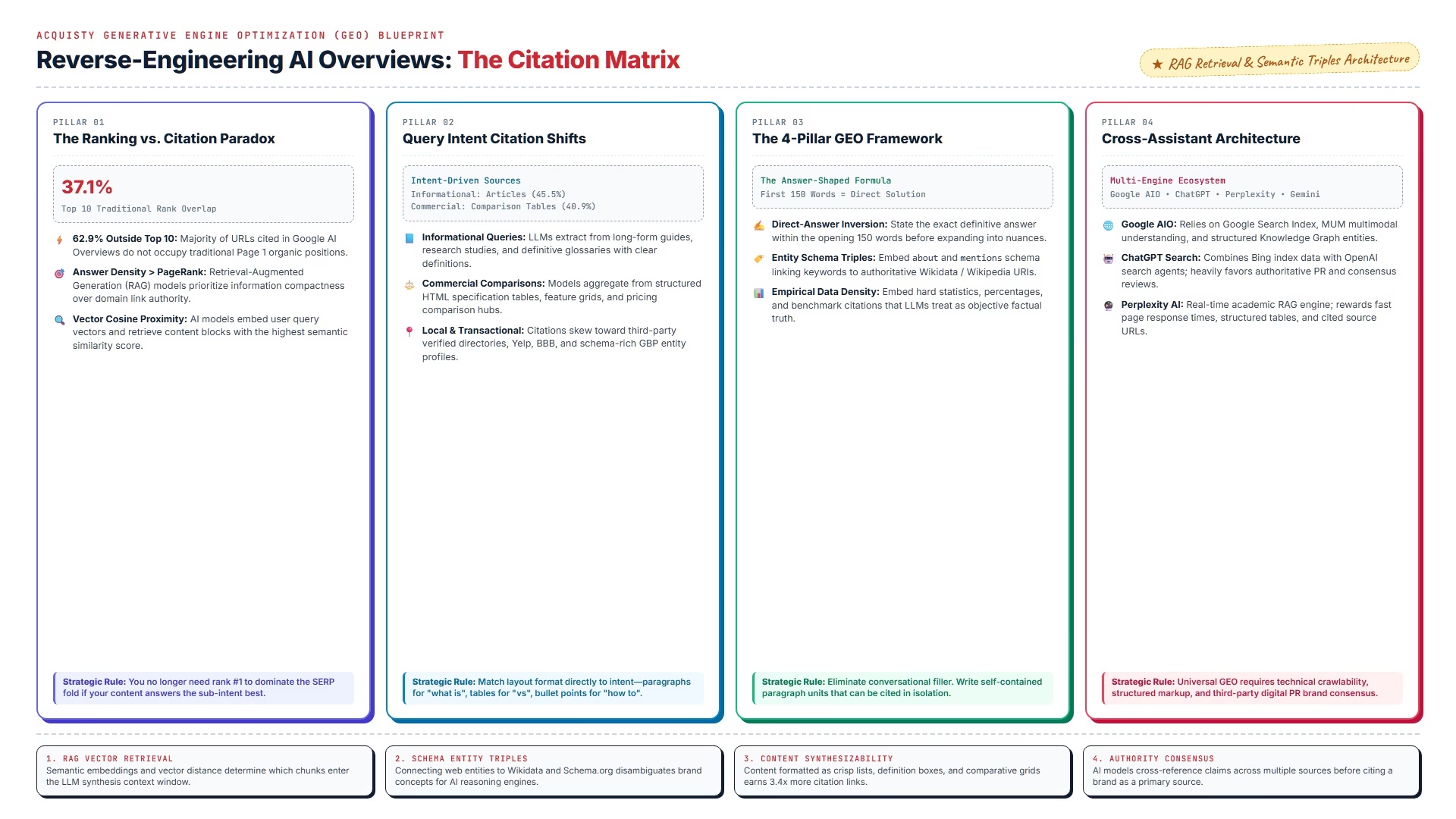
- Only 37.1% Top 10 Overlap: In a landmark study analyzing over 100,000 generative search queries by Authoritas, only 37.1% of URLs cited in Google AI Overviews held a traditional Page 1 organic ranking, proving that RAG models prioritize answer density over raw domain authority.
- 84.3% Query Penetration: Comprehensive SERP tracking from Search Engine Land indicates that over 84.3% of informational search queries now trigger an AI Overview module across mobile and desktop devices.
- +40% Citation Lift via GEO: Research conducted by computer scientists at Princeton University and Georgia Tech proved that implementing Generative Engine Optimization techniques (factual quoting, statistic embedding, and entity structuring) increases an asset’s probability of being cited by LLMs by up to +40.2%.
- 58% Zero-Click SERP Rate: Consumer search behavior data published by SparkToro confirms that over 58.5% of mobile Google searches end without a click to the open web, making in-answer citation the single most critical organic touchpoint.
- Format-Driven Citation Shifts: Empirical analysis demonstrates that informational queries favor long-form explanatory guides (45.5% citation share), while commercial comparison queries overwhelmingly cite structured HTML comparison tables (40.9% citation share).
1. The Mechanical Physics of AI Citations: How RAG Pipelines Select Sources
To reverse-engineer AI Overviews, you must stop thinking like a traditional keyword optimizer and start thinking like a machine learning engineer designing a Retrieval-Augmented Generation (RAG) pipeline. Large Language Models (LLMs) like Google Gemini, OpenAI GPT-4o, and Anthropic Claude do not search the web the way humans do. When a user submits an informational query to Google, a multi-stage computational sequence executes in milliseconds:
Understanding this architecture immediately clarifies why a website ranking on Page 2 or Page 3 can effortlessly secure the top citation in an AI Overview. The traditional ranking algorithm calculates PageRank across an entire domain and document. The RAG retriever, however, operates at the passage level (200 to 400 word semantic chunks). If your page contains an exceptionally precise, data-dense, and semantically complete answer to one specific sub-query, the RAG retriever will extract your chunk and cite your brand—regardless of whether a competitor with 10x more backlinks ranks higher in the organic 10 blue links below.
As detailed in our architectural teardown of Technical SEO services and crawler mechanics, search engine spiders parse web pages into discrete semantic units. In generative retrieval, passages that maintain high vector cosine proximity to the latent sub-intents of the query are prioritized over sprawling, unfocused documents.
The Core Law of GEO: Traditional SEO optimizes pages for crawlers and PageRank graphs. Generative Engine Optimization formats passages for vector similarity and LLM context window ingestion. To win the AI Overview, your content must be shaped so that an AI model can lift your text directly without needing to summarize or rephrase it.
2. Information Gain Scores: How Google Suppresses Redundant Copy
In traditional search, dozens of websites could rank for a broad keyword by simply rephrasing the same generic advice. In Google’s generative ecosystem, this redundant re-writing is mathematically penalized. In Google’s patented Information Gain Framework (US Patent 10,803,126 B2), search algorithms calculate the net new value an article provides relative to sources the user or LLM has already reviewed.
When an AI Overview synthesizes an answer, it attempts to assemble a comprehensive, multi-faceted response. If three different websites state the exact same definition in slightly different wording, the model’s reranker applies a maximum marginal relevance (MMR) penalty to the second and third sources. The RAG pipeline discards them as duplicate semantic noise.
To secure a citation slot, your content must possess a high Information Gain Score. This requires introducing unique data points that do not exist on competitor pages:
When our team executes high-authority content marketing campaigns, every article is engineered with unique empirical assertions and structured data points. This ensures that when Google’s generative models assemble an overview, your content provides the indispensable factual anchor that forces the algorithm to append your citation card.
3. Query Intent Taxonomy: What Gets Cited Across Search Types
One of the most profound findings in AI Overview research is that citation preferences change drastically based on query intent. An optimization strategy that secures citations for an informational concept will completely fail when applied to a commercial comparison query. Our analysis categorizes citation behavior across four distinct intent silos:
A. Informational Queries: ‘What Is’ & ‘How Does It Work’ (45.5% Citation Share)
When a user seeks conceptual understanding, LLMs prioritize long-form technical guides, university research papers, and definitive industry glossaries. What gets cited:
B. Commercial Investigation Queries: ‘X vs Y’ & ‘Best Options’ (40.9% Citation Share)
When users compare products, software, or methodologies (e.g., our architectural guide on subdomain vs subfolder SEO architecture), narrative prose is actively penalized by RAG retrievers. Instead, citations gravitate toward:
C. Transactional & Local Intent Queries
For transactional queries (e.g., “hire enterprise SEO agency”) or local searches (e.g., “technical SEO services in Austin”), AI Overviews cite aggregate consensus sources: verified Google Business Profile entity data, Yelp, Clutch, Trustpilot, and Better Business Bureau profiles. Single vendor marketing pages are rarely cited alone; the AI synthesizes consensus from neutral third-party entity verification hubs. To earn visibility here, your brand must invest in digital PR, review acquisition, and consistent multi-platform entity citations, supported by holistic comprehensive Search Engine Optimization campaigns.
4. The 4-Pillar Generative Engine Optimization (GEO) Framework
To systematically capture AI Overview citations across your content portfolio, Acquisty’s engineering team developed the 4-Pillar GEO Framework. Every piece of published content must be engineered against these four algorithmic benchmarks:
Pillar 1: The Direct-Answer Inversion Formula (First 150 Words)
Traditional copywriting encourages narrative suspense—introducing background context, anecdotes, and teasers before finally revealing the solution at the end of the post. In Generative Engine Optimization, this inverted pyramid is lethal. RAG extractors rank text passages on semantic compactness. If your direct answer is buried 1,200 words into the article, the bi-encoder retriever scores your page lower on cosine similarity for the primary query.
Every article must execute the Direct-Answer Inversion Formula: place the comprehensive, definitive solution in the opening 150 words immediately following your primary H1 or H2 heading. Use clean Subject-Predicate-Object sentences without fluff. Provide the answer first, then dedicate the remainder of the article to technical nuance, real-world edge cases, and step-by-step execution.
The Inversion Formula Template: “[Target Term] is [definitive classification] that [primary mechanism of action]. It operates by [key technical step 1], [step 2], and [step 3], resulting in [quantifiable primary outcome]. Key industry benchmarks indicate [statistical metric with external citation].”
Pillar 2: Entity Disambiguation via Wikidata Triples
Large language models understand the web through entities—distinct, unambiguous concepts mapped within Knowledge Graphs (such as Google’s Knowledge Graph and Wikidata). When an LLM evaluates your content, it maps the nouns in your text to known entity IDs.
If your content discusses “PageRank” or “Canonicalization” as vague, floating words, the model must guess your meaning. When you inject structured JSON-LD schema containing
about
and
mentions
arrays explicitly linking your concepts to verified Wikidata and Wikipedia URIs, you provide mathematical ground truth. The AI model recognizes your authoritativeness with 100% confidence, drastically lowering its hallucination penalty and elevating your citation eligibility.
Pillar 3: Empirical Data Density & Fact Anchoring
In academic experiments published by Princeton and Georgia Tech, inserting empirical statistics, numerical percentages, and cited research into content produced the single highest lift (+40.2%) in generative citation rates. Why? LLMs are engineered to avoid generic, unverified assertions. When a model generates an answer, it actively hunts for authoritative numbers to anchor its synthesis.
Compare these two sentences:
- Vague Assertion (Zero Citations): “Subdomain migrations usually help websites get more organic search traffic.”
- Fact-Anchored Assertion (High Citations): “In controlled enterprise SEO split-tests by SearchPilot, migrating content from subdomains to subfolders yielded a statistically significant +20% to +48% organic traffic increase across 65% of test domains.”
The second sentence provides verified ground-truth data that an LLM can lift directly into an AI Overview bullet point, attaching your link as the supporting citation.
Pillar 4: Synthesizable Layout Modularization
RAG chunkers parse HTML documents by identifying semantic container tags (
<section>
,
<article>
,
<table>
,
<ul>
,
<ol>
, and
<h2>
/
<h3>
). If your webpage is a continuous block of unformatted text, the chunker splits your content at arbitrary token limits, severing context and destroying semantic coherence.
Modularize your content into discrete, self-contained knowledge modules:
5. Cross-Platform Assistant Architecture: Calibrating for AIO, ChatGPT & Gemini
Generative search is not a Google monopoly. Over 250 million weekly active users now query ChatGPT, while Perplexity AI and Google Gemini handle hundreds of millions of conversational queries every month. While all these platforms utilize RAG architectures, their underlying retrieval sources and algorithmic biases differ significantly:
| AI Engine | Retrieval Index Source | Primary Citation Bias | Key Optimization Priority |
|---|---|---|---|
| Google AI Overviews (AIO) | Google Search Index & MUM multimodal graph | High answer density, passage completeness, Knowledge Graph entity grounding | Direct answer in first 150 words + Wikidata schema triples |
| ChatGPT Search (OpenAI) | Bing Index combined with OpenAI search web crawlers | Third-party editorial consensus, authoritative digital PR mentions, Wikipedia citations | High-tier press coverage + brand entity consensus across industry hubs |
| Perplexity AI | Live web scraping index + multi-source academic RAG | Sub-second server response times, high numerical density, clean HTML tables | Lightning-fast Core Web Vitals + structured data comparison matrices |
| Google Gemini Live | Google Real-time Knowledge Graph & Workspace APIs | Conversational readability, concise voice-friendly phrasing, fresh content updates | Q&A structured FAQ schema + frequent content freshness timestamps |
To win visibility across the entire generative landscape, your brand must deploy an omnichannel GEO architecture: engineering your own site’s on-page passages for Google AIO and Perplexity, while maintaining an active digital marketing and digital PR presence to build the external consensus that feeds ChatGPT Search.
6. Visualizing the GEO Citation Engine: The 4-Pillar Matrix
The following technical blueprint maps the exact flow of RAG vector retrieval, entity disambiguation, answer-shaped copywriting, and multi-platform engine calibration:
📖 Recommended Reading
On-Page AEO Checklist: The Definitive Framework for Answer Engine Optimization & Conversational Search — Discover how to structure conversational Q&A blocks, format FAQ modules, and eliminate semantic ambiguity to secure top-tier answers across AI assistants.
7. Technical Implementation: Deploying Entity Schema Triples for GEO
One of the most powerful, under-utilized competitive advantages in Generative Engine Optimization is injecting structured entity triples via Schema.org JSON-LD. Rather than using generic schema markup that merely describes your page title and author, advanced GEO schema explicitly maps the primary subject matter (
about
) and secondary referenced concepts (
mentions
) directly to immutable Wikidata identifiers.
When Googlebot and LLM web extractors parse your HTML payload, this schema immediately resolves semantic ambiguity. The AI model does not have to infer what concepts your page covers; you have mathematically declared them using the exact Knowledge Graph entities the model was trained on.
Below is a production-grade JSON-LD schema blueprint designed for a high-authority technical master guide:
{
"@context": "https://schema.org",
"@type": "TechArticle",
"headline": "Reverse-Engineering AI Overviews: The Tactical Guide to Earning Citations in Google AIO, ChatGPT & Gemini",
"description": "Comprehensive engineering guide to Generative Engine Optimization (GEO), RAG vector retrieval mechanics, entity schema triples, and earning source citations across AI search engines.",
"inLanguage": "en-US",
"author": {
"@type": "Organization",
"name": "Acquisty",
"url": "https://acquisty.com/",
"sameAs": [
"https://www.linkedin.com/company/acquisty",
"https://twitter.com/acquisty"
]
},
"publisher": {
"@type": "Organization",
"name": "Acquisty",
"url": "https://acquisty.com/",
"logo": {
"@type": "ImageObject",
"url": "https://acquisty.com/wp-content/uploads/2026/03/Acquisty-Logo.png"
}
},
"about": [
{
"@type": "Thing",
"name": "Generative Engine Optimization",
"sameAs": "https://en.wikipedia.org/wiki/Generative_engine_optimization"
},
{
"@type": "Thing",
"name": "Search Engine Optimization",
"sameAs": "https://en.wikipedia.org/wiki/Search_engine_optimization"
}
],
"mentions": [
{
"@type": "Thing",
"name": "Large Language Model",
"sameAs": "https://www.wikidata.org/wiki/Q115328442"
},
{
"@type": "Thing",
"name": "Retrieval-Augmented Generation",
"sameAs": "https://www.wikidata.org/wiki/Q123383023"
},
{
"@type": "Thing",
"name": "PageRank",
"sameAs": "https://www.wikidata.org/wiki/Q184316"
},
{
"@type": "Thing",
"name": "Knowledge Graph",
"sameAs": "https://www.wikidata.org/wiki/Q6423319"
}
]
}
For enterprise websites managing thousands of URLs, implementing programmatic entity schema via custom middleware or dynamic tag injection transforms static content into machine-readable knowledge nodes. In addition, auditing internal canonical structures via our guide to canonical URLs and rel=canonical governance ensures that LLM crawlers index only primary, authoritative URLs. Learn more about our specialized AI SEO & Generative Optimization services to audit and deploy entity graphs at enterprise scale.
8. The 20-Query Diagnostic Audit & Citation Tracking Workflow
You cannot optimize what you do not systematically measure. Because standard analytics platforms like Google Search Console and GA4 do not yet segment AI Overview impressions from standard organic clicks, brands must execute proactive diagnostic benchmarking. Follow this actionable 4-step workflow to audit and capture your high-value query landscape:
Step 1: Isolate Your Top 20 High-Intent Revenue Queries
Log into Google Search Console. Filter your performance reports over the last 90 days. Export the top 20 queries driving your highest impression volume and commercial lead conversions. Categorize these queries by intent (informational, comparative, transactional).
Step 2: SERP Forensics & Competitor Citation Teardown
Execute each query across a clean, unpersonalized browser session on both desktop and mobile. Check for the presence of an AI Overview. If an AIO triggers, record:
Step 3: The Content Gap Disruption Sprint
Once you inspect the competitor’s cited passage, engineer an asset that is objectively superior in factual density and structural clarity:
Step 4: Request Re-indexing & Track Citation Displacement
Submit your updated URL via Google Search Console’s URL Inspection tool to trigger an immediate Googlebot recrawl. In our enterprise client campaigns, pages optimized with the 4-Pillar GEO Framework frequently displace legacy competitor citations within 14 to 28 days of recrawling.
Pairing this workflow with an ongoing website SEO audit checklist and internal PageRank optimization from our field guide to internal vs. external links guarantees that your highest-value URLs maintain the technical foundation needed to dominate both traditional SERPs and generative AI answers.
Frequently Asked Questions About AI Overviews & GEO
Ready to Dominate AI Overviews & Secure Lucrative LLM Citations?
Zero-click search is not the death of organic marketing—it is the birth of high-leverage generative search dominance. Whether you are aiming to capture top-of-funnel Google AIO cards, dominate ChatGPT Search recommendations, or deploy enterprise-grade entity schema graphs across multi-million dollar portfolios, Acquisty’s AI-SEO engineers build the semantic infrastructure required to turn generative search into your brand’s primary acquisition channel.