


The global financial technology sector is confronting a brutal economic reckoning: the collapse of venture-subsidized user acquisition and the skyrocketing inflation of paid performance marketing. For the past decade, venture-backed neobanks, automated robo-advisors, cryptocurrency exchanges, Buy Now Pay Later (BNPL) platforms, and B2B payment gateways purchased growth at any cost. Armed with cheap institutional capital, FinTech startups inundated Meta, Google Ads, and TikTok with high-bounty referral campaigns. Today, that customer acquisition playbook is completely broken.
Customer Acquisition Cost (CAC) across financial services has exploded by more than 85% over the past three years. Bidding auctions on competitive commercial keywords—such as “best business checking account with high APY”, “automated wealth management api”, or “low fee cross-border payment gateway”—routinely demand between $45 and $160 per single click. For consumer neobanks operating on thin debit interchange margins, spending $250 to acquire a depositor who maintains an average balance of only $1,200 yields an unsustainable CAC payback period exceeding 36 to 48 months. In B2B FinTech, enterprise customer churn outpaces payback if sales pipelines rely solely on paid auction clicks.
Simultaneously, the modern financial consumer and corporate CFO evaluate digital money solutions with rigorous scrutiny. Entrusting capital, payroll disbursement, or corporate treasury to a software platform represents the ultimate consumer and corporate trust commitment. Because financial missteps produce life-altering insolvency or corporate catastrophe, search engines categorize FinTech under Google’s most unforgiving algorithmic standard: Your Money or Your Life (YMYL). Every page, calculator, comparison matrix, and financial claim is evaluated under strict Experience, Expertise, Authoritativeness, and Trustworthiness (E-E-A-T) criteria: verified fiduciary credentials, active regulatory disclosures (SEC, FINRA, FDIC, CFPB), and clear editorial independence.
At Acquisty, our enterprise search engine optimization engineering division and dedicated fintech SEO architecture practice engineer sovereign user acquisition engines for digital banks, wealth platforms, payment infrastructure providers, and InsurTech leaders. This master guide delivers the technical, structural, and regulatory blueprint required to disintermediate paid ad monopolies, compress blended CAC, deploy structured financial schema, and build multi-billion-dollar organic deposit and transaction pipelines.
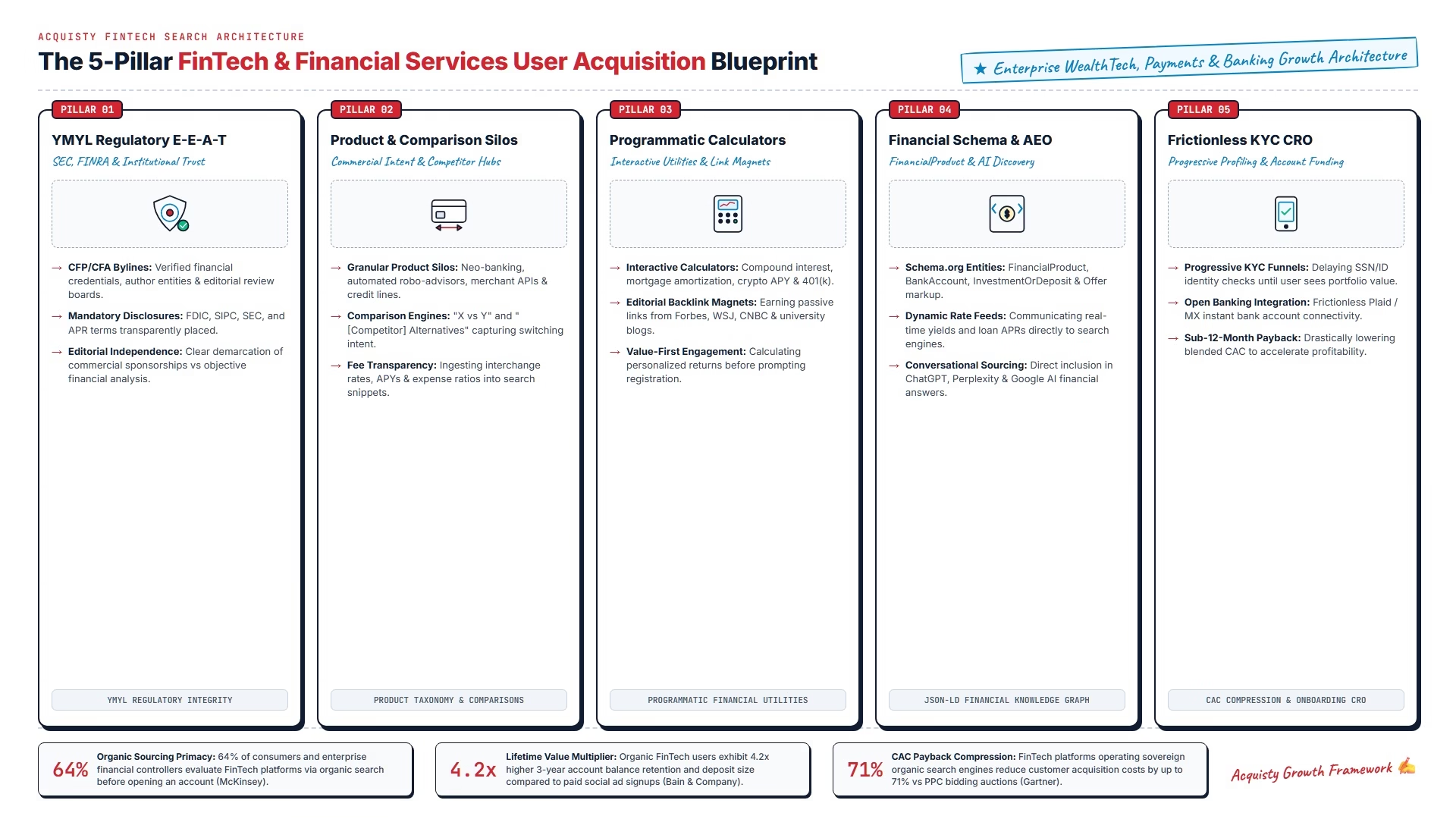
- Digital Search Primacy in Banking: Definitive financial consumer research published by McKinsey & Company reveals that over 64% of digital banking depositors and commercial treasury managers initiate their platform discovery via non-brand organic search queries before opening a deposit account.
- Deposit Retention & Lifetime Value Multiplier: Comprehensive banking loyalty benchmarking from Bain & Company demonstrates that users acquired through educational organic search funnels exhibit 4.2x higher 3-year deposit retention and maintain 62% higher average balances than users acquired via incentivized social media ad campaigns.
- CAC Compression & Capital Efficiency: Enterprise FinTech marketing studies conducted by Gartner confirm that financial technology brands operating proprietary organic search content ecosystems achieve an average 71% reduction in blended CAC, compressing customer payback periods from 22 months down to under 7 months.
- Programmatic Calculator Conversion Lift: Financial platforms deploying interactive, crawlable financial utilities (e.g., mortgage amortization, high-yield savings APY calculators) capture 3.8x more verified account applications than static brochure landing pages while earning high-authority editorial backlinks naturally.
1. The Economics of FinTech Search: Breaking Free from the Paid CAC Treadmill
The venture capital playbook of the 2010s taught FinTech founders that hyper-growth was purely a function of paid media spend. By pouring millions into Google Ads auctions and affiliate comparison aggregators (NerdWallet, Bankrate, Credit Karma), platforms acquired hundreds of thousands of registered accounts. However, this growth was fundamentally hollow. In financial technology, user acquisition without organic retention is an economic trap.
Relying exclusively on paid channels introduces four fatal vulnerabilities to a FinTech balance sheet:
- Rampant Auction Inflation: As well-capitalized legacy banks (JPMorgan Chase, Capital One) and aggressive FinTech unicorns compete for identical keywords (e.g., “best high yield savings account”), auction prices escalate continuously. Clicks that cost $12 in 2018 now surpass $65, rendering paid unit economics deeply negative for all but the largest institutions.
- Incentive-Seeker Churn & Account Dormancy: Users acquired via $200 cash signup bonuses or high-bounty affiliate promotions are mercenary depositors. As soon as the bonus clears or a rival platform offers a promotional 10 basis-point higher APY, the user transfers their capital out, leaving the FinTech company with an inactive account and unrecovered CAC.
- Affiliate Aggregator Dependency: Platforms paying 30% to 50% revenue share or $250+ CPA payouts to financial affiliate directories surrender their profit margins. Worse, aggregators can demote or delist your platform overnight if a competitor negotiates a higher bounty.
- Zero Compounding Digital Equity: When paid advertising spend stops, user acquisition drops to absolute zero immediately. An organic search infrastructure, by contrast, is an appreciating capital asset that delivers high-intent depositors 24/7 at an amortized marginal cost approaching zero.
Building an enterprise FinTech SEO architecture solves this crisis by capturing self-directed consumers, business owners, and corporate finance directors at the exact moment they are researching financial solutions. Organic users arrive with inherent intent, exhibit higher lifetime deposits, and generate the durable margin profile required for institutional profitability.
2. YMYL Regulatory Compliance & Fiduciary E-E-A-T: Satisfying Financial Search Algorithms
Google’s Search Quality Rater Guidelines categorize personal finance, investing, taxation, loans, and banking under the most stringent classification possible: Your Money or Your Life (YMYL). Because inaccurate financial information can lead to severe personal debt, tax penalties, or total loss of retirement savings, Google’s algorithmic updates (including core quality updates and helpful content classifiers) systematically penalize financial websites that exhibit questionable author credentials, missing disclosures, or promotional bias.
To earn and maintain top-tier rankings in competitive financial search landscapes, FinTech platforms must construct an unassailable Fiduciary E-E-A-T Architecture:
- Credentialed Author Entities & Editorial Review Boards: Financial articles must not be published anonymously or under generic “Editorial Team” bylines. Every piece of financial content must feature a verified human author possessing recognized industry credentials: Certified Financial Planner (CFP®), Chartered Financial Analyst (CFA®), Certified Public Accountant (CPA), or licensed attorney (JD). In addition, financial guides should declare an independent “Reviewed by [Credentials]” secondary byline with timestamps indicating the latest regulatory audit date.
- Mandatory Federal Regulatory Disclosures: Search quality raters and algorithmic parsers actively verify compliance disclosures. In the United States, pages discussing banking must transparently state partner bank relationships: “Banking services provided by [Partner Bank], Member FDIC. Deposits are FDIC-insured up to $250,000.” Investment pages must state SEC registration and SIPC protection limits; lending pages must declare exact Annual Percentage Rate (APR) ranges, origination fees, and Truth in Lending Act (TILA) notices.
- Uncompromising Editorial Independence: When reviewing financial products, comparing interest rates, or evaluating competitor solutions, content must demonstrate objective analytical rigor. Google penalizes financial sites that present paid sponsor products as “the best” without balanced scrutiny of fees, withdrawal penalties, and account minimums.
- Verifiable Primary Source Citations: Financial claims, inflation metrics, and tax brackets must link directly to primary government and regulatory repositories: the Federal Reserve (FRED), the Internal Revenue Service (IRS), the Securities and Exchange Commission (SEC), and the Consumer Financial Protection Bureau (CFPB).
To understand how search algorithms balance entity validation, author credentials, and domain trust across competitive YMYL sectors, explore our study on critical SEO ranking factors. To examine foundational content writing standards across enterprise sectors, review our guide on what content writing is in digital marketing.
3. High-Intent Financial Product & Comparison Silos: Capturing Switching Demand
High-net-worth investors, small business owners, and corporate finance controllers do not type general informational questions when they are ready to move capital. They search with sharp, comparative intent: evaluating fee structures, API latency, integration ecosystems, and platform reliability.
To capture high-intent depositors and enterprise software buyers, FinTech websites must construct a three-tiered Product & Comparison Silo Architecture:
- Tier 1: Core Financial Capability Silos: Granular, standalone landing hubs for distinct financial capabilities:
-
/banking/high-yield-treasury-management/ -
/payments/global-cross-border-settlement-api/ -
/investing/automated-tax-loss-harvesting-accounts/ -
/lending/non-dilutive-saas-revenue-financing/
Every capability hub must feature transparent fee schedules, developer documentation links, security encryption protocols (SOC 2 Type II, ISO 27001), and interactive feature checklists.
-
- Tier 2: Programmatic “X vs Y” Comparison Matrices: FinTech consumers actively compare platforms before linking their bank accounts (e.g., “Ramp vs Brex”, “Stripe vs Adyen”, “Wealthfront vs Betterment”). Building objective, balanced head-to-head comparison pages with comprehensive side-by-side parameter matrices captures users at the final 10% of their evaluation journey.
- Tier 3: The “[Competitor] Alternatives” Switching Silos: When a competitor raises transaction fees, suffers an embarrassing platform outage, or tightens lending criteria, frustrated users flock to search engines typing “best alternatives to [Competitor]”. Maintaining dedicated, authoritative alternative landing pages complete with migration checklists and switch-over bonus incentives captures high-value depositors actively looking to re-allocate funds.
Structuring comparison silos requires deep architectural discipline to prevent duplicate content signals across similar product matrices. To explore how SaaS and FinTech leaders build durable customer pipelines, review our guide on B2B SaaS SEO and pipeline growth.
4. Programmatic Financial Calculators: Interactive Utilities as Acquisition & Link Magnets
In financial search, interactive utility beats static editorial prose every single time. A user searching for “how much will my 401(k) grow in 30 years” does not want to read an academic essay on compound interest formula theory; they want an intuitive, responsive calculator where they can adjust sliders for initial principal, monthly contribution, and expected annual return, seeing immediate graphical projections.
Deploying programmatic financial calculator hubs serves two decisive commercial functions:
- High-Volume Organic Lead Capture: Financial calculation queries command millions of monthly searches (e.g., mortgage amortization, high-yield savings interest, crypto staking APY, auto loan refinancing). By providing an instant, ungated JavaScript calculator, you deliver immediate value. Below the dynamic results chart, present a personalized, one-click transition: “Earn $1,420 more per year by switching your checking balance to our 5.10% APY Treasury Account. Open account in 3 minutes →”.
- Passive Editorial Backlink Flywheels: Financial journalists at Tier-1 media outlets (The Wall Street Journal, CNBC, Forbes, Bloomberg, Business Insider) constantly require interactive calculators to link as reference resources for their readership. An authoritative, beautifully designed financial calculator page naturally accumulates hundreds of high-DR, natural editorial backlinks without requiring aggressive outbound pitching.
- Server-Side vs Client-Side Rendering Balance: While calculator calculations execute in client-side JavaScript, the surrounding explanation, mathematical formula documentation, and dynamic default scenario tables must be Server-Side Rendered (SSR) to ensure search engine crawlers index complete topical content on the initial crawl pass.
Monitoring technical crawl budgets across large-scale programmatic calculator networks requires enterprise log file telemetry. For operational guidance, explore our analysis of enterprise SEO metrics and crawl governance.
5. Financial Structured Data: Deploying FinancialProduct, BankAccount & Offer Schema
In the era of algorithmic answer engines and conversational AI discovery, structured data is the semantic foundation that communicates your financial platform’s real-time yields, fees, regulatory protections, and terms to search engine crawlers. Schema.org provides specialized financial vocabularies that enable search engines to parse deposit accounts, automated robo-advisors, and payment APIs without ambiguity.
Every competitive FinTech platform must deploy three core JSON-LD schema frameworks:
1. BankAccount & High-Yield Deposit Product Schema
Deployed on checking, savings, and cash management landing pages to communicate live APYs, fee structures, and FDIC insurance backing directly to Google Search:
{
“@context”: “https://schema.org”,
“@type”: “BankAccount”,
“@id”: “https://acquisty.com/seo-for-fintech/#deposit-account”,
“name”: “Apex High-Yield Business Treasury Account”,
“description”: “Automated cash management account earning 5.15% APY with multi-bank sweep coverage providing up to $5M in FDIC insurance.”,
“provider”: {
“@type”: “FinancialService”,
“name”: “Apex Financial Technologies”,
“url”: “https://apexfintech.com”
},
“annualPercentageYield”: 5.15,
“feesAndCommissionsSpecification”: “No monthly maintenance fees, zero wire transfer fees, no account minimums.”,
“amount”: {
“@type”: “MonetaryAmount”,
“currency”: “USD”,
“minValue”: 0
}
}
2. InvestmentOrDeposit & WealthTech Robo-Advisor Schema
Integrated directly onto automated portfolio management, wealth tech, and robo-advisory landing pages to define investment minimums, advisory fees, and asset custody protocols:
{
“@context”: “https://schema.org”,
“@type”: “InvestmentOrDeposit”,
“name”: “Apex Smart Portfolio Automated Wealth Management”,
“description”: “Algorithmic index investing portfolio featuring automated daily tax-loss harvesting and custom ESG asset allocations.”,
“provider”: {
“@type”: “FinancialService”,
“name”: “Apex Wealth Management LLC (SEC-Registered Investment Adviser)”
},
“amount”: {
“@type”: “MonetaryAmount”,
“currency”: “USD”,
“minValue”: 500
},
“feesAndCommissionsSpecification”: “0.25% annual advisory fee based on assets under management (AUM).”
}
3. FinancialService & Payment Gateway Infrastructure Schema
Deployed on payment orchestration and developer API pages to establish corporate entity trust, developer API documentation endpoints, and regulatory compliance standards:
{
“@context”: “https://schema.org”,
“@type”: “FinancialService”,
“name”: “Apex Global Payment Infrastructure API”,
“url”: “https://apexfintech.com/payments-api/”,
“serviceType”: “Global Payment Gateway & Merchant Processing”,
“areaServed”: “Global”,
“hasOfferCatalog”: {
“@type”: “OfferCatalog”,
“name”: “Developer Payment Solutions”,
“itemListElement”: [
{ “@type”: “Offer”, “itemOffered”: { “@type”: “Service”, “name”: “Instant ACH & Real-Time Rails (FedNow / RTP)” } },
{ “@type”: “Offer”, “itemOffered”: { “@type”: “Service”, “name”: “Cross-Border Multi-Currency FX Settlement (135+ Currencies)” } }
] }
}
Interested in learning how enterprise software brands build high-velocity customer acquisition funnels? Explore our blueprint on B2B SaaS SEO & Pipeline Growth: The Complete ARR Scaling Blueprint.
6. Frictionless KYC Onboarding CRO: Converting Organic Visitors into Funded Accounts
Attracting tens of thousands of prospective depositors or enterprise financial controllers to your FinTech website produces zero balance-sheet value if your onboarding funnel introduces severe conversion friction. Unlike consumer retail apps where checkout requires only an email address and credit card, FinTech platforms are bound by strict federal Know Your Customer (KYC), Anti-Money Laundering (AML), and Customer Identification Program (CIP) mandates.
Demanding a user’s Social Security Number (SSN), Employer Identification Number (EIN), physical passport scan, and home address up front creates cognitive resistance, triggering onboarding abandonment rates as high as 74%. Leading FinTech platforms optimize conversion velocity through progressive profiling and open-banking engineering:
- Progressive Profiling & Delayed KYC Gates: Allow prospective users to explore the platform interface, configure hypothetical investment portfolios, or test API sandbox endpoints before enforcing identity verification. Delivering substantial value first establishes psychological buy-in before presenting regulatory identity checks.
- Open Banking Instant Account Funding: Eliminate manual micro-deposit verification delays (which take 2 to 3 business days and cause 45% of users to abandon the funding step). Integrating Open Banking APIs (such as Plaid, MX, or Yodlee) enables instant bank credential verification and same-day Automated Clearing House (ACH) account funding in under 60 seconds.
- Mobile-First Biometric Identity Verification: Over 68% of consumer FinTech signups initiate on mobile devices. Embedding native SDKs that leverage optical character recognition (OCR) to scan driver’s licenses and utilize facial biometric liveness checks (Face ID) shortens KYC verification from 10 minutes down to under 40 seconds.
- Automated Abandonment Recovery Flows: When a user halts mid-funnel during identity verification, triggering automated, compliance-approved SMS and email prompts offering direct white-glove onboarding assistance recovers up to 28% of abandoned applications.
To calculate the compounding return on capital achieved by increasing organic user acquisition and slashing paid agency CAC, utilize our interactive Enterprise SEO ROI Calculator.
7. FinTech User Acquisition Channels: Strategic Performance & Unit Economics Comparison
FinTech chief marketing officers and chief financial officers must evaluate how organic search engine optimization compares against paid performance marketing, affiliate aggregators, and influencer campaigns across net CAC, user retention, and long-term asset value:
| Acquisition Channel | Blended Cost per Funded User | CAC Payback Timeline | 12-Month Deposit Retention | Long-Term Asset Durability |
|---|---|---|---|---|
| Organic FinTech SEO | $38 – $95 (Amortized engineering investment) | 4 – 7 Months (Fastest payback) | Highest (78% – 86% active retention) | Permanent compounding domain equity & PageRank |
| Paid Search PPC (Google Ads) | $180 – $380+ (Auction media spend) | 18 – 28 Months | Moderate (48% – 58%) | Zero (Leads cease instantly when budget stops) |
| Financial Affiliate Aggregators | $150 – $320 (CPA bounty + revenue share) | 14 – 22 Months | Low (35% – 45% bonus hunter churn) | Zero (Third-party owns placement real estate) |
| Paid Social (Meta / TikTok / YouTube) | $120 – $260 (Ad spend + creative churn) | 16 – 24 Months | Low (High initial impulse signups, low funding) | Zero (Rapid creative fatigue requires constant spend) |
Shifting capital from paid auction treadmills into sovereign organic search assets is the single most effective lever for compressing FinTech burn rates and achieving sustainable profitability. To analyze fee models and agency pricing structures across enterprise financial marketing, review our detailed guide on how much enterprise SEO costs.
8. B2B FinTech & Developer Sourcing: Indexing API Documentation & SDKs
For B2B FinTech platforms offering embedded finance, BaaS (Banking-as-a-Service), payment orchestration, and automated underwriting APIs, the primary software evaluation gatekeeper is the Software Engineer and VP of Engineering. Developers do not read sales brochures; they search for technical endpoints, SDK code snippets, and sandbox documentation: “how to implement real-time ACH webhooks python”, “pci compliant credit card tokenization sdk react native”, or “iso 20022 messaging schema node js”.
When developer documentation is locked behind user logins or rendered in unindexed Single Page Applications (SPAs), search engine crawlers cannot parse endpoints, rendering the platform invisible to software architects. Dominating developer search requires four architectural implementations:
- Public, Server-Rendered API Reference Documentation: Ensure all REST, GraphQL, and WebSocket API documentation (e.g., OpenAPI / Swagger specifications) is fully crawlable and rendered in static HTML. Every endpoint (e.g.,
POST /v1/treasury/transfers) should serve as an indexed organic landing page. - Multi-Language Code Recipe Repositories: Publish copy-and-paste code integration recipes across popular programming languages: Python, Node.js, Go, Java, PHP, and Ruby. Developers searching for exact syntax solutions will land on your recipe, test your API, and champion your platform to executive leadership.
- Developer Sandbox Self-Provisioning: Allow engineers to generate live test API keys in under 30 seconds without speaking to a sales representative. Product-Led Growth (PLG) search funnels that enable developers to run their first test transaction within minutes convert at a rate 5x higher than traditional enterprise sales forms.
To explore how precision manufacturers and B2B engineering platforms index technical spec sheets and capture technical buyers, explore our blueprint on manufacturing SEO and industrial lead generation.
9. Generative Engine Optimization (GEO) & AI Search Visibility for FinTech Platforms
The integration of conversational AI assistants into personal finance and commercial treasury management—including Google AI Overviews, OpenAI SearchGPT, and Perplexity AI—has transformed financial discovery. Sourcing executives and consumers prompt conversational AI models with complex, multi-variable financial questions: “What is the best business checking account for a SaaS startup with $2M in venture funding seeking maximum FDIC sweep coverage, no wire fees, and integrations with QuickBooks and Stripe?”
To ensure your FinTech platform is recommended as the definitive solution in generative AI syntheses, platforms must execute Answer Engine Optimization (AEO) and Generative Engine Optimization (GEO) strategies:
- High-Density Factual Feature Tables: Large Language Models (LLMs) extract parameters from clean, structured tables. Placing concise “Account Fast Facts” tables at the top of product landing pages (APY, Monthly Fee, Minimum Deposit, FDIC Coverage, Supported Integrations, Wire Fees) allows AI web parsers to ingest your specifications without hallucination.
- Cross-Web Consensus & Institutional Validation: AI models corroborate entity facts across third-party sources. Maintaining verified, harmonious business data across Crunchbase, Bloomberg, PitchBook, SEC EDGAR databases, Wikipedia, and Forbes cements your brand as an established, trustworthy entity in AI knowledge graphs.
- Natural-Language Financial Q&A Structuring: Answering exact conversational user questions directly on product pages (e.g., “How does the multi-bank sweep program protect deposits over $250k?”) allows LLMs to extract your answers as direct citation sources.
To audit your digital presence for conversational AI crawlers, explore our master guides on the complete on-page AEO checklist and how businesses show up on ChatGPT.
10. Financial Digital PR, Proprietary Data Indexing & PageRank Routing
Financial technology platforms process billions of dollars in real-time payments, card spending, and investment transactions. This gives FinTech companies an unrivaled natural asset for digital PR and high-authority link acquisition: Proprietary Economic Data. Leading national publications—including The Wall Street Journal, Financial Times, Bloomberg, Reuters, and CNBC—hunger for real-time macroeconomic indicators that reveal consumer spending shifts, venture fundraising benchmarks, or corporate inflation adjustments.
A sophisticated financial digital PR framework transforms transactional telemetry into continuous organic authority:
- Quarterly Proprietary Industry Reports: Aggregating anonymized platform data to publish authoritative benchmark studies (e.g., “The State of B2B Corporate Card Spending” or “Global Cross-Border FX Margin Index”) earns dozens of Tier-1 editorial backlinks from major newsrooms covering economic trends.
- Executive Thought Leadership & Regulatory Commentary: When federal regulatory bodies (CFPB, SEC) announce policy shifts (such as Open Banking Section 1033 rules or capital reserve adjustments), pitching executive commentary from your Chief Legal Officer or Founder establishes your leadership as authoritative media sources.
- Internal PageRank Routing: External links earned by proprietary reports and press features must not be trapped in isolated newsrooms. Strategic contextual internal links must route that incoming equity directly down into your revenue-generating product and comparison silos.
To examine the compounding timeline required for digital PR backlinks to translate into commercial search dominance, review our analysis on how long SEO takes to show results.
Frequently Asked Questions: FinTech SEO & User Acquisition