

For business owners, chief marketing officers (CMOs), and founders evaluating organic growth channels, few questions generate more friction and uncertainty than: “How much does SEO really cost?” Search the web, and you will encounter an astonishing spread of conflicting numbers. One agency pitches a transactional “bronze package” for $250 per month, another quotes $3,500 per month for standard commercial execution, and global search consultancies demand $15,000 to $30,000+ monthly for multi-regional enterprise engagements.
This extreme price variance exists because search engine optimization is neither a commoditized off-the-shelf software utility nor a simple mechanical checklist. Professional SEO is a high-skill operational discipline combining software engineering, website taxonomy, technical crawl optimization, editorial journalism, data science, and digital public relations. According to industry research from SparkToro and global surveys published by Ahrefs, over 74% of organizations investing in search marketing pay between $1,500 and $7,500 per month, while specialized enterprise retainers routinely surpass $10,000 monthly.
At Acquisty, we believe in radical commercial clarity. Investing in organic search should never feel like a blind gamble or an opaque black box. Whether you are a local service business, a scaling eCommerce catalog, or an established B2B enterprise expanding pipeline velocity, this definitive guide de-complicates SEO pricing models, breaks down what you are actually funding, exposes the hidden traps of cheap SEO packages, and outlines the exact mathematical framework required to calculate your true return on investment (ROI).
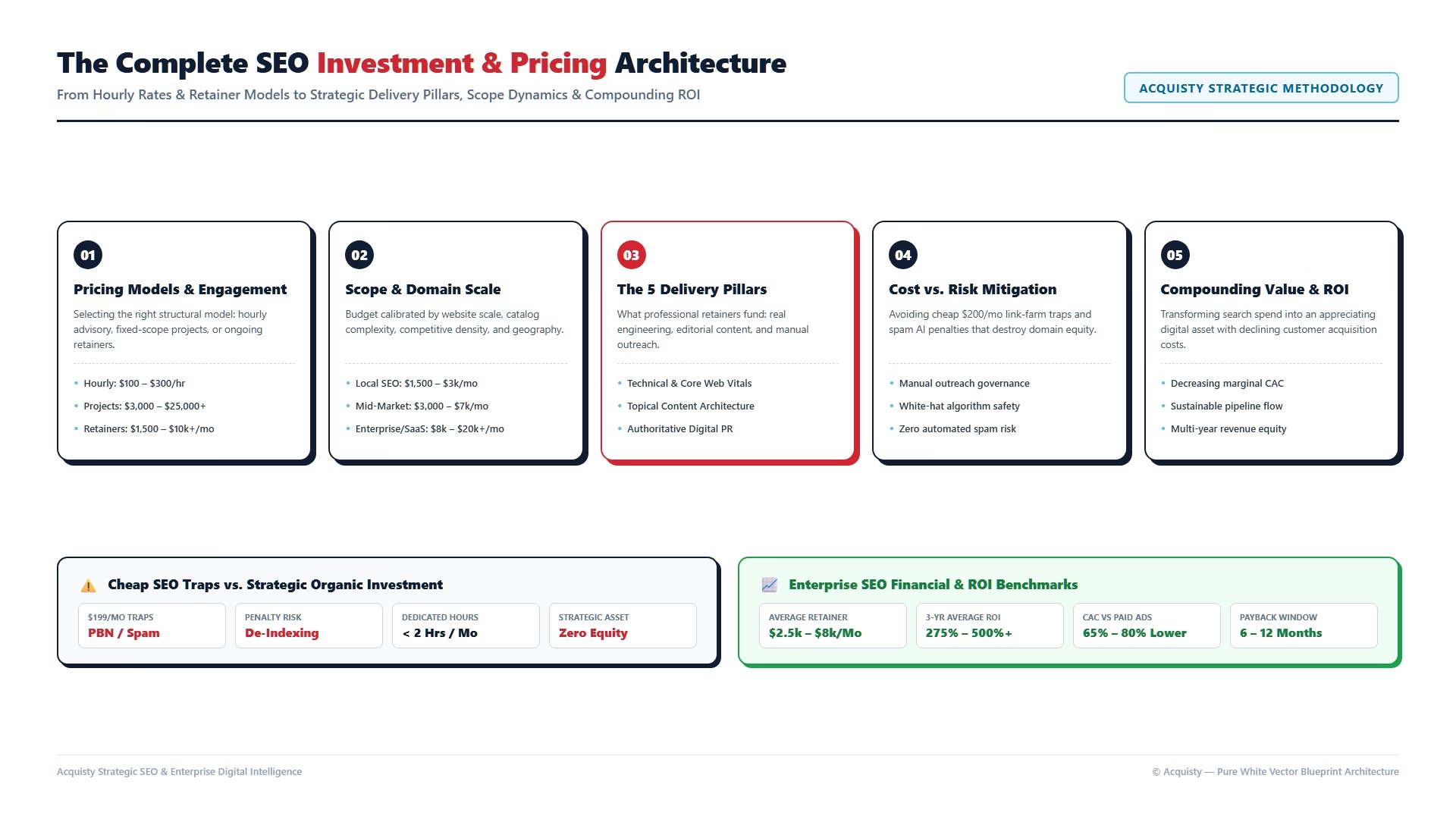
- Standard Monthly Retainers: 74.2% of businesses pay between $1,500 and $7,500 per month for ongoing agency retainers, with an industry median of $3,200/month (Ahrefs Industry Survey).
- Average Hourly Rates: Experienced SEO consultants and specialized search agencies charge between $100 and $250 per hour, reflecting technical data science and engineering expertise (Search Engine Land).
- Long-Term ROI Multiplier: Organic search generates an average 275% to 500%+ ROI over a 3-year horizon, delivering a customer acquisition cost (CAC) up to 80% lower than paid search channels (Gartner Marketing Data).
- Payback Window: Modern technical and topical SEO programs typically achieve positive monthly cash-flow payback within 6 to 9 months as compound organic rankings mature (HubSpot Inbound Research).
1. Quick Breakdown: Real-World SEO Cost Ranges
To give you an immediate executive snapshot before exploring granular delivery scopes, here is how professional search marketing costs break down across standard pricing tiers, target business profiles, and expected deliverable volumes:
If an agency or freelancer offers to execute national or global SEO for $200 to $500 per month, extreme caution is warranted. At that price level, the agency cannot afford to assign qualified engineers, professional writers, or manual link-building specialists. Instead, cheap packages rely on automated bot spam, scraped AI content, and private blog networks (PBNs) that routinely trigger severe algorithmic penalties.
2. The 4 Common SEO Pricing Models Explained
When hiring an agency or consultant, you will encounter four primary commercial engagement models. Understanding how each model functions allows you to select the structure that aligns best with your organizational cash flow, internal resources, and growth objectives:
Model 1: Monthly Retainer (Most Popular & Effective)
The monthly retainer is the gold standard for professional SEO services. In this arrangement, your business pays a predictable fixed monthly fee (e.g., $3,000 to $8,000/month) in exchange for an ongoing allocation of dedicated technical hours, content development, manual link acquisition, and proactive conversion optimization.
Because organic search is a compound game that requires sustained momentum—crawling updates, publishing topical clusters, earning high-authority editorial mentions, and refining user experience—the retainer model aligns the agency’s incentives directly with your long-term revenue growth. High-performing retainers provide continuous iterative improvements rather than one-off band-aids.
Model 2: Project-Based Fixed Pricing
Project-based pricing is ideal for finite, well-defined technical deliverables. Rather than signing an ongoing contract, you hire an agency for a discrete outcome. Standard project engagements include:
Model 3: Hourly Consulting & Advisory
Hourly billing typically ranges from $100 to $300 per hour, depending on seniority, geography, and specialized technical mastery. This structure is commonly utilized by enterprise organizations that already employ internal software developers, content writers, and copywriters, but require external senior architectural guidance to validate complex technical deployments or review high-level topical roadmaps.
The primary risk with hourly billing is open-ended project drift. If requirements are not rigorously scoped, technical investigations can consume dozens of hours without producing concrete on-site deliverables.
Model 4: Performance-Based SEO (The Warning Signs)
On the surface, “pay only for results” or “rank #1 or you don’t pay” sounds enticing to cost-conscious buyers. However, in professional search marketing, pure performance pricing is filled with severe operational conflicts of interest:
3. What Are You Actually Paying For? Inside a Professional SEO Retainer
A common question from executive boards is: “Where does our monthly retainer actually go?” When you partner with an established search agency, your monthly investment is actively deployed across five specialized operational disciplines:
The 5 Operational Pillars Funded by Your Retainer:
1. Technical Architecture & Engineering: Diagnosing crawl errors, server logs, rendering performance, and Core Web Vitals.
2. Topical Content Development: Drafting research-backed, 3,500+ word expert guides with custom diagrams and empirical citations.
3. Manual Digital PR & Link Building: High-touch outreach to real industry publications for verified contextual backlinks.
4. On-Page & Entity Schema Optimization: Injecting structured JSON-LD data graphs, title testing, and internal linking silos.
5. Data Analytics & Conversion Optimization: Tracking revenue pipeline, keyword Share of Voice, and user conversion paths.
When you break down the true cost of specialized labor, software tooling, and execution, the economics become crystal clear. A high-performing SEO campaign requires access to premium enterprise tools (such as Ahrefs, Semrush, Screaming Frog, and Google BigQuery) which cost between $1,000 and $3,000 per month alone in software subscriptions. Add in senior technical architects, seasoned subject-matter writers, and PR outreach specialists, and it is easy to see why comprehensive retainers begin at $3,000/month.
For organizations wanting to master their search visibility without hiring four full-time in-house specialists, relying on specialized technical SEO audit services and integrated content marketing services provides an immediately profitable operational advantage.
📖 Recommended Reading
Enterprise SEO Metrics: The Executive Guide to Measuring Organic Traffic, Pipeline & Revenue ROI — Discover how leading organizations quantify the financial impact of search engine optimization, track Share of Voice, and report clear ROI metrics to executive leadership.
4. The 7 Hidden Factors That Influence Your Custom SEO Quote
Why do two companies of similar size receive completely different agency pricing quotes? The reality is that search difficulty is dictated by your website’s historical baggage, technological architecture, and competitive landscape. Here are the seven primary variables that determine your pricing tier:
Factor 1: Technical Debt & CMS Architecture Complexity
A clean WordPress or Shopify website with standard templates is fast and straightforward to optimize. In contrast, complex headless CMS architectures (e.g., Next.js, React, Nuxt) with dynamic client-side JavaScript rendering require specialized frontend engineers to diagnose hydration gaps, pre-render static HTML snapshots, and configure server-side edge caching. The more custom your tech stack, the higher the technical engineering hours required each month.
Factor 2: Domain Age & Historical Toxic Link Footprint
If your website is brand new, Google places it in an algorithmic trust sandbox, requiring patient foundational link building and content velocity to establish topical authority. Conversely, if your domain was penalized in previous years due to low-quality link building from a legacy agency, your new partner must spend the first 60 to 90 days conducting forensic disavow audits and content cleanups before growth can resume.
Factor 3: Competitive Density of Your Target Industry
Ranking for commercial search terms in hyper-competitive verticals (such as FinTech, Cyber Security, SaaS, Legal Services, and Insurance) requires immense editorial rigor and high-DR outreach. Competing against established industry leaders with Domain Ratings of 85+ demands significantly greater publishing velocity and bespoke digital PR campaigns than ranking in regional B2B manufacturing or niche local services.
Factor 4: Geographic Scope & Multi-Language Targeting
Optimizing for a single metropolitan area requires a fraction of the budget needed to dominate nationwide or international markets. When expanding across multiple countries, search campaigns must incorporate international hreflang tag governance, localized currency and shipping signals, regional server distribution (CDNs), and native multi-lingual content adaptation.
Factor 5: In-House Developer Agility & Implementation Velocity
An SEO agency can provide brilliant architectural audits, but if your internal IT team takes six months to push recommended title changes, Schema tags, or Core Web Vitals fixes to production, your organic progress stalls. If the agency is asked to handle direct code implementation via Git pull requests and CMS deployment, the retainer scope naturally increases to cover developer execution.
Factor 6: Regulatory Constraints & YMYL Compliance
Websites in “Your Money or Your Life” (YMYL) sectors—including healthcare, medical devices, wealth management, and legal advisory—are held to Google’s most stringent Experience, Expertise, Authoritativeness, and Trustworthiness (E-E-A-T) standards. Content must be drafted or reviewed by credentialed medical or financial professionals, verified with author schema, and vetted through internal compliance boards, increasing production timelines and costs.
Factor 7: Existing Content Asset Inventory & Information Gain
If your site already has 300 published articles that simply suffer from keyword cannibalization, outdated benchmarks, or thin sections, optimizing existing assets (content pruning and refreshing) is often faster and more cost-effective than starting from scratch. Conversely, if your site has zero topical footprint, building an authoritative library of 40+ master pillar guides requires a sustained content production investment.
5. SEO Pricing by Business Scale: Local vs. Mid-Market vs. Enterprise
Your total investment is directly determined by the scale of your digital footprint, your market competition, and the geographical reach of your audience. Here is what to expect across three primary business categories:
Category A: Local SEO Pricing ($1,500 – $3,000 / month)
Local SEO focuses on capturing “near me” searches and ranking in Google’s Local Map Pack for geo-specific commercial terms (e.g., “commercial plumbing contractor in Chicago” or “corporate immigration attorney in London”). Dedicated local SEO campaigns focus on Google Business Profile (GBP) optimization, geo-grid tracking, localized service page generation, NAP citation consistency, and hyper-local link acquisition.
Category B: eCommerce SEO Pricing ($3,500 – $10,000+ / month)
Online retail stores face unique technical challenges: faceted navigation, dynamic URL parameters, out-of-stock product handling, category pagination, and duplicate product descriptions across hundreds or thousands of SKUs. Effective ecommerce SEO architecture demands heavy crawl governance, automated Product schema injection, and high-velocity category content to compete against retail giants like Amazon.
Category C: Enterprise & B2B SaaS SEO Pricing ($8,000 – $25,000+ / month)
Enterprise companies and high-growth B2B software providers require sophisticated search strategies. Enterprise retainers address international hreflang targeting, custom server-side edge rendering, programmatic landing page generation, in-depth competitor gap analysis, and authoritative digital PR. At this level, SEO functions as an enterprise pipeline acceleration engine, directly generating high-LTV demo requests and recurring annual contract value (ACV).
6. The Hidden Dangers of Cheap SEO: How $299 Packages Destroy Domain Equity
Every week, business owners receive unsolicited emails offering “Guaranteed #1 Google Rankings for $199/month.” While the budget appeal is tempting, purchasing low-cost commoditized SEO packages is one of the most dangerous marketing mistakes a company can make.
Here is the harsh operational reality of what cheap SEO providers actually do:
⚠️ Why “Cheap SEO” Costs 10x More in the Long Run:
- Private Blog Networks (PBNs) & Spam Links: Cheap providers place automated links on expired domains and link farms. When Google discovers the network, your site receives an algorithmic penalty or manual action, wiping out your organic traffic overnight.
- Spun Low-Quality AI Content: Cheap packages publish repetitive, hallucinated AI copy with zero proprietary research, triggering Google’s Helpful Content System down-ranking filters.
- Broken Code & Schema Errors: Inexperienced offshore contractors often tamper with theme files, creating broken canonical tags, CSS rendering errors, and mobile usability failures.
- Catastrophic Recovery Expenses: Recovering from an algorithmic penalty requires a forensic link audit, manual disavow compilation, content rewriting, and technical re-architecting, routinely costing between $5,000 and $15,000 just to regain your baseline.
Treat SEO as an appreciating capital investment in your company’s digital real estate. High-quality execution built around rigorous on-page SEO optimization and white-hat high-authority link building protects your brand equity and compounds year after year.
7. In-House Team vs. Specialized Agency vs. Freelancer: Total Cost Breakdown
When planning your search marketing budget, you must decide between hiring an in-house team, retaining a specialized agency, or contracting solo freelancers. Comparing the total cost of ownership (TCO) reveals significant financial and operational differences:
For mid-market and enterprise organizations, hiring an agency provides an immediate 60% to 75% cost savings compared to hiring an equivalent internal team (consisting of a Senior SEO Director at $130k, a Technical Developer at $110k, a Content Lead at $75k, plus $25k in annual tool licenses). With an agency, you gain an entire squad of vetted specialists for a fraction of a single executive salary.
8. How to Budget for SEO: The 12-Month Resource Allocation Blueprint
A successful search marketing program changes focus as your site matures. Allocating your budget dynamically across the four quarters of your campaign ensures maximum capital efficiency:
9. How to Calculate True SEO ROI: The Executive Math Framework
SEO is not an administrative marketing overhead; it is a revenue generation pipeline. To justify your search investment to executive leadership, you must measure your returns using clear financial formulas rather than vanity keyword metrics:
The Mathematical Formula for Net SEO ROI:
Where Total SEO Investment includes agency retainer fees, internal developer hours, and content asset creation costs over the measured period.
To model your projected returns before signing a contract, utilize this 4-step pipeline valuation formula:
Concrete Example: A B2B company invests $4,000 per month ($48,000 annually) into an Acquisty organic growth program. Within 10 months, organic traffic increases by 8,000 monthly visits. At a 2% lead conversion rate (160 leads) and a 20% sales close rate, they generate 32 new clients. If their average customer LTV is $8,000, that represents $256,000 in gross revenue—a remarkable 433% net return on investment.
10. 5 Red Flags to Watch Out For in Agency Proposals
Before signing an agency contract, vet the proposal against these five major warning signs:
- 1. Guaranteed #1 Google Rankings: No agency has a special relationship with Google. Promising guaranteed rankings within 30 to 60 days is a definitive sign of dishonest sales tactics or dangerous short-term manipulation.
- 2. Refusal to Disclose Backlink Sources: If an agency claims their link-building network is “proprietary” and refuses to show you where your links will live, they are almost certainly utilizing private blog networks (PBNs) or link farms.
- 3. One-Size-Fits-All Commodity Packages: A single-location local contractor and a 50,000-SKU eCommerce site have entirely different technical needs. Agencies selling identical $499 packages across all industries lack operational depth.
- 4. Hostage Account Access: Reputable agencies always work directly inside your existing Google Search Console, Google Analytics 4, and Tag Manager accounts. Never allow an agency to create properties under their private master logins where you lack admin control.
- 5. Automated Monthly PDF Reports Without Commentary: If your monthly reporting consists of a 40-page automated tool dump with zero strategic analysis or pipeline revenue attribution, the agency is not actively managing your account.
11. Modern Budget Allocation: Investing in Generative Engine Optimization (GEO)
As search evolves beyond traditional blue links into AI Overviews, Perplexity, and conversational answer engines, progressive marketing budgets must allocate resources toward generative engine optimization (GEO).
Ranking in conversational AI engines requires more than basic keyword matching; it demands structured entity knowledge graphs, direct informational answer blocks, verified author credentials (E-E-A-T), and technical machine-readability. When budgeting for organic search, ensure your agency allocates dedicated hours toward multi-modal RAG retrieval, structured JSON-LD schema, and AI citation engineering.
To learn more about modern ranking mechanisms, consult our comprehensive breakdown of core Google ranking factors or review our step-by-step website SEO audit playbook.
12. Frequently Asked Questions About SEO Pricing & Costs
Ready for Transparent, ROI-Driven Search Engine Optimization?
Stop guessing how your digital marketing budget is spent. Partner with Acquisty to engineer a transparent, high-impact SEO growth engine backed by dedicated technical specialists, data-driven content velocity, and measurable pipeline ROI. Explore our tailored retainers or contact Acquisty’s growth team today for an open, data-backed strategy session.