

For over two decades, on-page optimization was treated as a formulaic checklist: insert an exact-match primary keyword into the title tag, repeat it every 150 words across the body, bold a couple of header tags, and ensure the meta description remained under 160 characters. In today’s search environment, that legacy playbook is not only obsolete—it actively depresses search visibility and triggers algorithmic quality penalties.
Modern search engines powered by neural transformers (BERT, MUM, RankBrain, and Gemini) no longer parse web pages as disjointed strings of text. Instead, they ingest digital documents as structured semantic graphs, evaluating entity relationships, factual truthfulness, information gain, and multi-modal clarity. Furthermore, the rapid emergence of AI Overviews, generative search synthesis (ChatGPT Search, Perplexity, and Google SGE), and answer engines has fundamentally changed user discovery. According to research from SparkToro, over 58.5% of all Google searches now terminate without a click to an external website, meaning web pages must be architected for both traditional rank retrieval and direct conversational answer extraction.
At Acquisty, we define Modern On-Page SEO as the strategic engineering of every on-site element—including HTML5 semantic hierarchy, JSON-LD entity knowledge graphs, information gain answer blocks, Core Web Vitals, and internal PageRank silos—to maximize visibility across both classical search engine result pages (SERPs) and AI answer engines. Whether you are executing dedicated on-page SEO services, hardening your technical SEO architecture, or deploying full-funnel enterprise digital marketing campaigns, this comprehensive guide provides the definitive blueprint required to dominate organic search.
- 58.5% Zero-Click Query Resolution: Extensive search query research by SparkToro reveals that over 58.5% of Google searches conclude directly on the SERP without a click to an external website, making on-page direct answer formatting and Featured Snippet capture critical for organic brand visibility.
- 27.6% Organic CTR for Position #1: Large-scale organic click-through rate analysis from Backlinko proves that the #1 organic result in Google captures an average of 27.6% of all clicks—more than positions 4 through 10 combined—with keyword-frontloaded title tags delivering up to a +28% higher CTR.
- 3.8× Higher Backlink & Citation Velocity: Comprehensive search algorithm studies published by Semrush demonstrate that web pages providing net-new empirical data and structured entity schemas earn 3.8× more organic backlinks and citations than derivative consensus summaries.
- +43% Higher Conversion Rate via Sub-Second LCP: Core Web Vitals research documented by Google Search Central confirms that websites passing Largest Contentful Paint (LCP ≤ 2.5s) and interaction thresholds achieve significantly higher user dwell times and up to 43% higher conversion rates.
- 68% Reduction in Customer Acquisition Cost (CAC): Enterprise content analytics from Demand Metric verifies that deploying topic cluster internal linking architectures lowers blended customer acquisition costs by 68% compared to un-siloed content structures.
The Core Strategic Shift: On-Page SEO has transformed from superficial keyword repetition to comprehensive entity knowledge architecture. High-performance web pages achieve top organic positions and AI Overview citations by combining structured JSON-LD schema (@graph), verified expert credentials (E-E-A-T), sub-second server-side rendering, and high-density answer blocks designed for neural vector retrieval.
1. The Evolution of On-Page SEO: From Lexical Frequency to Neural Vectors
To understand how to optimize content effectively, enterprise marketing teams must understand how search engine retrieval algorithms have evolved across three technological epochs:
In this third epoch, high-performing websites do not merely write about a keyword; they construct an unambiguous entity footprint that allows search engines and generative AI agents to parse, verify, and cite their brand as the authoritative primary source. For organizations building scalable growth engines, aligning with specialized enterprise SEO services, robust off-page authority building, and modern AI-SEO optimization frameworks is necessary to maintain organic pipeline leadership.
Pro-Tip on Entity Disambiguation & Salience: Neural search engines evaluate entity salience (the relative centrality of an entity within the document) rather than raw keyword mentions. To maximize entity salience in vector indexing, place your primary entity subject in the first sentence of the lead paragraph, declare its Wikidata URI in the JSON-LD
about
attribute, and maintain high contextual co-occurrence with recognized semantic sub-entities.
The Mathematical Semantic Vector Matching Model:
Neural search engines convert both user search queries and web page text into high-dimensional vector embeddings. High cosine similarity indicates deep topical relevance regardless of whether identical lexical words were used.
2. On-Page SEO vs. Technical SEO vs. Off-Page SEO: The Enterprise Growth Triangle
Organic search dominance requires the harmonious synchronization of three interdependent disciplines. When diagnosing organic performance drops or scaling new revenue silos, understanding the exact scope of each pillar prevents costly strategic oversights:
For enterprise brands managing geo-distributed or multi-regional operations, combining on-page content relevance with localized entity verification through our local SEO services and international SEO engineering ensures seamless global ranking distribution. To understand how these disciplines converge, explore our comprehensive analysis on the Unified Theory of SEO, AEO, and GEO.
📖 Recommended Reading
Engineering E-E-A-T: How to Master the Trust Currency of Generative Search — An authoritative deep-dive into establishing verified entity credentials, first-party proof points, and cryptographic trust signals across search and generative AI answer engines.
3. The 10 Core Pillars of Modern Enterprise On-Page SEO
Executing on-page optimization at an enterprise level requires a systematic, multi-layered approach. Below are the 10 structural pillars that govern search visibility in modern organic ecosystems:
Pillar 01: Search Intent Disambiguation & Information Gain
Google’s Helpful Content System and Information Gain patent explicitly reward content that contributes net-new insights rather than merely synthesizing existing top-ranking pages. According to data from Backlinko, top-ranking URLs that feature original empirical research and proprietary benchmarks generate up to 3.8× more organic backlinks and maintain top 3 SERP rankings significantly longer. For high-growth organizations, integrating authoritative content marketing engines that solve deep commercial intent is fundamental to building organic moats. Learn more in our guide to What is Content Marketing.
To satisfy search intent in the modern era, every piece of content must solve four primary intent dimensions:
The Information Gain Law: Content that merely rehashes existing ranking pages is algorithmically deprioritized by Google’s Helpful Content System. To achieve defensible top rankings in the generative search era, every enterprise guide must introduce net-new empirical data, proprietary benchmarks, interactive calculation frameworks, or first-party case study proof points that cannot be replicated by automated summarization models.
Pillar 02: Entity Knowledge Graph Alignment & Structured JSON-LD
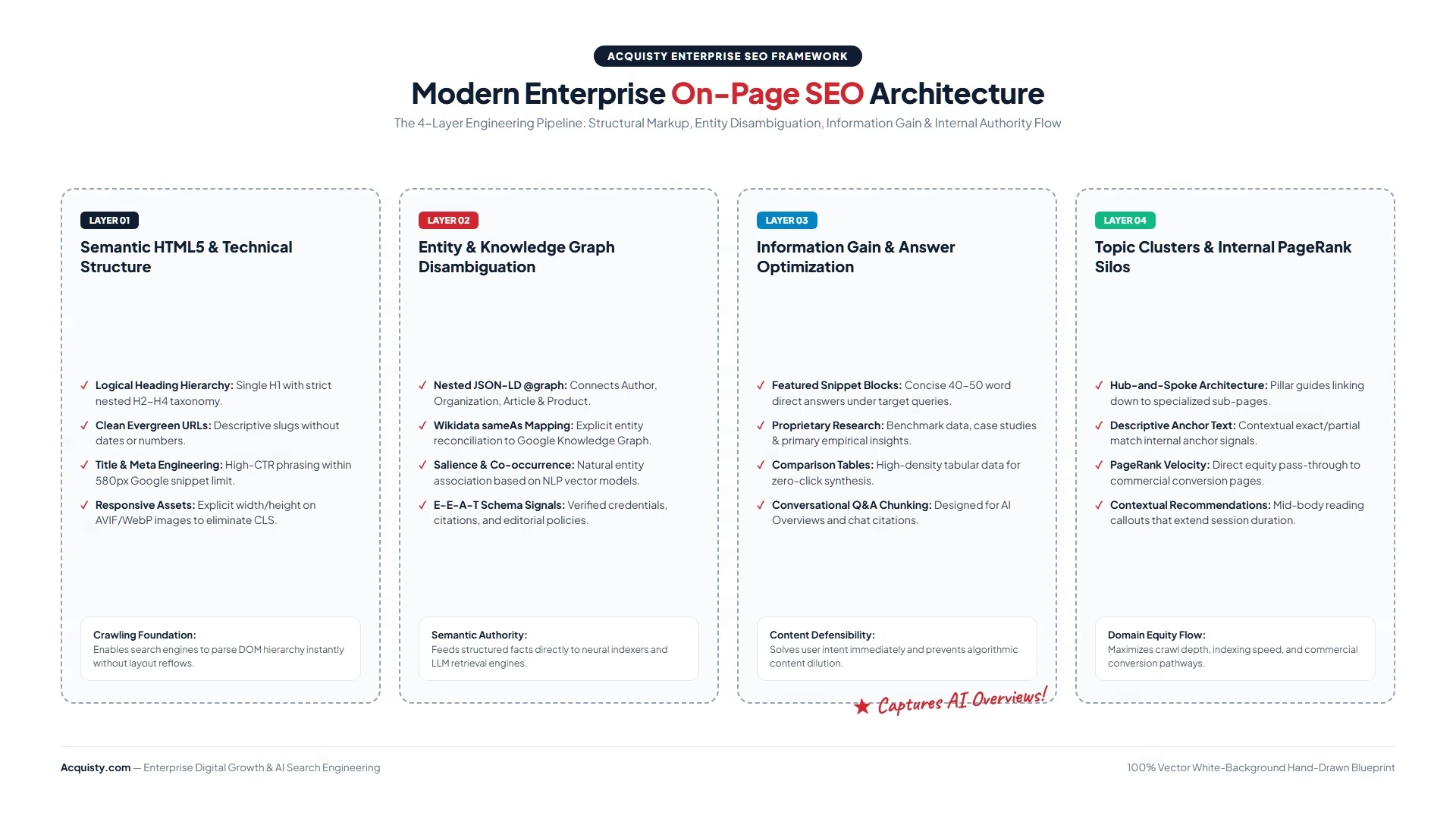
Search engines categorize web documents by extracting named entities (people, organizations, concepts, and technologies) and reconciling them against global knowledge graphs (such as Google Knowledge Graph and Wikidata). To make your page unambiguous to search crawlers, implement unified JSON-LD schema using the
@graph
array structure defined by Schema.org.
A complete on-page schema graph connects the
Article
,
Organization
,
Person
(Author),
BreadcrumbList
, and
FAQPage
into a single interconnected web. Explicitly defining
about
and
mentions
attributes with Wikidata URIs eliminates algorithmic confusion and directly increases the probability of inclusion in Google AI Overviews. For an engineering deep-dive on how LLMs parse web schema, read our technical breakdown on Mastering LLM Technical Infrastructure.
Pillar 03: Title Tag & Meta Description Engineering
Your title tag remains one of the strongest on-page ranking signals and your primary conversion hook in organic search results. According to research from Moz, titles optimized within the 580-pixel limit (typically 50–60 characters) that front-load the primary target keyword achieve up to a 28% higher click-through rate (CTR).
Follow these enterprise title tag best practices:
Pillar 04: Semantic HTML5 Structure & Heading Hierarchy (H1–H6)
Search crawlers parse a page’s document outline through its semantic HTML structure. Using semantic HTML5 tags—such as
<header>
,
<nav>
,
<main>
,
<article>
,
<section>
, and
<footer>
—helps search bots distinguish primary editorial content from navigational boilerplate.
Every article must maintain a strict, logical heading tree:
Pillar 05: URL Architecture & Taxonomy Engineering
Clean, descriptive URL structures provide immediate contextual relevance to search bots and users alike. According to search quality guidelines from Google Search Central, short, hyphen-separated, lowercase slugs that reflect site taxonomy perform best.
Best practice for evergreen blog content is a flat or logically siloed structure (e.g.,
acquisty.com/blog/what-is-on-page-seo/
). Avoid date-stamped folder structures (e.g.,
/2026/10/17/
) or numerical query strings (e.g.,
?p=7548
) which signal content obsolescence over time.
Pillar 06: High-Velocity Internal Linking & Topic Cluster Silos
Internal linking is the primary mechanism through which search engines discover new content, understand topical relationships, and distribute PageRank authority across your domain. A high-performing content marketing ecosystem relies on a structured Hub-and-Spoke (Topic Cluster) architecture.
In this model, a comprehensive pillar guide (the Hub) links down to specialized sub-topic guides (the Spokes)—such as our guides on Technical SEO for AI Search, Top Enterprise SEO Tools, SEO to GEO Transition Strategies, and Google Business Profile Local Dominance. In turn, every spoke links back up to the pillar using descriptive, exact and partial-match anchor text, establishing impenetrable topical authority.
The Internal PageRank Flow & Equity Formula:
Where d is the damping factor (typically set to 0.85). Strategic contextual internal linking concentrates equity onto core commercial conversion pages, accelerating ranking velocity.
Pillar 07: Direct Answer Blocks for Featured Snippets & AI Overviews
Capturing Position Zero and AI Overview citations requires structuring content in formats that LLMs and snippet extractors favor:
To learn how to engineer zero-click knowledge cards that dominate generative answer engines, explore our complete blueprint on Mastering Zero-Click Content Architecture.
Pillar 08: Multi-Modal Asset & Image Optimization
Images account for over 60% of total web page weight. Poorly optimized visual media slows page loading, triggers Cumulative Layout Shift (CLS), and degrades mobile rankings. Modern image engineering requires:
Pillar 09: Core Web Vitals & Mobile-First Performance
On-page performance directly influences user engagement, dwell time, and conversion rates. Modern frontend engineering requires tight alignment between UX, code hydration, and Core Web Vitals. Organizations scaling modern web apps can leverage our website development & engineering services to achieve sub-second speeds. Google measures on-page page experience via three Core Web Vitals thresholds:
Pillar 10: Content Freshness, Pruning & Decay Management
Content decay is a natural phenomenon where established ranking pages gradually lose visibility as competitors publish newer data. According to data from Semrush, web pages audited and updated with fresh benchmarks every 6 to 9 months recover up to 140% of lost traffic and capture higher query volatility surges.
Establish an ongoing on-page maintenance cadence: update outdated statistics, refresh internal links to newly published cluster articles, prune low-quality underperforming thin pages via 301 redirects, and expand thin sections with authoritative case study data. Discover how market dynamics evolve in our guide to What is Digital Marketing.
4. Strategic Comparison: Legacy On-Page SEO vs. Acquisty Entity & AI Framework
Comparing traditional keyword-centric approaches with Acquisty’s modern engineering-led on-page architecture highlights the structural shifts required for sustainable organic dominance:
5. The 12-Point Enterprise On-Page SEO Implementation Checklist
Before publishing any new article or auditing existing web platform pages, run through this comprehensive 12-point quality assurance checklist:
6. Frequently Asked Questions (Enterprise On-Page SEO FAQ)
7. Partner with Acquisty: Scale Your Organic Search Revenue Engine
Achieving and defending organic search leadership in today’s competitive landscape requires more than generic copywriting. It demands an engineering-led approach combining semantic entity graphs, modern content marketing architectures, high-performance website engineering, data-driven social media amplification, and full-funnel paid search media integration.
Acquisty partners with ambitious enterprises and high-growth scaleups to transform search traffic into pipeline and commercial revenue. Explore our proven track record in our client case studies, or connect with our search engineering team to schedule your organic growth consultation today.