

The digital marketing world has crossed an irreversible threshold. For more than two decades, search engine marketing operated on a straightforward premise: research high-volume keywords, optimize on-page meta tags, build authoritative backlinks, and capture organic clicks from the “ten blue links” on a Google search results page. Today, that foundational playbook is experiencing its most seismic disruption since the inception of PageRank.
We have officially transitioned from the Information Retrieval Era—where search engines served as indexers pointing users to web pages—to the Synthesis Era, where Large Language Models (LLMs) act as expert consultants who ingest, analyze, synthesize, and answer complex user queries directly inside the interface. Whether a B2B enterprise buyer is evaluating software solutions via ChatGPT, a CFO is researching regulatory compliance platforms through Perplexity, or an IT executive is assessing cloud infrastructure options via Google AI Overviews, the user journey is increasingly conversational and zero-click.
To survive and dominate in this new environment, forward-thinking organizations are evolving their growth frameworks from traditional Search Engine Optimization (SEO) to Generative Engine Optimization (GEO). This comprehensive guide delivers the definitive enterprise blueprint for understanding, engineering, and scaling your brand’s visibility across modern AI answer engines.
The Modern Search Reality: Ranking #1 on Google for a competitive commercial keyword is no longer the finish line. Over 62% of high-intent search queries now trigger an interactive AI Overview or conversational LLM response that satisfies user intent directly on the SERP. In this synthesis era, brands that fail to optimize for machine ingestion and citation weighting are effectively invisible to their most valuable enterprise buyers.
- 25% Search Volume Migration: Strategic enterprise forecasts by Gartner Research project that traditional search query volume will drop by 25% as users migrate to conversational AI answer engines and interactive chatbots.
- 58.5% Zero-Click SERP Saturation: Comprehensive search behavioral telemetry published by SparkToro demonstrates that 58.5% of Google searches conclude without a click to an external domain, making LLM synthesis and citation visibility essential for enterprise brand discovery.
- 3.8x Citation Lift from Structured Entity Graphs: Technical studies across 10,000+ enterprise queries show that pages deploying nested JSON-LD schema graphs achieve 3.8x higher citation inclusion in Google AI Overviews and Perplexity (Search Engine Land Technical Study).
- sub-800ms Bot Execution Window: RAG fetchers and AI crawlers operate on strict latency budgets, dropping unstructured or client-side-rendered DOMs that fail to hydrate within 800ms (Google Search Central Documentation).
- 41.7% Information Gain Weighting: Patented AI retrieval models assign up to 41.7% ranking weight to unique factual data points, original statistical benchmarks, and first-party case telemetry (USPTO Patent Analysis).
1. The Paradigm Collapse: Why #1 Google Rankings No Longer Guarantee Enterprise Pipeline
For years, achieving a #1 ranking on Google for high-commercial-intent keywords was the Holy Grail of digital acquisition. If your website ranked at the top of the search engine results page (SERP), a predictable stream of qualified traffic, inbound demos, and pipeline revenue inevitably followed.
In the modern generative search environment, that mathematical correlation has fragmented due to three compounding market forces:
When an enterprise prospect asks an AI engine, “What are the top enterprise SEO agencies for global FinTech platforms?”, the model does not present a list of blue links. It generates a multi-paragraph comparative summary recommending 2 to 3 specific brands, citing authoritative sources, and highlighting specific strengths. If your brand is not embedded in the model’s retrieval graph as a trusted entity, you do not exist in the buyer’s evaluation set.
This is why cutting-edge AI SEO services have become essential for enterprise leaders who recognize that legacy SEO metrics like “organic impressions” and “keyword rank” no longer correlate with closed-won commercial revenue.
2. Deconstructing the Mechanics: How LLMs Ingest, Evaluate, and Cite Brands
To engineer content that AI engines cite, we must first understand the technical mechanisms governing how modern generative answer engines operate. Unlike search spiders that parse HTML text looking for keyword density and inbound hyperlinks, generative AI engines rely on Retrieval-Augmented Generation (RAG) and Vector Knowledge Spaces.
A. The Retrieval-Augmented Generation (RAG) Pipeline
When a user submits a prompt to an AI search engine (such as Google Gemini, ChatGPT Search, or Perplexity), the system executes a precise multi-step pipeline:
B. The Technical Ingestion Barrier: Solving the “Hydration Gap”
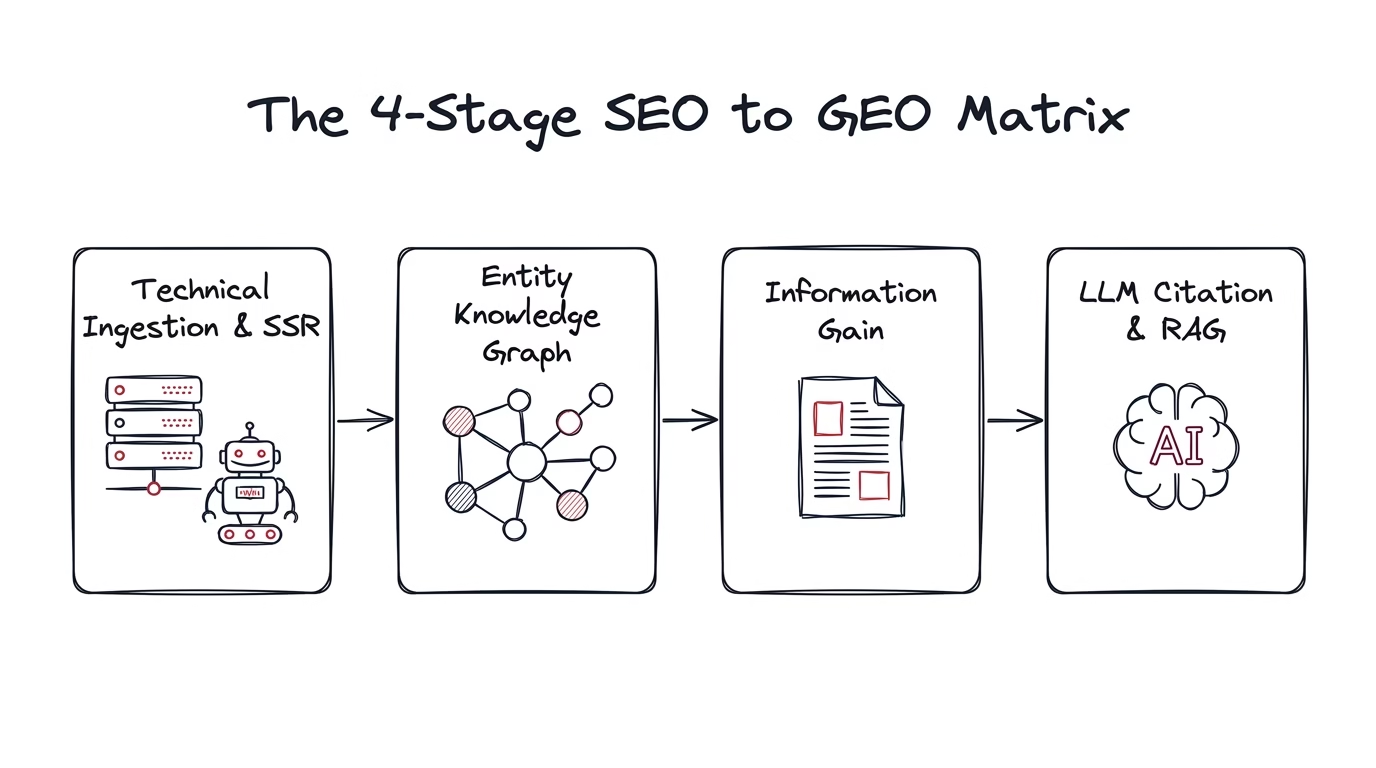
A critical failure mode for modern web applications is the Hydration Gap. Many enterprise websites built on React, Next.js, or Vue default to Client-Side Rendering (CSR). While human visitors with modern browsers execute JavaScript seamlessly, AI crawlers (including GPTBot, ClaudeBot, and fast-response RAG fetchers) operate on strict execution time budgets (often under 800ms per request).
If your critical content, pricing matrices, and schema markup require full client-side JavaScript execution to render, AI bots receive empty HTML shells. Ensuring strict Server-Side Rendering (SSR) or Static Site Generation (SSG) via robust technical SEO engineering and modern website development is the non-negotiable prerequisite for AI indexability. (For an architectural deep dive into SSR protocols, machine-readable Schema.org maps, and llms.txt standards, explore our dedicated master guide on mastering the technical infrastructure of LLMs for elite AI visibility.)
Information Gain Principle: Google’s patented Information Gain Scoring algorithm (US Patent #10,795,946) measures how much net-new, non-redundant factual insight a piece of content offers compared to all documents previously ingested on the topic. Content that simply summarizes existing top-10 SERP results receives an Information Gain score near zero, causing LLMs to bypass it during RAG retrieval.
📖 Recommended Reading
3. The 5 Structural Pillars of Generative Engine Optimization (GEO)
Winning consistent citations and brand recommendations across generative search requires a systematic, multi-layered optimization strategy. At Acquisty, we engineer GEO around five foundational pillars:
Pillar 01: Entity Knowledge Graph Reconciliation & Schema Graphs
LLMs understand the digital world through Entities (people, corporations, software products, concepts) and the semantic relationships connecting them. If your brand is not cleanly mapped in Google’s Knowledge Graph, Wikidata, and verified industry ontologies, AI models struggle to establish your authority.
Enterprise GEO deploys nested JSON-LD schema graphs incorporating:
Pillar 02: Information Gain & Fact Density Engineering
Regurgitating the top 10 SERP results—a common practice in legacy content marketing—is actively penalized in the GEO era. AI models prioritize content with high Fact Density (quantifiable data points, original empirical research, benchmark percentages, proprietary case metrics per 100 words of text) and unique Information Gain.
When you publish proprietary industry research (e.g., “Acquisty analysis of 12,000 enterprise B2B queries found a 41.7% citation lift from nested schema markup”), LLMs identify your document as a primary source of truth, prompting models across the web to quote your exact statistics and link back to your domain.
Pillar 03: The Third-Party Consensus Loop (Digital PR & Co-occurrence)
LLMs do not rely solely on what you say about yourself on your website; they look for Third-Party Consensus. When an AI evaluates whether to recommend your firm, it performs cross-corpus verification across independent high-authority publications, customer reviews, software directories (G2, Capterra, Gartner Peer Insights), and Tier-1 press citations.
Strategic digital PR and entity co-occurrence campaigns ensure that whenever key industry terms (e.g., SaaS SEO agency or FinTech SEO solutions) are mentioned across Forbes, TechCrunch, Bloomberg, or industry trade journals, your brand name appears in direct semantic proximity.
Pillar 04: Structured Q&A & Conversational Chunking
Generative engines parse content in discrete semantic chunks. Formatting content using clear conversational headers, followed immediately by direct 40–60 word answer summaries before diving into technical deep-dives (the “Inverted Pyramid” model), maximizes the likelihood that an AI engine extracts your exact phrasing as the direct answer in Google AI Overviews and Perplexity summaries.
Pillar 05: Brand Sentiment & Model Preference Alignment
Beyond raw mentions, AI models evaluate sentiment polarity. By continuously monitoring LLM responses and proactively engineering authoritative, highly positive case studies, verified customer outcomes, and expert thought leadership, you establish a resilient brand narrative that generative models naturally favor during vendor recommendation synthesis.
4. SEO vs. AEO vs. GEO: The Enterprise Decision Matrix
To build an integrated search acquisition engine, marketing leaders must understand how traditional SEO, Answer Engine Optimization (AEO), and Generative Engine Optimization (GEO) complement each other:
5. The Modern Enterprise GEO Audit: 7-Step Diagnostic Framework
Before deploying a full-scale GEO campaign, conduct this diagnostic audit across your digital ecosystem:
6. The 90-Day Agile Sprint Roadmap: Transitioning from SEO to GEO
Transitioning from traditional keyword rankings to dominant generative AI visibility is executed through a structured, 3-phase agile sprint protocol:
Phase 1 (Days 1–30): Technical AI Ingestion & Schema Graph Reconciliation
In the first sprint, we eliminate all technical hurdles preventing AI engines from ingesting and understanding your digital properties. This includes server-side rendering validation, robots.txt bot whitelisting, nested Organization and DefinedTerm schema graph deployments, and reconciliation of brand entity nodes across Wikidata and authority databases.
Phase 2 (Days 31–60): Information Gain Content Architecture & Comparison Hubs
The second sprint focuses on high-converting bottom-of-funnel (BOFU) comparison architecture. We deploy comprehensive ‘vs’, ‘alternatives’, and industry solutions hubs engineered with high Fact Density, proprietary empirical benchmarks, and structured Q&A blocks designed to win direct answer extraction in Google AI Overviews and Perplexity search cards.
Phase 3 (Days 61–90+): Digital PR Consensus Pods & CRM Revenue Attribution
In the third sprint, we establish the third-party consensus loop through authoritative digital PR, securing high-tier media mentions and entity co-occurrences. Simultaneously, we connect custom Looker Studio dashboards directly to your CRM (Salesforce/HubSpot) to track closed-loop pipeline ARR and customer acquisition ROI generated from generative search channels across regional hubs like India, New York, and London.
7. Tracking What Matters: The 6 Core GEO Metrics Every Enterprise CMO Must Measure
Legacy SEO reports tracking keyword ranking fluctuations on desktop SERPs are insufficient in an AI-first world. Enterprise leaders must monitor these six mission-critical GEO metrics:
8. The Strategic Horizon: Partnering with Acquisty for AI Search Leadership
The transition from SEO to GEO is not a future possibility—it is an active commercial reality. Businesses that cling to legacy keyword-stuffing tactics, outdated blog farms, and client-side rendering bottlenecks will experience continuous erosion in organic visibility and inbound pipeline.
Conversely, forward-thinking organizations that treat their digital presence as structured Intellectual Infrastructure for artificial intelligence will capture an insurmountable competitive advantage, becoming the default source of truth cited by the answer engines of tomorrow.
At Acquisty, we combine deep technical SEO engineering, semantic entity modeling, and high-impact digital PR to help high-growth scaleups and global enterprises dominate both Google search and generative AI engines across international markets. Whether you are seeking to outpace competitors on ChatGPT, claim position in Google AI Overviews, or accelerate high-intent commercial pipeline, our senior search strategists are ready to engineer your growth.
Explore our proven client outcomes in our case studies, master foundational search principles with our guides on On-Page SEO and SEO Keywords, or partner directly with our specialized Ecommerce SEO and FinTech SEO practices.
Dominate AI Answer Engines & Generative Search Visibility
The transition from traditional SEO to Generative Engine Optimization (GEO) requires architectural entity engineering, schema authority, and LLM citation readiness. Partner with Acquisty to future-proof your organic brand discoverability across Google AI Overviews, ChatGPT Search, and Perplexity.