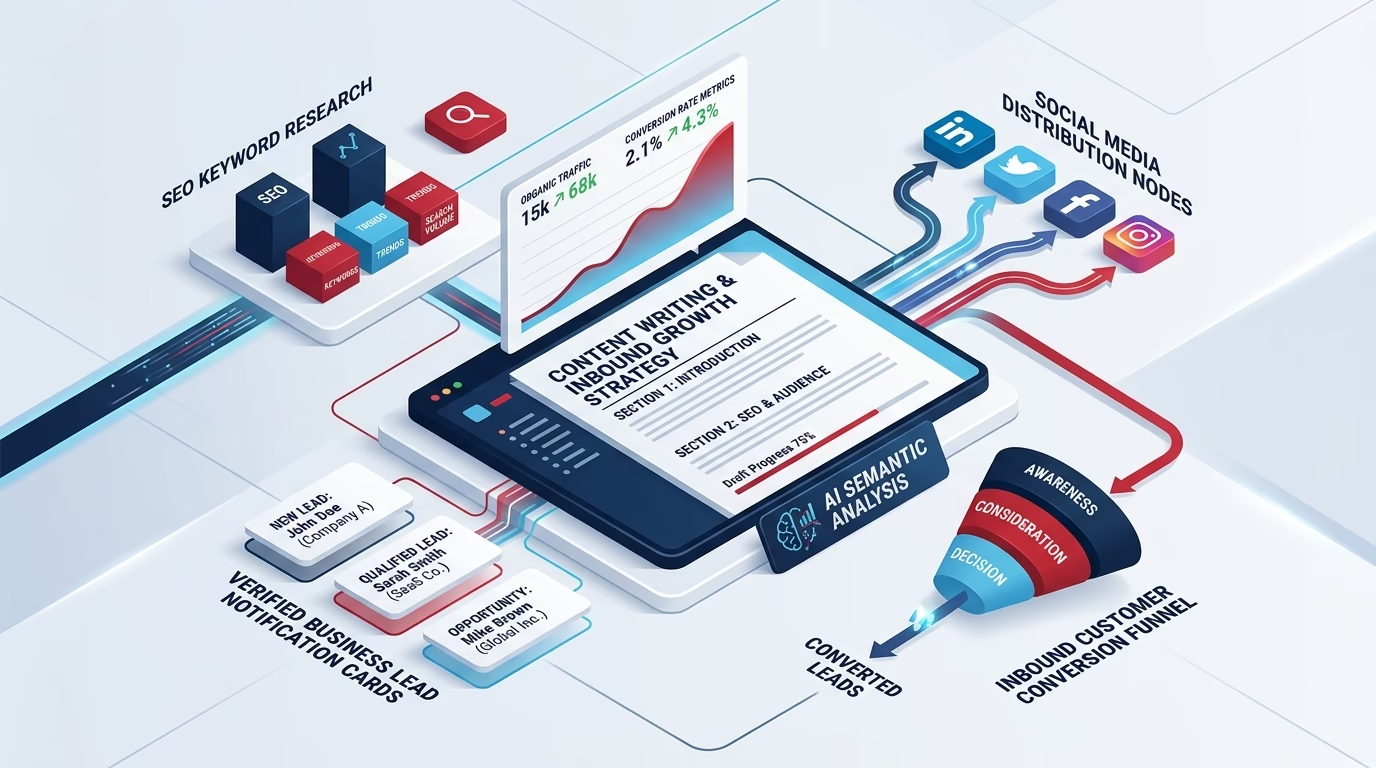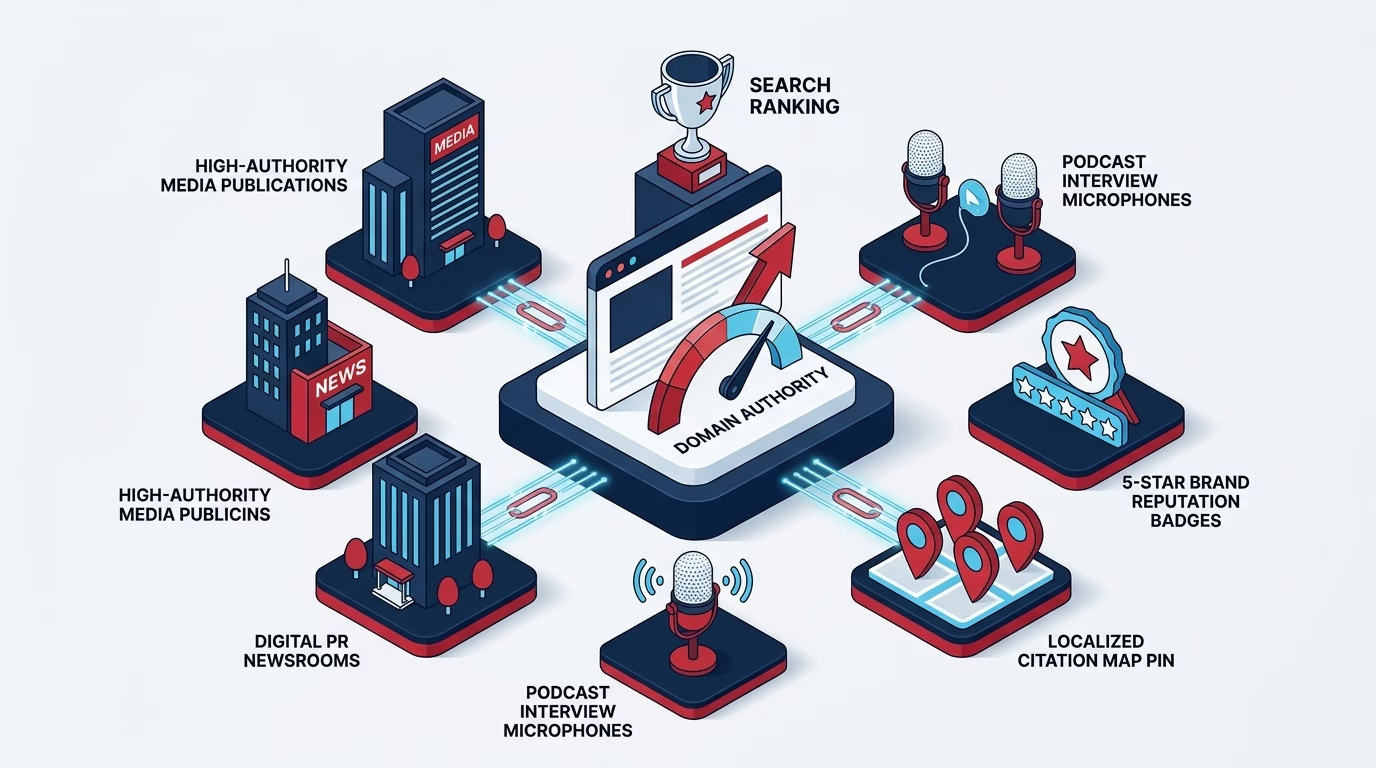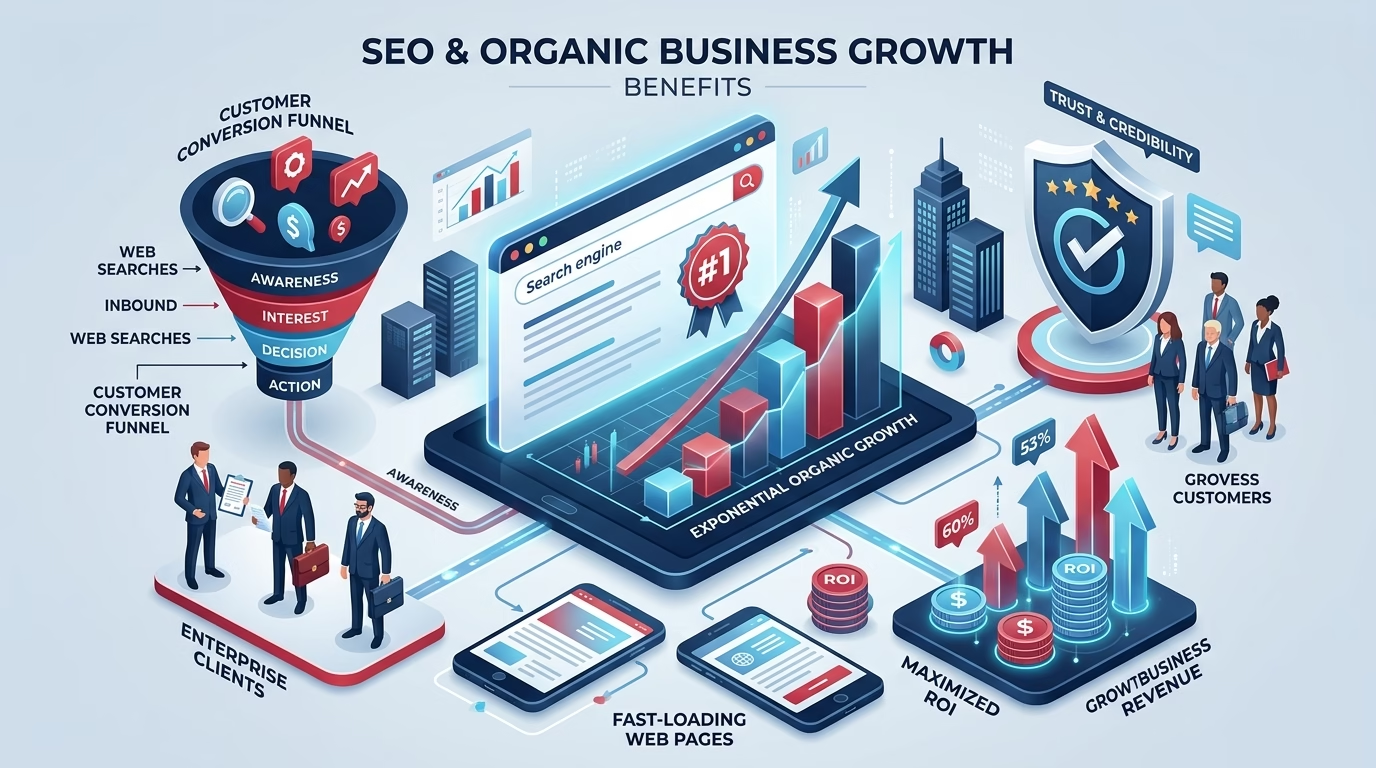



For modern enterprise organizations, venture-backed scaleups, and market leaders, digital marketing is no longer a peripheral collection of tactical experiments—it is the central operating system governing customer acquisition, revenue generation, and enterprise valuation. The historical paradigm where digital marketing was treated as an ad-hoc combination of banner ads, occasional social media posts, and uncoordinated email blasts has completely collapsed.
In today’s highly dynamic digital economy, market leadership requires an interconnected, full-funnel growth architecture. This system must seamlessly synchronize traditional search engines, conversational AI answer engines, algorithmic paid media, conversion-engineered web applications, and real-time first-party telemetry into a unified revenue engine. Organizations that successfully engineer this omnichannel flywheel capture dominant organic and paid market share, while those trapped in legacy, siloed marketing departments face escalating Customer Acquisition Costs (CAC), fragmented brand messaging, and diminishing returns.
To help Chief Marketing Officers, growth directors, and enterprise business leaders navigate this landscape, Acquisty’s Growth & Search Engineering team has developed this definitive enterprise blueprint to What is Digital Marketing, deconstructing every core discipline, economic formula, and execution framework required to achieve compounding commercial dominance.
- $667+ Billion Global Media Allocation: Market intelligence from eMarketer / Insider Intelligence indicates that global digital advertising expenditure exceeds $667 billion, accounting for more than 70% of total worldwide media investments across both enterprise B2B and direct-to-consumer sectors.
- 15%–25% Customer Lifetime Value (LTV) Lift: Empirical growth research conducted by McKinsey & Company reveals that enterprise brands deploying unified omnichannel customer journeys and real-time behavioral personalization achieve a 15% to 25% increase in customer lifetime value while reducing blended Customer Acquisition Costs (CAC) by up to 30%.
- 3x Lead Generation at 62% Lower Cost: Rigorous comparative marketing studies published by Demand Metric prove that structured digital inbound strategies generate 300% more qualified pipeline per dollar spent than traditional outbound tactics while costing 62% less to maintain.
The Modern Digital Marketing Paradigm Shift: The transition from Web 2.0 to the AI-augmented search and programmatic economy has eliminated the effectiveness of single-channel marketing silos. Growth is no longer driven by isolated PPC campaigns or superficial blog posts; it is driven by a synchronized Flywheel of Intent—where high-authority organic content, conversational AI citations, algorithmic paid media, sub-second web experiences, and first-party CRM automation feed data back into each other continuously.
1. What is Digital Marketing? (Definition, Purpose & Commercial Scope)
At its foundational level, digital marketing represents the systematic orchestration of data-driven methodologies, creative communication, and technological platforms to identify, attract, engage, convert, and retain customers across internet-connected devices and electronic channels. Unlike traditional mass media, digital marketing operates on continuous feedback loops characterized by granular intent targeting, deterministic measurement, multivariate experimentation, and bidirectional interactivity.
In an enterprise setting, comprehensive digital marketing services operate not as discrete projects, but as a compounding revenue infrastructure organized around three core commercial mandates:
The economic leverage of digital marketing stems from its ability to turn marketing from a subjective cost center into a predictable, mathematically modelable capital investment. When unit economics—such as Customer Acquisition Cost (CAC), Customer Lifetime Value (LTV), and Time-to-Payback—are rigorously tracked, digital marketing functions as an uncapped growth accelerator.
2. Traditional Marketing vs. Digital Marketing: The Structural Paradigm Shift
To appreciate why digital marketing dominates contemporary corporate strategy, one must examine the economic, structural, and behavioral divergence between legacy outbound channels and modern digital growth architectures:
Pro-Tip on Omnichannel CAC & Attribution: Enterprise brands frequently fall into the trap of over-crediting last-click paid advertising while neglecting the top-of-funnel organic and technical foundations that educate the buyer. True commercial efficiency requires blended multi-touch modeling (Marketing Efficiency Ratio – MER) to ensure paid acquisition is consistently reinforced by compounding organic topical authority.
3. The 8 Core Disciplines of Modern Enterprise Digital Marketing
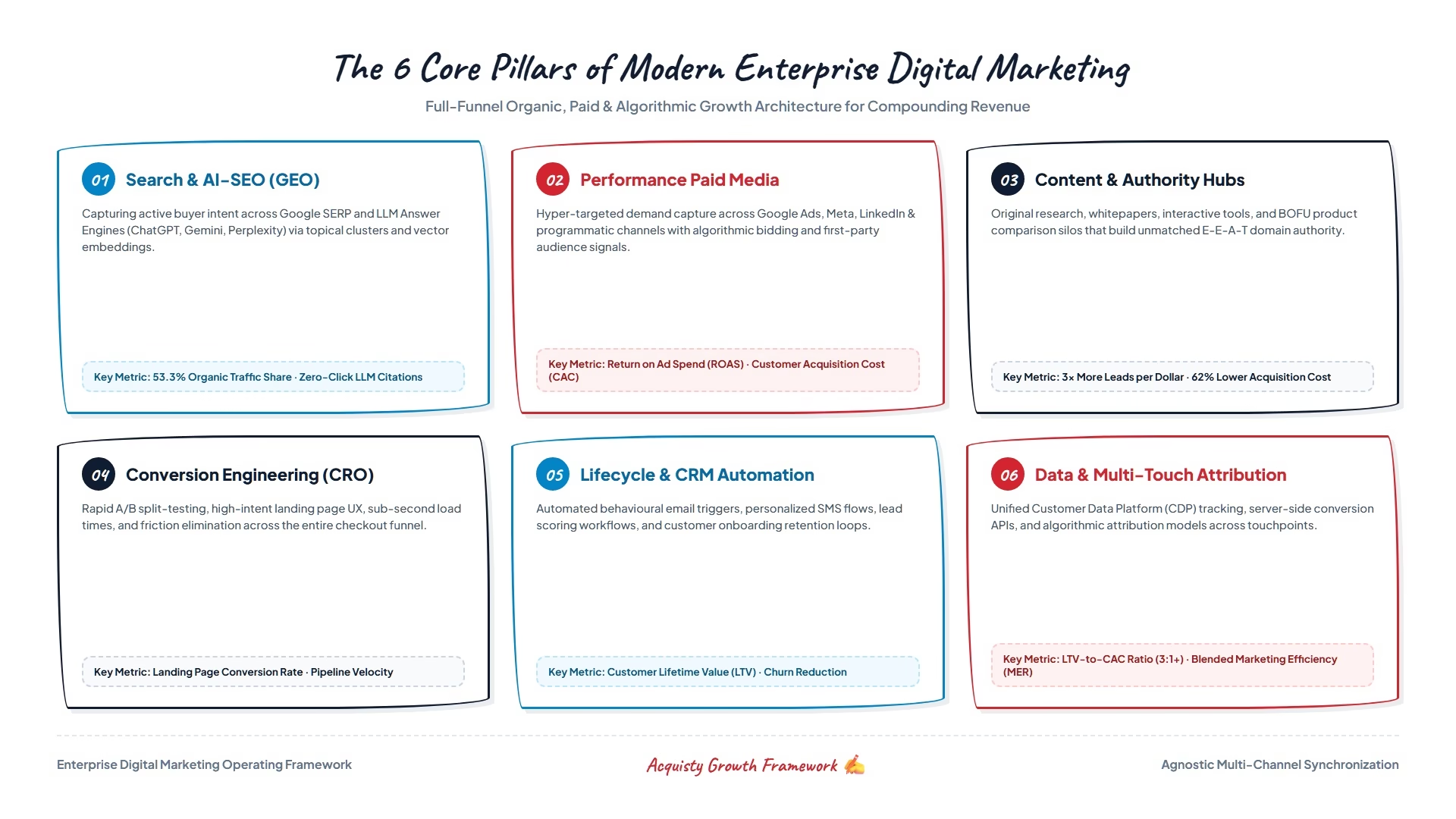
To build an unassailable acquisition engine, leading growth organizations deploy an integrated multi-channel architecture spanning eight specialized disciplines:
A. Search Engine Optimization (SEO) & Generative Engine Optimization (GEO)
Search Engine Optimization (SEO) remains the single most cost-effective organic pipeline driver in enterprise marketing. However, modern SEO has evolved far beyond basic on-page keyword density. Enterprise search strategies now integrate AI SEO Services (GEO) to ensure brand entities are ingested into neural retrieval systems and cited as authoritative sources in generative AI engines like ChatGPT, Google Gemini, and Perplexity.
A mature organic search program requires world-class technical SEO (server-side rendering hydration, crawl budget management, nested JSON-LD schema markup), comprehensive topical clusters, and authoritative digital PR co-citations that reinforce Google’s Experience, Expertise, Authoritativeness, and Trustworthiness (E-E-A-T) benchmarks, as outlined in official guidelines from Google Search Central.
📖 Recommended Reading
The Evolution of Digital Marketing: Trends and Predictions — Explore the seismic shifts in digital channels, customer data privacy, and generative AI acquisition strategies.
B. Performance Paid Media & Programmatic Acquisition
Performance paid advertising acts as an instantaneous growth lever, enabling organizations to deploy targeted capital across Google Ads (Search, Performance Max, YouTube), Meta Ads (Instagram, Facebook), LinkedIn Marketing Solutions, and programmatic Demand-Side Platforms (DSPs). By injecting first-party offline conversion data into algorithmic smart bidding models, enterprise growth teams optimize campaigns directly for pipeline revenue rather than low-quality superficial clicks.
C. Content Marketing & Thought Leadership Hubs
High-performing content marketing builds enduring commercial trust. According to research from the Content Marketing Institute, 83% of top-performing marketing teams operate with a documented content model that blends top-of-funnel educational frameworks, proprietary research benchmarks, and bottom-of-funnel commercial comparison matrices designed to shorten enterprise sales cycles.
D. Website Engineering & Conversion Rate Optimization (CRO)
Your corporate website is the ultimate destination where all inbound traffic is monetized. Professional website development services engineer lightweight, accessible, mobile-first web applications with sub-second page speeds. Integrated Conversion Rate Optimization (CRO) programs deploy multivariate split-testing across landing page headlines, interactive multi-step forms, and social proof modules to continuously lower effective CAC.
E. Social Media Marketing & Brand Communities
Strategic social media marketing builds engaged organic communities and amplifies corporate thought leadership across LinkedIn, YouTube, X, Instagram, and TikTok. Rather than broadcasting generic corporate PR, modern social programs emphasize employee advocacy, executive point-of-view content, and high-engagement short-form video.
F. Email Marketing & Lifecycle Marketing Automation
Owned email databases represent the highest margin acquisition and retention channel in digital marketing. Integrating modern CRM platforms (HubSpot, Salesforce, Klaviyo) with behavioral event triggers enables real-time lead nurturing, automated cart recovery, customer onboarding sequences, and predictive churn prevention workflows.
G. Influencer Marketing & Digital PR Co-Citations
Digital PR bridges brand credibility and search algorithm validation. By securing authoritative coverage across premier publications (Forbes, Bloomberg, TechCrunch) and orchestrating vetted industry creator collaborations, brands construct strong semantic entity associations that train both search engine ranking models and LLM neural networks.
H. Customer Data Platforms (CDP) & Multi-Touch Attribution
In a privacy-first, cookie-less browser landscape, enterprise data governance relies on Customer Data Platforms (CDPs) and server-side tracking infrastructure. Unifying first-party user interactions across web, mobile apps, and offline sales pipelines allows marketing leaders to calculate true Blended Marketing Efficiency Ratios (MER) and optimize marketing mix allocation with high statistical confidence.
The Attribution Blindspot: Relying exclusively on platform-reported ROAS (e.g. Meta Ads Manager or Google Ads dashboard) creates severe data distortion. Ad platforms frequently claim credit for the same conversion multiple times. True growth leaders implement server-side Conversion APIs (CAPI), first-party data warehouses (Google BigQuery), and blended econometric modeling to verify actual incremental revenue.
4. B2B vs. B2C Digital Marketing: Strategic Operational Framework
While both B2B and B2C organizations utilize digital channels, their operational strategies, decision frameworks, and revenue mechanics diverge significantly:
5. Enterprise Budget Allocation: The 70 / 20 / 10 Framework
One of the most persistent failure points in enterprise marketing operations is unstructured budget distribution. Growth leaders structure their annual digital capital allocation using the 70/20/10 Portfolio Optimization Model:
6. The 10 Core Enterprise Digital Marketing KPIs & Target Benchmarks
To maintain financial governance and executive confidence, digital growth teams monitor a concise set of mathematical metrics across acquisition, conversion, and unit economics:
7. Frequently Asked Questions (FAQ) About Enterprise Digital Marketing
8. Partner with Acquisty to Scale Your Digital Growth Engine
Scaling enterprise revenue in today’s multi-modal digital economy requires world-class technical precision, deep organic search authority, algorithmically managed paid media, and sophisticated biometric UX optimization. At Acquisty, our dedicated growth pods embed directly with forward-thinking enterprise brands to build compounding, highly profitable digital acquisition flywheels.
Explore our verified client case studies to see how we accelerate enterprise pipeline, or contact our senior growth strategists today to receive a comprehensive multi-channel digital performance and AI search audit.
Transform Your Full-Funnel Digital Growth & Customer Acquisition
Scaling modern digital marketing requires harmonizing organic search, performance advertising, conversion rate optimization, and AI customer journeys into a unified revenue engine. Acquisty delivers the strategic rigor and engineering execution needed to accelerate market share.