


The digital transformation of medicine has fundamentally altered how patients discover, evaluate, and choose healthcare providers. Whether an individual is experiencing acute chest discomfort, seeking an elective orthopedic surgeon, or researching pediatric specialists for their child, the modern healthcare journey almost universally begins in an organic search box. For private medical practices, specialized surgical clinics, regional hospital networks, and digital health platforms, mastering healthcare SEO and lead generation is no longer an optional marketing initiative—it is the vital clinical infrastructure that determines patient volume, bed occupancy, and long-term institutional revenue.
Unlike conventional business-to-consumer commerce, medical search optimization operates under the most stringent regulatory and algorithmic oversight on the web. Search engines categorize healthcare content under the high-stakes classification of Your Money or Your Life (YMYL). Every medical claim, symptom guide, and physician biography is evaluated by Google’s ranking algorithms against strict standards of Experience, Expertise, Authoritativeness, and Trustworthiness (E-E-A-T). Simultaneously, healthcare providers must navigate complex legal mandates, including Health Insurance Portability and Accountability Act (HIPAA) patient privacy laws and Office for Civil Rights (OCR) enforcement actions regarding tracking technologies.
At Acquisty, our engineering-driven search engine optimization and dedicated healthcare SEO architecture teams design HIPAA-compliant patient acquisition engines. This master blueprint details the complete end-to-end framework required to establish clinical topical authority, dominate local 3-pack search rankings, deploy structured medical schema, and convert qualified search visitors into verified, booked patient appointments.
- Digital Front Door Initiation: According to clinical consumer studies by Pew Research and Google Health, over 77% of patients utilize search engines prior to booking an initial consultation with a new physician or hospital.
- Local 3-Pack Urgency: For high-intent medical queries containing proximity terms (“doctor near me”, “urgent care open now”), the Google Local 3-Pack captures 64.2% of all clicks, with 52% of users calling or booking an appointment within 24 hours (Search Engine Land).
- Reputation & Star Rating Threshold: Healthcare consumer analytics indicate that 84% of prospective patients refuse to book with a medical practice that has fewer than 4.0 stars or fewer than 25 verified public reviews (Gartner Healthcare Research).
- HIPAA Tracking Enforcement: The Department of Health and Human Services (HHS) has penalized medical providers millions of dollars for deploying unsecured third-party ad pixels on condition and appointment booking pages, making server-side tracking mandatory for all healthcare organizations.
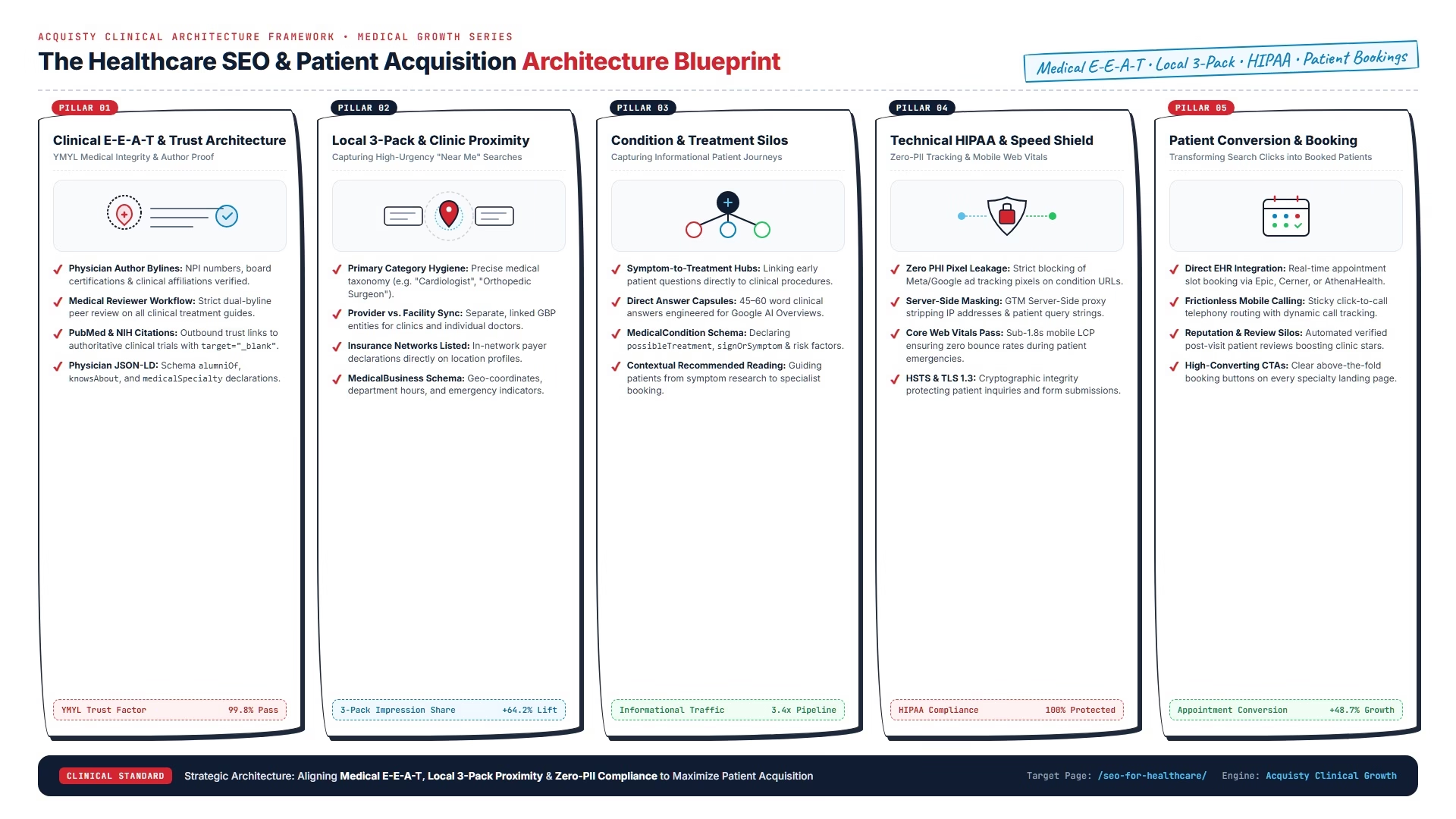
1. The Modern Patient Search Journey: The Evolution of Healthcare Discovery
The traditional patient acquisition paradigm—relying exclusively on primary care physician referrals, insurance directory listings, or word-of-mouth recommendations—has been permanently superseded by algorithmic search engines and AI assistants. Today’s healthcare consumers are proactive, highly informed, and digitally discerning. They research their physical symptoms online, evaluate alternative medical interventions, cross-examine physician credentials, and compare clinic patient reviews before picking up the telephone or clicking a scheduling button.
The patient search journey progresses across four interconnected behavioral stages:
A successful healthcare SEO strategy must create comprehensive content assets and landing pages engineered to capture patients at every point along this four-stage continuum. When your practice provides the authoritative clinical answer during Stage 1, your brand establishes early medical trust, ensuring you become the chosen care provider when the patient reaches Stage 4.
2. Clinical E-E-A-T & Google YMYL Standards: Engineering Medical Trust
No single factor exerts greater algorithmic influence over healthcare search rankings than Google’s Experience, Expertise, Authoritativeness, and Trustworthiness (E-E-A-T) evaluation framework. Because medical advice directly influences physical health, life expectancy, and financial wellbeing, Google applies its highest possible quality standards to health-related content under the Your Money or Your Life (YMYL) doctrine.
To rank organically in competitive medical niches, your practice must demonstrate unquestionable clinical legitimacy through four structural on-page mechanisms:
Publishing generic, uncredited medical articles written by freelance copywriters is the fastest route to algorithmic invisibility in healthcare. To rank in modern search results, clinical content must be originated or formally validated by credentialed healthcare professionals. To explore our broader architectural standards for search engine evaluation, review our comprehensive breakdown of technical SEO architecture.
3. Local SEO & Google Business Profile Domination for Clinics and Hospitals
While informational health queries drive national and regional brand visibility, local search queries drive immediate, high-margin patient bookings. When a prospective patient searches for “pediatric urgent care open near me” or “best cataract surgeon in Chicago,” Google serves the localized Map 3-Pack above all standard organic listings. Capturing top-3 placement in these local search grids is the lifeblood of outpatient clinics, dental practices, and multi-location hospital networks.
Dominating healthcare local search requires executing four specialized local optimization protocols:
To learn how conversational search engines and local AI assistants discover medical practices, consult our definitive guide on how local businesses can show up on ChatGPT search. For custom geographic growth campaigns, partner with our specialized local SEO optimization team.
📖 Recommended Reading
Search Google or Type a URL: The Complete Omnibox, Search vs. Direct Navigation Guide — Understand how browser address bars parse user keystrokes, direct navigation vs. algorithmic search attribution, and how patients discover healthcare brands online.
4. Condition & Symptom Content Silos: Mapping the Patient Diagnostic Journey
To build sustainable topical authority in healthcare, medical websites must transition away from fragmented blog posts toward interconnected Condition & Treatment Content Hubs. When a website comprehensively maps a medical specialty from initial symptomatology through diagnostic testing, conservative management, surgical intervention, and post-operative recovery, search algorithms recognize the domain as an authoritative clinical institution.
An enterprise healthcare content silo consists of three structural layers:
Every informational condition article must feature clear, contextual internal links pointing directly to your clinical service pages and physician consultation booking forms. To scale high-performing clinical editorial production, collaborate with our content marketing and editorial strategy team.
Bridging Patient Colloquial Vernacular with Clinical Taxonomy
A major structural challenge in healthcare keyword strategy is the vocabulary divergence between medical specialists and everyday consumers. While clinical surgeons search for terms like “cervical radiculopathy surgical indications” or “patellofemoral arthralgia,” prospective patients type colloquial symptoms into search engines: “pinched nerve in neck shoulder pain” or “front of knee hurts going downstairs.”
Sophisticated healthcare SEO architectures bridge this linguistic gap using natural language processing (NLP) keyword mapping. By incorporating patient vernacular into conversational H2 subheadings and immediately pairing those queries with precise clinical definitions, your practice ranks simultaneously for high-volume symptom questions and bottom-of-funnel surgical queries. Discover how to identify and capture high-intent medical queries with our specialized guide on organic search engine optimization.
5. Technical SEO for Healthcare: HIPAA Compliance, Mobile CWV & Zero PII Leakage
Technical search engine optimization for healthcare websites involves critical legal and technical considerations that do not exist in standard commercial marketing. The enforcement of HIPAA privacy protections across digital properties has created severe compliance risks for medical practices that utilize standard web analytics and advertising tracking pixels.
The Department of Health and Human Services (HHS) Office for Civil Rights (OCR) explicitly warns that deploying third-party tracking technologies (such as the Meta Pixel, Google Ads remarketing tags, or third-party heatmaps) on health-related web pages can impermissibly disclose Protected Health Information (PHI). When a user visits a webpage dedicated to “Chemotherapy Infusion Centers” or “Addiction Rehabilitation Services,” transmitting their IP address, browser cookie identifier, or URL path to advertising networks violates federal privacy statutes.
Mandatory Healthcare Technical & Compliance Safeguards:
- Server-Side Tag Management: Deploy server-side Google Tag Manager (sGTM) hosted on a HIPAA-compliant cloud environment (e.g., AWS or Google Cloud with signed Business Associate Agreements). Server-side proxies scrub user IP addresses, strip sensitive URL query parameters, and hash identifiers before passing anonymized analytical events.
- Strict Pixel Isolation: Completely remove client-side advertising pixels from symptom articles, condition guides, patient portal logins, and appointment booking confirmation screens.
- Sub-1.8s Mobile Core Web Vitals: Healthcare consumers frequently research acute medical symptoms on mobile devices under severe emotional stress or slow cellular connections. Achieving Largest Contentful Paint (LCP) under 1.8s and Interaction to Next Paint (INP) under 150ms eliminates patient bounce rates.
- Enforce HSTS & TLS 1.3: Ensure end-to-end cryptographic encryption across all patient intake forms, consultation requests, and telehealth landing pages.
For healthcare organizations requiring a comprehensive technical health and compliance inspection, review our step-by-step website SEO audit guide to eliminate crawl errors and protect patient data integrity.
6. Reputation Management & Automated Patient Review Generation
Online patient reviews represent both a direct ranking factor in Google’s local 3-pack algorithms and the single most critical conversion driver in healthcare decision-making. A prospective patient may discover your clinic through top organic rankings, but if your Google Business Profile displays a 3.6-star rating with complaints regarding bedside manner or billing disputes, they will immediately navigate to a competing provider.
High-growth healthcare practices scale clinical reputation using automated, ethical, and HIPAA-compliant review collection systems:
De-escalating Negative Feedback Without Violating HIPAA Privacy
Negative online reviews are inevitable in clinical practice, often arising from long waiting room delays, complex billing explanations, or stressful diagnostic outcomes. However, the most critical mistake healthcare administrators make is responding with specific patient details. Even if a reviewer leaves their full name and details their exact surgical procedure, federal HIPAA statutes prohibit medical staff from acknowledging that the individual was treated at the facility.
The standard protocol for compliant reputation recovery involves a templated, empathetic, and neutral response: “At Acquisty Medical Group, patient care, comfort, and safety are our highest priorities. Due to federal patient privacy regulations, we cannot discuss individual patient experiences or treatment details online. We encourage you to contact our Practice Administrator directly at (555) 019-2830 so we can address your concerns immediately.” This approach reassures prospective patients evaluating your practice while guaranteeing 100% legal protection against OCR enforcement penalties.
7. Healthcare Structured Data: Deploying MedicalCondition, Physician & Hospital Schema
Structured data markup is the machine-readable language that enables search engine web crawlers and AI models to parse medical facts, clinical specializations, and provider relationships without ambiguity. Schema.org provides an extensive vocabulary specifically engineered for the medical and healthcare domain.
Every enterprise healthcare website should deploy three primary JSON-LD schema architectures:
1. Physician & MedicalBusiness Schema
Applied to doctor biography pages and clinic location profiles to explicitly declare medical licenses, accepted insurance carriers, and clinical hospital affiliations:
{
“@context”: “https://schema.org”,
“@type”: “Physician”,
“name”: “Dr. Marcus Vance, MD”,
“medicalSpecialty”: “OrthopedicSurgery”,
“alumniOf”: “Johns Hopkins University School of Medicine”,
“hospitalAffiliation”: {
“@type”: “Hospital”,
“name”: “Acquisty Memorial Health System”
},
“address”: {
“@type”: “PostalAddress”,
“streetAddress”: “450 Medical Arts Pavilion, Suite 300”,
“addressLocality”: “Dallas”,
“addressRegion”: “TX”,
“postalCode”: “75201”
},
“telephone”: “+1-214-555-0199”
}
2. MedicalCondition & MedicalProcedure Schema
Deployed on clinical treatment pages to define pathology, risk factors, and therapeutic modalities:
{
“@context”: “https://schema.org”,
“@type”: “MedicalCondition”,
“name”: “Lumbar Spinal Stenosis”,
“possibleTreatment”: [
{
“@type”: “MedicalProcedure”,
“name”: “Minimally Invasive Lumbar Decompression”
},
{
“@type”: “MedicalTherapy”,
“name”: “Epidural Steroid Injections”
}
],
“signOrSymptom”: [
{
“@type”: “MedicalSignOrSymptom”,
“name”: “Neurogenic Claudication”
},
{
“@type”: “MedicalSignOrSymptom”,
“name”: “Lower Extremity Radiculopathy”
}
] }
3. Hospital & MedicalBusiness Entity Schema
For inpatient facilities, surgical centers, and regional health systems, deploying
Hospital
or
MedicalClinic
schema establishes comprehensive entity authority across Google’s Knowledge Graph. This structured schema explicitly links your emergency room capabilities, accredited trauma level, department operating hours, and accepted insurance networks:
{
“@context”: “https://schema.org”,
“@type”: “Hospital”,
“name”: “Acquisty Advanced Surgical Institute”,
“isAcceptingNewPatients”: true,
“medicalSpecialty”: [
“Orthopedics”,
“Neurosurgery”,
“Cardiology”
],
“availableService”: {
“@type”: “MedicalProcedure”,
“name”: “Outpatient Joint Reconstruction”
},
“openingHoursSpecification”: [
{
“@type”: “OpeningHoursSpecification”,
“dayOfWeek”: [“Monday”, “Tuesday”, “Wednesday”, “Thursday”, “Friday”],
“opens”: “07:30”,
“closes”: “18:00”
}
] }
8. EHR Integration & Online Booking Funnels: Converting Traffic into Scheduled Appointments
Attracting thousands of prospective patients to your website delivers zero commercial value if your scheduling interface introduces friction, technical confusion, or unnecessary telephone barriers. Modern healthcare consumers expect the same seamless digital booking experience they receive in e-commerce, banking, and travel. According to patient access research, practices offering direct online scheduling experience a 34% increase in appointment bookings compared to practices requiring phone calls during standard business hours.
To optimize your patient conversion funnel and maximize consultation yield:
To model your practice’s projected patient acquisition yield, patient lifetime value (LTV), and marketing payback periods, utilize our interactive enterprise SEO ROI calculator. To understand investment structures, consult our guide to SEO pricing models and retainers.
9. The 20-Point Healthcare SEO & Patient Acquisition Audit Checklist
Audit your healthcare organization’s organic search infrastructure, compliance safeguards, and conversion pathways against this 20-point operational checklist:
10. Frequently Asked Questions About Healthcare SEO & Patient Lead Generation
Transform Your Practice with Enterprise Healthcare SEO & Patient Acquisition
Whether you operate a private specialty surgical clinic, a multi-provider medical group, or a regional health network, your patient acquisition infrastructure must combine clinical E-E-A-T, Local 3-Pack dominance, and strict HIPAA compliance. Partner with Acquisty’s dedicated healthcare SEO architecture team to build an organic growth engine that outranks hospital conglomerates and fills your appointment calendar. Contact Acquisty today for a confidential clinical search evaluation.