

Hyperlinks represent the foundational nervous system of the World Wide Web. Long before complex machine learning algorithms, natural language transformers, and conversational AI search interfaces emerged, search engines relied upon the mathematical topology of hyperlinks to discover, index, evaluate, and rank web documents. Yet, in modern enterprise search marketing, few concepts remain as fundamentally misunderstood as the distinct structural and algorithmic roles played by internal links versus external links.
Many organizations treat linking as an afterthought—dropping occasional Wikipedia citations or randomly hyperlinking keywords across blog articles without architectural governance. In enterprise digital ecosystems encompassing thousands of URLs, multi-region product catalogs, and complex content silos, haphazard linking creates catastrophic search friction. Orphaned commercial URLs, dissipated PageRank equity, crawl budget exhaustion, internal keyword cannibalization, and algorithmic link penalties are the direct consequences of unmanaged link graphs.
At Acquisty’s Enterprise SEO practice, we approach hyperlink infrastructure as a mathematical routing discipline. Internal linking is the deliberate circulation and preservation of algorithmic equity across your owned digital real estate, while external linking governs your domain’s credibility, citation reputation, and semantic grounding in the broader web ecosystem. Navigating the modern search landscape—where Google Search, Bing, and generative engines like Perplexity and Google AI Overviews synthesize web entities—demands an uncompromising mastery of both linking paradigms.
- The Invariant Law of Random Surfer PageRank: Stanford University’s original research by Lawrence Page and Sergey Brin establishes that a document’s calculated PageRank is fundamentally a probability distribution representing the likelihood that a random web surfer clicks on hyperlinks. Without a deliberate internal link mesh, high-value pages receive near-zero probability weight.
- 90.63% of All Web Pages Receive Zero Organic Search Traffic: An exhaustive empirical study analyzing over 1 billion web pages by Ahrefs Research revealed that 90.63% of pages get no organic search traffic from Google, with 66.31% lacking even a single external referring domain and possessing insufficient internal link equity to trigger indexation.
- Crawl Budget & Click-Depth Inverse Decay: Official crawling guidelines from Google Search Central confirm that Googlebot allocates crawl budget proportionally to URL importance. Documents buried more than 3 to 4 clicks away from root navigation suffer severe crawl latency, often requiring weeks to register structural updates.
- 53.3% of All Trackable Enterprise Website Traffic Originates from Organic Search: Longitudinal digital channel benchmarking by BrightEdge Technologies confirms that organic search drives 53.3% of total enterprise web traffic—outperforming paid search (15%), social media (5%), and other digital channels combined, underscoring the compounding revenue leverage of organic link architecture.
- Knowledge Graph Triples & LLM Citation Grounding: Groundbreaking research from the MIT CSAIL & ArXiv NLP Consortium demonstrates that generative AI engines rely on explicit anchor co-occurrences and outbound domain trust anchors to extract Subject-Predicate-Object knowledge triples, directly governing citation frequency in AI Overviews and conversational answer cards.
The Core Strategic Shift: An enterprise website is not an arbitrary collection of isolated pages; it is a directed mathematical graph. Internal links construct the structural pathways through which algorithmic crawlers navigate and distribute authority across that graph. External links represent your website’s diplomatic and commercial relationships with the external universe. When these two systems operate in mathematical harmony, organic visibility compounds exponentially.
1. Deconstructing Hyperlink Anatomy: Internal vs. External Links Defined
At the HTML syntax level, internal and external links are constructed using identical anchor tags (
<a href="...">
). However, their operational domain target, network scope, and algorithmic treatment by search engines differ entirely.
Internal Links: An internal link is any hyperlink that connects one webpage to another webpage located on the exact same root domain or designated subdomain (e.g., from
https://acquisty.com/services/search-engine-optimization/
to
https://acquisty.com/services/search-engine-optimization/technical-seo/
). Internal links govern website navigation, establish topical hierarchies, circulate existing link equity, and define the parent-child relationships of content clusters.
External Links: An external link connects two completely distinct root domains. External links operate in two distinct directions, each carrying entirely different strategic implications:
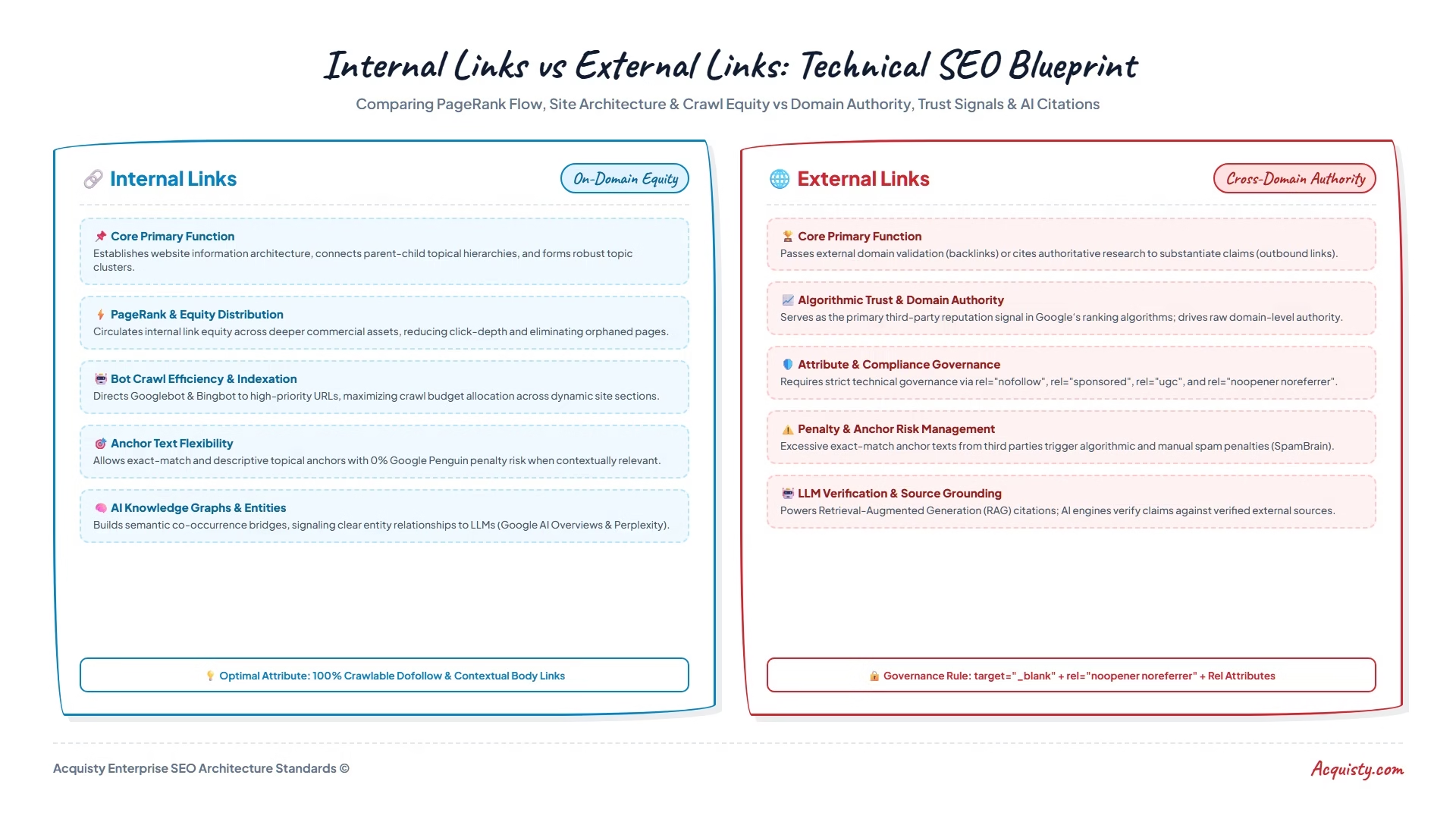
The following comparative architectural matrix breaks down the fundamental differences between internal and external linking across 10 critical enterprise dimensions:
| Technical Dimension | 🔗 Internal Linking Architecture | 🌐 External Linking Dynamics |
|---|---|---|
| Domain Scope | Intra-domain (Strictly within the same host and protocol). | Cross-domain (Connects two separate Autonomous System domains). |
| Primary Algorithmic Role | Circulates PageRank equity; defines taxonomy; aids crawl discovery. | Inbound: Builds domain authority. Outbound: Establishes semantic grounding. |
| Ownership & Control | 100% Controllable: Complete freedom over placement, anchors, and destination. | Partial / External: Outbound is controllable; inbound requires outreach, PR, or earning. |
| Anchor Text Governance | High tolerance for descriptive, exact-match keywords without over-optimization risk. | Strict compliance needed; unnatural inbound exact-match patterns trigger Google SpamBrain penalties. |
| Crawl Budget Impact | Directly guides search bots to priority pages; prevents crawl waste. | Outbound links direct crawlers off-site; inbound links trigger initial crawler visits. |
| User Journey & CRO | Directs visitors along conversion funnels; reduces site bounce rate. | Validates third-party claims; may divert users away if opened in parent tab. |
| Technical Rel Attributes | Default to standard
dofollow
. Never use nofollow internally. | Utilize
rel="sponsored"
,
rel="ugc"
, or
rel="nofollow"
based on relationship. |
| Target Window Protocol |
target="_self"
(Preserves smooth browsing experience within application). |
target="_blank" rel="noopener noreferrer"
(Prevents reverse tabnabbing). |
| Entity Graph Association | Constructs topical silos, entity co-occurrence, and thematic hierarchy. | Anchors domain within global Knowledge Graphs via verified external entities. |
| Maintenance & Decay | Risk of internal 404 broken links, 301 redirect hops, and orphan pages. | Risk of external link rot, expired domain hijacking, and backlink decay. |
2. The Mathematical Foundations: PageRank Mechanics, CheiRank & Crawl Equity
To architect an enterprise internal linking model that drives measurable organic revenue, search marketers must transcend high-level analogies like “link juice” and understand the mathematical equations governing link equity transfer.
The fundamental equation of PageRank, formulated by Larry Page and Sergey Brin at Stanford University, models the probability that a hypothetical user traversing hyperlinks will arrive at a given document A:
PR(A) = (1 – d) / N + d × ∑ [ PR(T_i) / C(T_i) ]
This formula yields several vital architectural implications for enterprise website engineering:
The Evolution to the Reasonable Surfer Model
In early search engine iterations, all links on a page were treated equally—a link buried in a legal disclaimer footer passed the exact same mathematical weight as a prominent link in the opening paragraph. However, Google’s breakthrough patent on the Reasonable Surfer Model (US Patent 7,720,835) fundamentally transformed link equity distribution.
Under the Reasonable Surfer Model, search engines calculate the probabilistic likelihood that a real human user will interact with a specific link based on its Document Object Model (DOM) positioning, visual styling, and contextual prominence:
Algorithmic Pro-Tip (Reasonable Surfer Weighting): Links positioned high within the editorial body copy, rendered in contrasting colors, surrounded by semantically relevant paragraphs, and accompanied by explicit anchor text receive substantially higher PageRank multipliers than links located in boilerplate headers, secondary sidebars, or footer clusters. For maximum technical impact, integrate your core commercial internal links into early contextual editorial text rather than relying solely on global navigation menus.
📖 Recommended Reading
What is SEO and How Does It Work? The Enterprise Blueprint for Organic Search Supremacy — Discover how search engine crawlers, mathematical ranking algorithms, and technical search infrastructure intersect to drive compounding enterprise search performance.
3. Enterprise Information Architecture: Silos, Clusters & Hub-Spoke Models
Effective internal linking is impossible without a sound information architecture (IA). When scaling enterprise websites containing hundreds or thousands of URLs, digital leaders must implement deliberate architectural models to organize topical entities and direct algorithmic crawlers.
The two predominant architectural frameworks employed by high-performance enterprise teams are Physical Siloing and Virtual Topic Clustering:
The Hub-and-Spoke (Pillar-Cluster) Model
In modern content marketing strategy and enterprise organic execution, the Hub-and-Spoke model represents the single most effective structure for establishing topical authority:
- The Pillar Hub: A comprehensive, high-level guide targeting broad, high-volume commercial or informational queries (e.g., our master guide to On-Page SEO services).
- The Supporting Spokes: Hyper-focused, granular articles targeting long-tail queries and specific sub-topics (e.g., URL slug optimization, header tag hierarchy, schema markup implementation).
- Bidirectional Hyperlink Routing: Every spoke links directly back to the pillar hub using descriptive anchor text, and the pillar hub references each spoke within its relevant subsection. Furthermore, adjacent spokes link horizontally to each other when contextually relevant.
This bidirectional linking structure signals to Google’s semantic index that your domain offers complete, exhaustive coverage of the entity cluster. To automate and map these intricate topical relationships, enterprise teams often deploy our automated AI Keyword Cluster & Search Intent Generator, ensuring zero blind spots in topical coverage.
Compressing Click-Depth & Reclaiming Orphan Pages
Two of the most destructive architectural flaws uncovered during technical enterprise audits are excessive click-depth and orphan pages:
- The 3-Click Rule: Every critical commercial page, service offering, and high-converting asset must be reachable within 3 clicks or fewer from the homepage. When URLs are buried 5, 6, or 7 clicks deep, crawl frequency drops precipitously, and incoming PageRank dissipates completely.
- Orphan Page Eradication: An orphan page is an active URL that possesses zero incoming internal links from within the website’s navigation or body copy. Even if the URL is submitted in an XML sitemap, search engine crawlers struggle to discover or prioritize it. Orphan pages represent wasted development resources and lost revenue opportunities. In large-scale eCommerce SEO programs and complex website development builds, automated crawl routines must continually flag and reconnect orphaned product variants and deprecated blog posts into active taxonomy hubs.
4. Anchor Text Optimization: Relevance vs. Algorithmic Risk
The anchor text—the visible, clickable text string enclosed within a hyperlink—is one of the most powerful contextual signals in search engine retrieval. It explicitly informs algorithmic bots and human users what the destination document represents. However, the rules governing anchor text optimization diverge completely between internal and external links.
Internal Anchor Text Freedom vs. Cannibalization Traps
A persistent myth in modern SEO is that websites can be penalized for using “too many exact-match internal anchor texts.” Google’s Webmaster Guidelines and algorithmic enforcement systems (including Google Penguin and SpamBrain) strictly target manipulative external backlink profiles. You cannot trigger a manual or algorithmic Google over-optimization penalty through descriptive, keyword-rich internal links.
However, internal linking introduces an equally dangerous structural failure: Internal Keyword Cannibalization. When multiple distinct pages on your website are internally linked using the exact same keyword anchor text, you confuse search engines regarding which URL is the true canonical authority for that query.
Critical Governance Rule (Cannibalization Prevention): Maintain a strict 1-to-1 mapping between your core target commercial keywords and their designated canonical landing pages. For instance, if you are targeting “Off-Page SEO Services,” ensure that 100% of internal links using that exact anchor point exclusively to your dedicated Off-Page SEO service page—never to a general blog post or adjacent case study.
External Inbound Anchor Text Governance
In stark contrast to internal linking, third-party inbound backlink profiles must maintain natural mathematical diversity. In enterprise digital PR and link acquisition campaigns, aggressive exact-match commercial anchors (e.g., hundreds of external sites linking with the exact phrase “best CRM software”) trigger algorithmic link spam filters, resulting in rank suppression or algorithmic demotions.
High-authority backlink profiles naturally adhere to balanced distribution curves:
- Branded Anchors (45% – 55%): Company name, brand variants, executive names (e.g., “Acquisty,” “Acquisty Agency”).
- Topical & Partial Match Anchors (20% – 25%): Natural descriptive phrases combining topic and context (e.g., “enterprise growth strategies from Acquisty,” “comprehensive technical SEO analysis”).
- Naked URLs & Generic Anchors (15% – 20%): Clean URL strings and operational callouts (e.g., “https://acquisty.com,” “source,” “visit website”).
- Exact Commercial Matches (5% – 10%): Highly restricted, organic commercial terms earned through high-tier editorial placements.
5. Technical Attributes & Protocol Governance: Dofollow, Nofollow, Sponsored & UGC
The technical attributes appended to hyperlinks govern how search bots interpret link equity transfer, commercial relationships, and security protocols. Misconfiguring these attributes can inadvertently nullify your internal SEO investments or violate search engine spam policies.
Client-Side Rendering (CSR) vs. Server-Side Rendering (SSR) in Link Discovery
In modern web engineering utilizing React, Angular, Vue, or Next.js, a frequent technical failure occurs when internal links are implemented as JavaScript click handlers (
<button onclick="navigate('/page')">
or
<div role="link">
) instead of semantic HTML anchor elements.
Googlebot and Bingbot perform two distinct waves of indexing: the initial HTML parsing wave and the delayed Web Rendering Service (WRS) wave. Non-semantic JavaScript links cannot be followed during the first wave; they must wait in the rendering queue until computing resources become available, which can delay link discovery by days or weeks. For flawless technical SEO execution, every internal navigational element must output semantic HTML anchor tags with valid
href
attributes directly in the initial server response.
6. The Generative AI & LLM Frontier: How AI Overviews & Perplexity Traverse Link Graphs
The search landscape is undergoing its most profound transformation in three decades with the emergence of generative AI search systems, including Google AI Overviews, Microsoft Copilot, Perplexity AI, and SearchGPT. In this new paradigm of AI-driven search optimization, hyperlinks perform dual roles that extend far beyond raw PageRank calculation.
Generative search engines operate on Retrieval-Augmented Generation (RAG) frameworks. When a user submits an intricate conversational query, the engine executes vector searches to retrieve authoritative document passages, constructs a dynamic Knowledge Graph, and synthesizes an answer while citing verified source documents. Hyperlinks are the exact semantic bridges these systems utilize to evaluate factual validity:
7. The Enterprise Link Audit & Maintenance Protocol: A 6-Step Implementation Blueprint
Maintaining an optimal link graph across an enterprise website requires systematic operational governance. High-growth organizations, whether operating high-velocity B2B service models (SEO for B2B Services) or recurring subscription platforms (SEO for SaaS), must institute regular technical audit workflows.
Follow this 6-step enterprise audit protocol to identify and remediate link graph decay:
8. Frequently Asked Questions: Enterprise Link Architecture
Explore detailed technical answers to the most critical architectural questions encountered by enterprise search directors and engineering teams:
Engineer a High-Performing Information Architecture & Link Graph with Acquisty
Building and maintaining a mathematically sound link graph is the single highest-leverage investment an enterprise can make to accelerate organic revenue. Acquisty’s senior technical search strategists conduct full-scale mathematical PageRank simulations, eliminate crawl friction, restructure topic silos, and implement algorithmic internal linking systems that multiply your search visibility across Google, Bing, and conversational AI search engines.