


Every single day, prospective customers across the world type millions of questions, challenges, and buying queries into search engines. They are not looking for flashy corporate slogans, aggressive pop-up banners, or high-pressure sales pitches. They are looking for clear answers, actionable solutions, and trusted guidance to solve real operational and personal problems.
When a prospect searches for a solution and lands on a webpage that delivers an insightful, thorough, and easy-to-read answer, something powerful happens: trust is instantly established. The reader views the authoring company not as an aggressive vendor trying to extract money, but as an indispensable industry authority. When the time comes to hire a service provider, select software, or purchase a product, that company is naturally their first choice.
This is the fundamental objective of content writing. Content writing is not merely typing words to fill empty space on a website or churning out robotic blog entries to satisfy an arbitrary publishing quota. In modern digital marketing, content writing is the strategic discipline of creating valuable, search-optimized, and audience-centric editorial assets that attract qualified prospects, educate decision-makers, and systematically guide them through the buyer’s journey into paying customers.
In this comprehensive guide, we demystify content writing in plain English: what it is, how it differs from direct-response copywriting, the primary content formats every business needs, proven copywriting frameworks that simplify complex subjects, and a step-by-step workflow to build an inbound content engine that generates compounding traffic, qualified leads, and enterprise revenue.
- Content Marketing Generates 3x More Leads Than Outbound Marketing: Extensive research published by Demand Metric reveals that strategic content marketing produces over 300% more qualified business leads than traditional outbound marketing while costing 62% less on an ongoing basis.
- 82% of Marketers Actively Invest in Content Writing: The annual B2B and B2C marketing research conducted by Content Marketing Institute (CMI) confirms that 82% of high-growth organizations maintain dedicated content writing budgets, citing organic search visibility and thought leadership as their top acquisition drivers.
- Long-Form Content (≥ 3,000 Words) Gets 77.2% More Referring Domains: An empirical study analyzing 912 million blog posts conducted by Backlinko demonstrates that comprehensive, long-form articles earn 77.2% more backlinks and generate 3.5x more social shares than shallow 500-word articles.
- 70% of Customers Prefer Learning About a Company Through Articles: Survey data compiled by HubSpot indicates that over 70% of business buyers and consumers explicitly prefer learning about a brand, product, or service through helpful educational articles rather than sponsored advertisements.
- Executive Decision-Makers Consume 3 to 5 Content Assets Before Contact: Industry research from Gartner shows that enterprise buyers and high-ticket B2B decision-makers read between 3 and 5 pieces of in-depth content before ever reaching out to a vendor or submitting a sales inquiry.
Content Writing vs. Copywriting: Understanding the Essential Difference
One of the most frequent points of confusion for business owners, founders, and marketing managers is the distinction between content writing and copywriting. While both disciplines require crafting written words for a commercial enterprise, they serve entirely different purposes across the customer acquisition lifecycle:
| Strategic Dimension | Content Writing (Inbound & Educational) | Copywriting (Direct Response & Sales) |
|---|---|---|
| Primary Objective | Educate, solve problems, nurture trust, answer search intent | Persuade, eliminate friction, trigger immediate buying action |
| Sales Funnel Stage | Top & Middle of Funnel (TOFU & MOFU: Awareness & Consideration) | Bottom of Funnel (BOFU: Decision, Checkout & Conversion) |
| Primary Formats | In-depth blog guides, case studies, whitepapers, industry analyses | Landing pages, sales pages, PPC ad headlines, email sales pitches |
| Tone & Perspective | Educational, objective, authoritative, empathetic, conversational | Urgent, emotional, punchy, benefit-driven, persuasive |
| SEO Integration | Heavy focus on user search queries, topical clusters & semantic depth | Focus on conversion rate optimization (CRO) & click-through rate (CTR) |
| Economic Lifespan | Compounding digital asset (ranks and captures leads for years) | Immediate response (performance tied to active marketing spend) |
| Primary Success Metric | Organic search rankings, average session time, assisted conversions | Immediate conversion rate, cost per acquisition (CPA), direct sales |
To understand the distinction in real life, consider how a customer buys professional services. Suppose a business owner is experiencing high website bounce rates and declining revenue. When they search Google for “why is my website bounce rate so high,” they are looking for diagnosis, not a sales pitch. A strategic content writing guide explains the top technical and UX reasons for high bounce rates, providing immediate diagnostic clarity. Through this helpful guide, the business owner discovers that their technical page architecture is sluggish.
When the reader subsequently clicks over to a service page to book a technical consultation, copywriting takes over: concise benefit bullets, trust badges, customer testimonials, and an urgent call-to-action convince them to fill out the form right then. Content writing brings qualified prospects to your digital doorstep and establishes undeniable authority; copywriting invites them inside and closes the deal.
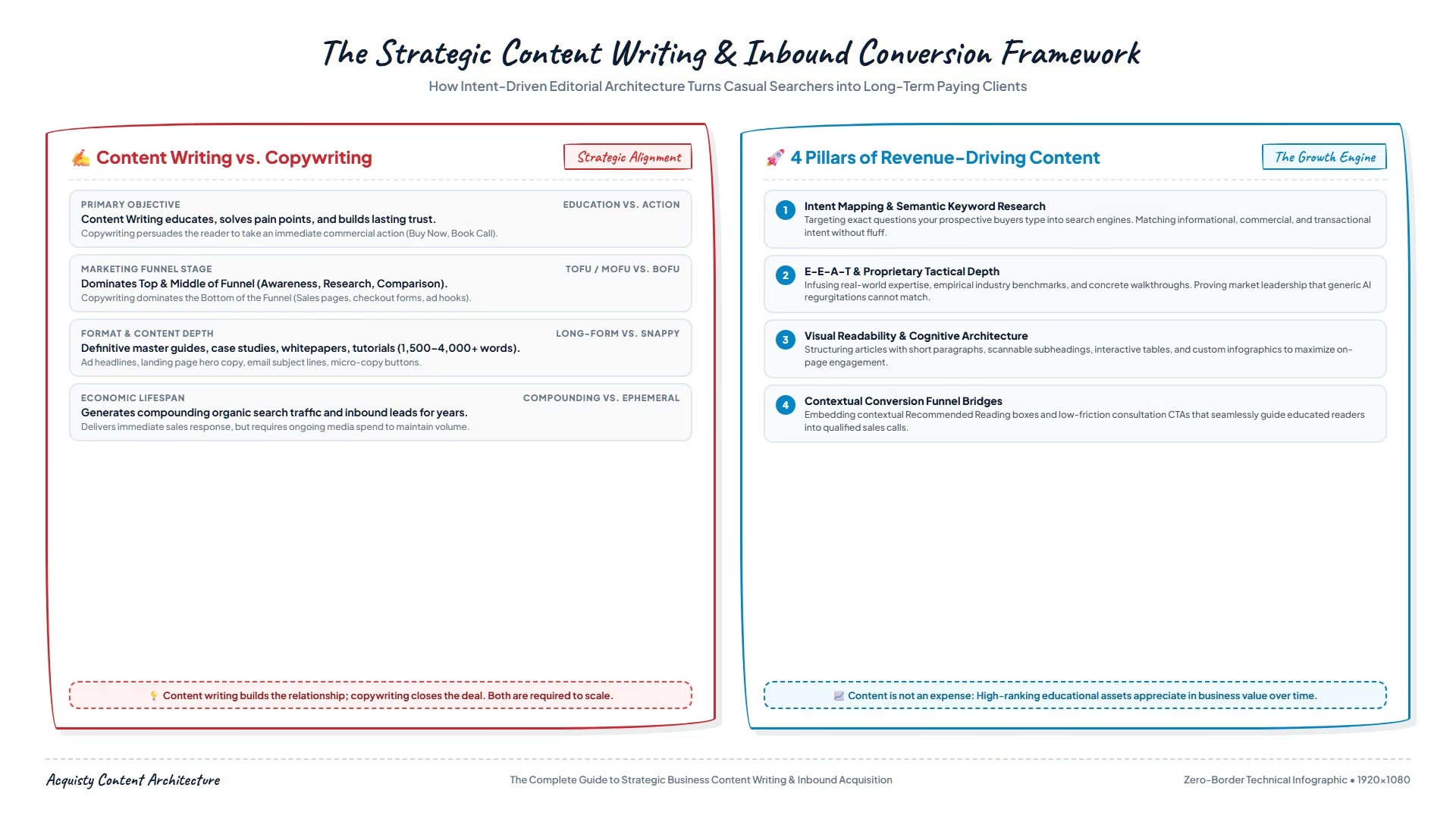
Visual Architecture: The Strategic Content Writing Framework
To visualize how intent-driven content writing guides prospects from initial search awareness through education and into qualified sales opportunities, examine the architectural framework below:
The 6 Essential Types of Business Content Writing
Depending on your business model, customer buying journey, and target market, your content engine will incorporate different editorial formats. Here are the six primary types of business content writing that drive pipeline and revenue:
1. Search-Optimized (SEO) Blog Guides & Pillar Articles:
These are comprehensive, long-form articles engineered to rank at the top of Google search results for specific informational and commercial queries. Rather than publishing superficial 500-word summaries, SEO pillar guides delve deeply into customer questions, resolving search intent so thoroughly that readers never need to return to Google. Each published guide acts as a permanent, 24/7 digital representative for your business that attracts pre-qualified prospects without ongoing advertising costs.
2. In-Depth Case Studies & Customer Proof Stories:
Case studies provide the empirical evidence that skeptical B2B buyers require before making substantial purchasing decisions. A high-converting case study follows a clear narrative arc: the client’s original operational roadblock, the exact strategic methodology deployed, and the audited commercial results (such as revenue lift, time saved, or conversion improvement). Highlighting authentic client outcomes eliminates purchase risk and shortens executive sales cycles.
3. Authoritative Whitepapers, E-Books & Industry Research:
For enterprise consulting, finance, technology, and B2B services, whitepapers represent the gold standard of lead generation. Packaging proprietary industry surveys, technical benchmarks, or regulatory walkthroughs into a downloadable PDF allows your company to capture executive contact information. Prospects gladly trade their email address and job title for insights that help them make critical corporate decisions.
4. Nurture Newsletters & Automated Email Sequences:
Driving traffic to your website is only the first step; retaining prospect attention until they are ready to transact is where email content writing shines. Value-driven weekly newsletters and automated email drip sequences deliver ongoing education, share practical tips, and celebrate client wins. Consistent email writing keeps your brand at the forefront of the buyer’s mind when contract renewal or vendor selection arrives.
5. Product Guides, Knowledge Bases & Implementation Docs:
Content writing does not conclude when a sales contract is signed. Customer retention, user onboarding, and product adoption rely heavily on crystal-clear technical documentation. Well-written knowledge base articles, step-by-step implementation walkthroughs, and FAQ repositories empower clients to extract maximum value from your offering, reducing support ticket volume and minimizing churn.
6. Executive Thought Leadership & Founder Perspectives:
In competitive markets, buyers do not simply purchase products; they buy into vision, integrity, and leadership. Executive thought leadership pieces—published on company blogs, Forbes, or LinkedIn—tackle emerging industry shifts, critique prevailing orthodoxies, and share lessons from the front lines of business. Thought leadership attracts top-tier talent, media interviews, speaking engagements, and strategic partnerships.
4 Proven Content Writing Frameworks That Make Complex Topics Simple
One of the biggest hurdles business owners and writers face is taking intricate, highly technical concepts and communicating them in a way that is engaging, easy to understand, and commercially compelling. Professional content writers rely on time-tested psychological frameworks to structure ideas logically:
Framework 1: The AIDA Model (Attention → Interest → Desire → Action)
AIDA is the classic advertising model adapted brilliantly for educational content writing:
- Attention: Open with a surprising statistic, a contrarian perspective, or a vivid customer problem that stops the reader from scrolling.
- Interest: Unpack the underlying reasons behind the problem, explaining why common remedies fail and presenting fascinating industry context.
- Desire: Illustrate the tangible benefits of solving the issue, showing real-world examples and proof that success is readily attainable.
- Action: Conclude with a clear, low-friction next step—whether reading an in-depth companion guide, downloading a free template, or requesting an audit.
Framework 2: The PAS Model (Problem → Agitate → Solve)
PAS is widely regarded as the most reliable formula for persuasive problem-solving articles:
- Problem: Clearly define the exact pain point the reader is struggling with (e.g., “Your organic traffic has plateaued despite publishing weekly blog posts.”).
- Agitate: Highlight the hidden costs of ignoring the problem—wasted payroll, lost market share to competitors, and declining pipeline velocity. Make the emotional and financial pain urgent.
- Solve: Introduce the clear, structured solution step-by-step, positioning your methodology as the definitive cure for their frustration.
Framework 3: The BAB Model (Before → After → Bridge)
The BAB formula is exceptional for transformation-focused case studies and educational tutorials:
- Before: Paint an empathetic picture of the reader’s current frustrating reality—complex spreadsheets, confusing data, and inconsistent sales leads.
- After: Describe the ideal future state—predictable inbound inquiries, automated lead scoring, and market leadership.
- Bridge: Show how your strategic framework, process, or service serves as the bridge that safely transports them from their current pain to their desired goal.
Framework 4: The FAB Model (Features → Advantages → Benefits)
When writing product guides or service comparisons, the FAB framework ensures you never talk solely about technical specifications:
- Features: What the service or product actually is (e.g., “Comprehensive 50-point technical SEO audit.”).
- Advantages: What the feature does (e.g., “Detects broken links, crawl errors, and slow-loading assets across all pages.”).
- Benefits: What the outcome means for the client’s bottom line (e.g., “Increases Google crawl frequency, elevates search rankings, and generates 45% more inbound sales inquiries.”).
Applying these structured frameworks prevents writer’s block, eliminates confusing industry jargon, and guarantees that every paragraph pulls the reader closer to a business decision.
📖 Recommended Reading
Long-Tail Keywords in SEO: The Step-by-Step Guide to Finding High-Intent Search Terms That Convert — Learn how to pair your content writing with low-competition, high-intent search queries that attract ready-to-buy customers to your business without expensive paid ads.
Step-by-Step Walkthrough: The 6-Step Inbound Content Writing Engine
Producing exceptional business content that consistently generates pipeline and revenue requires a disciplined, repeatable process. Rather than treating writing as an unpredictable creative exercise, high-performing marketing teams treat it as an engineered production workflow. Follow this battle-tested, six-step execution engine:
Step 1: Identify Real Customer Pain Points & Sales Objections:
Never brainstorm article ideas in an executive vacuum. The most profitable content topics already exist inside your sales and customer success conversations. Interview your sales representatives, review recorded customer discovery calls, and examine support tickets. What are the top 10 questions prospects ask before purchasing? What misconceptions prevent buyers from signing proposals? What technical obstacles cause customers frustration? When your content directly answers genuine commercial objections, it becomes an automated 24/7 sales enablement tool that primes prospects to buy before they ever speak with a sales rep.
Step 2: Map Keywords to Exact Searcher Intent:
Conduct comprehensive keyword research to uncover how real decision-makers phrase their problems in search engines. Classify every query into its primary intent category:
- Informational Intent: Prospects seeking education (e.g., “what is content writing” or “how to calculate customer acquisition cost”). Deliver deep, actionable clarity.
- Commercial Investigation Intent: Prospects comparing options (e.g., “best content marketing agencies” or “HubSpot vs Salesforce for B2B”). Provide unbiased comparison tables and evaluation criteria.
- Transactional Intent: Prospects ready to purchase (e.g., “hire enterprise SEO agency”). Direct them to dedicated conversion landing pages.
Never write an article without identifying its primary target keyword, secondary semantic queries, and specific intent stage.
Step 3: Architect for Cognitive Readability & Skimmability:
Online readers do not read web pages like paperback novels; they scan headers, diagrams, bold sentences, and bullet points. Format your articles for rapid visual digestion:
- Keep paragraphs short (strictly 2 to 3 sentences maximum) to maintain comfortable whitespace on mobile screens.
- Use informative, descriptive H2 and H3 subheadings that allow a scanning executive to grasp the core takeaway in under 20 seconds.
- Incorporate bold lead-ins for list items, clean comparison tables, and visual callout boxes to break up dense paragraphs.
Clear visual typography lowers bounce rates and signals to Google’s ranking systems that your page offers a superior user experience.
Step 4: Infuse Real-World Expertise & Data Benchmarks (E-E-A-T):
Google’s Search Quality Evaluator Guidelines place immense emphasis on Experience, Expertise, Authoritativeness, and Trustworthiness (E-E-A-T). Anyone can look up a basic definition, but only genuine industry leaders can share authentic war stories, proprietary data benchmarks, and contrarian insights. Elevate your content by citing empirical studies from reputable research institutions, embedding proprietary client metrics, and sharing candid practitioner advice that generic AI tools cannot reproduce.
Step 5: Engineer Contextual Internal Link Bridges:
An educational article should never be a dead end. Every guide should serve as an intentional bridge to other relevant resources across your website. Interlink related topic guides to build comprehensive topical authority, link out to relevant client case studies that validate your claims, and link to your core service offerings. Circulating organic search equity across your domain elevates search rankings site-wide while guiding warm readers deeper into your conversion funnel.
Step 6: Audit for Content Decay & Refresh Continuously:
Publishing an article is not the finish line; it is the beginning of an ongoing asset lifecycle. Over 12 to 24 months, statistical citations become outdated, competitor websites publish new analyses, and keyword rankings can gradually soften—a phenomenon known as content decay. Schedule bi-annual content audits to refresh statistics, expand sections with recent case studies, update meta titles, and optimize internal links. Regularly updating existing high-performing posts often delivers a 50% to 100% traffic increase with a fraction of the effort required to produce brand-new content from scratch.
If your marketing team wants to build an end-to-end inbound editorial pipeline that consistently ranks on Google and generates high-ticket clients, explore our specialized content marketing services to accelerate your growth.
How to Measure Content Writing Success: 5 Practical Business KPIs
One of the most dangerous traps in digital marketing is obsessing over vanity metrics—such as raw page views or social media likes—that have zero correlation with bank deposits. To build an executive-approved content program, focus on these five commercial key performance indicators (KPIs):
1. Non-Brand Organic Traffic & Keyword Breadth:
Track the number of non-brand keywords your content ranks for in positions 1 through 10 on Google Search Console. Brand searches (people searching your exact company name) represent existing awareness, whereas non-brand searches (people searching commercial solutions without knowing your brand) represent net-new audience acquisition.
2. Engaged Reading Time & Scroll Depth:
In Google Analytics 4 (GA4), examine average engagement time per session. If an in-depth 3,000-word article has an average engagement time of 15 seconds, readers are bouncing immediately due to poor formatting or mismatched search intent. High-performing content maintains average engagement times of 2 to 4 minutes and scroll depths exceeding 70%.
3. Content-Assisted Lead Conversions:
Configure multi-touch attribution in your CRM or GA4 to track assisted conversions. Prospective enterprise buyers rarely fill out a contact form on their first article visit. By tracking how many closed deals touched your blog guides during their research phase, you prove the direct pipeline contribution of your content assets.
4. High-Intent Organic Inquiries & Form Submissions:
Monitor direct conversion actions initiated from blog posts, such as booking a strategy consultation, downloading an enterprise whitepaper, or requesting pricing. Calculate the organic conversion rate (leads divided by unique page visitors) to identify which articles produce the highest commercial yield.
5. Compounding CAC Reduction (Customer Acquisition Cost):
Paid ad clicks stop flowing the second you pause your advertising budget. Conversely, a search-optimized content asset continues to attract organic prospects month after month with zero additional media cost. Over 12 to 24 months, your effective customer acquisition cost plummets as organic pipeline compounds.
| Metric Type | Vanity Indicator (Low Commercial Value) | Revenue Indicator (Executive Value) |
|---|---|---|
| Audience Reach | Gross pageviews and impressions | Target ICP non-brand organic search visitors |
| Reader Interest | Social media likes and retweets | Engaged reading time > 3 mins & scroll depth > 75% |
| Conversion Impact | Total generic email subscribers | Qualified sales discovery calls & RFP invitations |
| Financial ROI | Word count published per month | Pipeline generated & Customer Acquisition Cost (CAC) reduction |
The 30-Day Content Writing Sprint: A Practical Business Roadmap
If your company has struggled to maintain an active editorial schedule, attempting to plan six months in advance can feel overwhelming. Instead, execute this focused, four-week content sprint designed to publish your first four high-impact pillar articles:
Week 1: Customer Discovery & Topic Architecture
Dedicate the first week entirely to research and planning. Spend 60 minutes interviewing your top sales performers to document the 10 most common prospect questions. Cross-reference these questions with keyword research tools to discover exact search volumes and search intent. Select four high-priority topics that bridge customer pain points with your primary service solutions. Create a comprehensive editorial outline for each article detailing H2 subheadings, target word counts, and required data benchmarks.
Week 2: Subject Matter Expert Interviews & Drafting
Conduct brief 20-minute recorded interviews with internal subject matter experts (SMEs)—such as your head of engineering, senior consultants, or founder. Capture their authentic opinions, technical explanations, and client case studies. Use these transcripts to draft comprehensive articles that reflect genuine practitioner expertise. Focus on clarity, empathy, and depth, aiming for 2,500 to 3,500 words per pillar guide.
Week 3: Editing, Visual Design & On-Page Optimization
Perform a rigorous editorial review to eliminate fluff, shorten long sentences, and ensure clear subheadings. Check the article against our comprehensive on-page SEO best practices: optimize title tags, craft compelling meta descriptions, format descriptive alt text for images, and embed custom infographics or comparison tables. Insert contextual internal links connecting new drafts to your core service pages and high-priority posts.
Week 4: Publishing, Promotion & Multi-Channel Distribution
Publish your scheduled articles on WordPress with clean formatting, responsive tables, and structured FAQ schema. Do not let published content sit quietly on your blog. Repurpose each guide into multiple distribution assets: a 5-part LinkedIn carousel for company leaders, an insightful newsletter for your email subscribers, and summary talking points for your sales team to share during prospect follow-ups. Consistent distribution amplifies initial reach while search engines index the page for long-term organic rankings.
To understand how authoritative on-page content pairs with overall search marketing architecture, review our end-to-end guide to search engine optimization services.
Why Human Strategic Writing Out-Performs Generic AI Content
With the widespread availability of generative AI tools like ChatGPT and Claude, many business owners wondered if they could simply press a button to generate hundreds of blog posts at near-zero cost. In practice, companies that flooded their websites with unedited, automated AI content experienced severe organic traffic drops, Google algorithmic penalties, and damaged brand reputations.
Here is why human strategic writing remains irreplaceable for building authentic business authority and generating high-ticket sales pipeline:
At Acquisty, we utilize AI for semantic research, preliminary topic clustering, and data discovery, while relying entirely on expert human strategists to craft the authentic brand voice, real-world case studies, and conversion architecture that turn casual readers into loyal clients.
10 Costly Content Writing Mistakes That Destroy Marketing ROI
Even talented writers can fail to generate tangible business results if they fall into common commercial traps. Protect your content marketing investment by avoiding these ten frequent mistakes:
1. Writing Without a Clear Search Intent Target:
Publishing an article simply because the topic sounds interesting—without researching whether anyone is actually searching for it on Google—guarantees that the piece will receive zero organic traffic over its lifespan.
2. Burying the Solution Under Endless Fluff:
If a reader searches for a specific diagnostic answer, do not force them to scroll past five paragraphs of generic dictionary definitions before providing the solution. Deliver immediate value upfront to capture attention and slash bounce rates.
3. Dense, Unreadable “Walls of Text”:
Nothing causes modern mobile readers to hit the back button faster than six-line paragraphs on a small smartphone screen. Break text into bite-sized paragraphs, bulleted lists, bold callouts, and clean tables.
4. Forgetting the Next Logical Step (Missing CTAs):
An informative article that ends abruptly without inviting the reader to subscribe, download a checklist, or schedule a strategic consultation wastes the hard-earned attention you invested resources to attract.
5. Sacrificing Human Readability for Keyword Stuffing:
Repeating your target keyphrase in every single sentence creates robotic, awkward prose that repels prospective clients and triggers Google search spam algorithms. Write naturally for human decision-makers first, search engines second.
6. Inconsistent Publishing Schedules:
Publishing five articles in a single week and then disappearing for six months confuses search engine crawlers and prevents your brand from building consistent audience momentum. Predictable consistency compounds organic authority.
7. Ignoring On-Page Visuals & Architecture:
Articles featuring custom infographics, structured tables, and visual callouts keep readers engaged on page significantly longer than plain-text documents, boosting dwell time and ranking signals.
8. Neglecting Internal Linking Bridges:
Every blog guide should contextually link back to your core service pages and related topic cluster articles, circulating search equity throughout your website while guiding warm prospects toward conversion.
9. Talking Exclusively About Yourself:
Prospective buyers do not care about your internal office parties or awards; they care about solving their own pressing business challenges. Frame every piece of content around the customer’s problems, risks, and financial outcomes.
10. Failing to Measure Pipeline & Business Outcomes:
Traffic is a vanity metric; revenue is a sanity metric. Track which specific articles generate form submissions, phone inquiries, and assisted sales conversions inside your CRM rather than celebrating meaningless pageview spikes.
To learn how authoritative content connects with external authority signals to dominate Google search, read our detailed guide on what off-page SEO is and how to build backlinks.
Frequently Asked Questions About Content Writing
Ready to Turn Your Website into an Inbound Customer Acquisition Engine?
Stop wasting marketing budget on generic articles that fail to rank or convert. Partner with Acquisty’s technical content writing and inbound growth specialists to create high-impact, revenue-driving content that dominates search and scales your business.