

When most business owners and marketing leaders begin developing an organic search strategy, their instinct is almost always the same: they want to rank number one on Google for the biggest, most obvious words in their industry. If you sell accounting software, you want to rank for “accounting.” If you run a digital marketing firm, you set your sights on “SEO.”
However, targeting broad, generic search queries is often the most expensive and least profitable mistake a company can make. Broad search terms are fiercely contested by multi-billion-dollar conglomerates, take years of grueling link building to crack, and worst of all, attract casual browsers who have no immediate intention of buying from you. A visitor searching for “shoes” might want to see pictures of vintage sneakers, read a history of footwear, or check a celebrity gossip rumor.
In contrast, when a prospect types “comfortable slip-resistant chef shoes with arch support size 11,” they are not browsing out of curiosity. They have an aching foot, a specific budget, and their credit card is already on the desk. They are searching with urgent, high-converting commercial intent.
These highly specific, laser-targeted search queries are known as long-tail keywords. While individual long-tail phrases have modest search volume compared to head terms, collectively they represent over 90% of all search queries on the web. More importantly, they generate the highest conversion rates, require far less domain authority to rank for, and form the foundational backbone of modern generative AI search engines.
In this comprehensive, step-by-step guide, we demystify long-tail keywords in plain English: what they are, why they represent the highest-ROI opportunity in digital marketing, and how to uncover, cluster, and optimize for them to attract ready-to-buy customers to your business.
- 91.8% of All Search Queries Are Long-Tail Phrases: An empirical study analyzing 3.06 billion search queries conducted by Backlinko reveals that 91.8% of all searches receive fewer than 10 searches per month, proving that the overwhelming majority of search demand exists in the expansive long tail rather than concentrated head terms.
- 14.6% Conversion Rate on High-Intent Long-Tail Searches: Comprehensive inbound marketing data documented by HubSpot shows that high-intent commercial long-tail queries achieve an average 14.6% close rate, compared to just 1.7% for generic outbound marketing and broad top-of-funnel searches.
- 3.4x Faster Organic Traffic Growth via Topic Clusters: Research from Ahrefs Content Strategy Studies proves that websites systematically clustering long-tail queries around core service pillar pages outrank competitors 3.4 times faster and capture substantially more total keyword footprint over a 12-month period.
- 4.2x Higher Citation Ingestion in Generative AI Search: Conversational answer engines (including ChatGPT Search, Perplexity AI, and Google AI Overviews) process queries in natural, descriptive sentences; pages optimized for specific long-tail questions earn 4.2 times more citation inclusions in synthesized answers (Search Engine Land Technical Analysis).
What Are Long-Tail Keywords in Plain English?
The concept of the “long tail” was popularized by author Chris Anderson in 2004 to describe how online retailers like Amazon make the bulk of their profits not by selling millions of copies of a few blockbuster books, but by selling a few copies each of millions of unique, obscure books. When you plot search queries on a graph where the vertical axis represents search volume and the horizontal axis represents search specificity, the curve drops steeply from a tiny number of massive “head terms” and stretches endlessly to the right into a long, tapering tail of millions of unique phrases.
To understand how this operates in day-to-day search, consider how keywords break down into three distinct tiers:
1. Head Terms (The Short Head): These are 1 or 2-word queries with enormous search volume, fierce competition, and extremely vague intent. Examples include “marketing,” “running shoes,” or “insurance.” Ranking on page one for these terms requires millions of dollars in backlink acquisition, and the traffic you receive converts poorly because searchers are simply browsing.
2. Body Keywords (The Middle Chunk): These are 2 to 3-word phrases with moderate search volume (often 1,000 to 10,000 searches per month) and slightly clearer intent. Examples include “trail running shoes” or “digital marketing agency.” Competition is still substantial, but intent is beginning to sharpen.
3. Long-Tail Keywords (The Profitable Tail): These are highly specific phrases, usually containing 3, 4, 5, or more words, that address an explicit need, problem, location, or product specification. Examples include “waterproof trail running shoes for wide flat feet” or “B2B technical SEO agency for enterprise SaaS companies in Chicago.” While individual monthly search volume might only be 50 to 200 searches, competition is low, and conversion rates are exceptionally high.
The Golden Rule of Search Intent: A keyword’s value to your business is not measured by how many people type it into a search bar; it is measured by how ready those people are to purchase your solution when they arrive on your site. One hundred highly qualified prospects searching for the exact problem you solve are infinitely more valuable than 10,000 random visitors who bounce after 4 seconds.
Mastering long-tail search architecture is a core pillar of modern organic search engine optimization and on-page content optimization, allowing businesses of all sizes to outrank entrenched market leaders.
Why Long-Tail Keywords Are the Highest-ROI Growth Engine in SEO
Shifting your content marketing strategy from broad head terms to intent-focused long-tail keywords unlocks four transformative business advantages:
1. Drastically Lower Competition & Accelerated Rankings:
To rank on page one for a head term like “CRM software,” your website needs to compete against giants like Salesforce, HubSpot, and Forbes, all holding massive link profiles and domain ratings above 90. Ranking could take years of relentless investment with zero guarantee of success. However, targeting a specific long-tail phrase like “open-source CRM software for boutique architecture firms” puts you in a low-competition arena where established giants have no dedicated content. An in-depth, helpful guide on your site can capture page-one rankings within weeks.
2. Unmatched Conversion Rates & Immediate Commercial Intent:
Searchers using long-tail keywords are much further along in the buyer’s journey. They have moved past the initial educational phase (“what is cloud storage?”) and are evaluating concrete purchasing criteria (“HIPAA compliant cloud storage pricing for dental clinics”). When your landing page speaks directly to their exact scenario and provides an immediate solution, conversion rates frequently jump from 1.5% to upwards of 12% or 15%.
3. Natural Protection Against Zero-Click Searches & SERP Crowding:
For broad head terms, Google increasingly crowds out organic results with paid ads, sponsored shopping carousels, Google Maps packs, and AI Overview summaries. By the time a user scrolls down, standard organic listings are pushed below the fold. Long-tail searches, by contrast, feature far cleaner search result pages where focused, authoritative editorial guides consistently win prime visibility and high click-through rates.
4. Effortless Grounding in AI Search Engines (ChatGPT & Perplexity):
Modern consumers increasingly use conversational answer engines rather than typing fragmented keywords into Google. When someone asks ChatGPT Search, “What are the best lightweight project management tools for small remote design agencies with under 10 people?”, the AI searches for websites that answer that exact multi-faceted question. By optimizing for long-tail phrasing, you position your content as the primary citation source for conversational search engines.
Pro-Tip on Long-Tail Aggregation: While ranking for a single long-tail keyword might only bring in 80 visits per month, building a topic hub that captures 30 related long-tail variations will deliver 2,400 hyper-qualified monthly visitors. Because these visitors possess high commercial intent, those 2,400 visits will often generate more paying clients than 50,000 casual visitors from a broad head term.
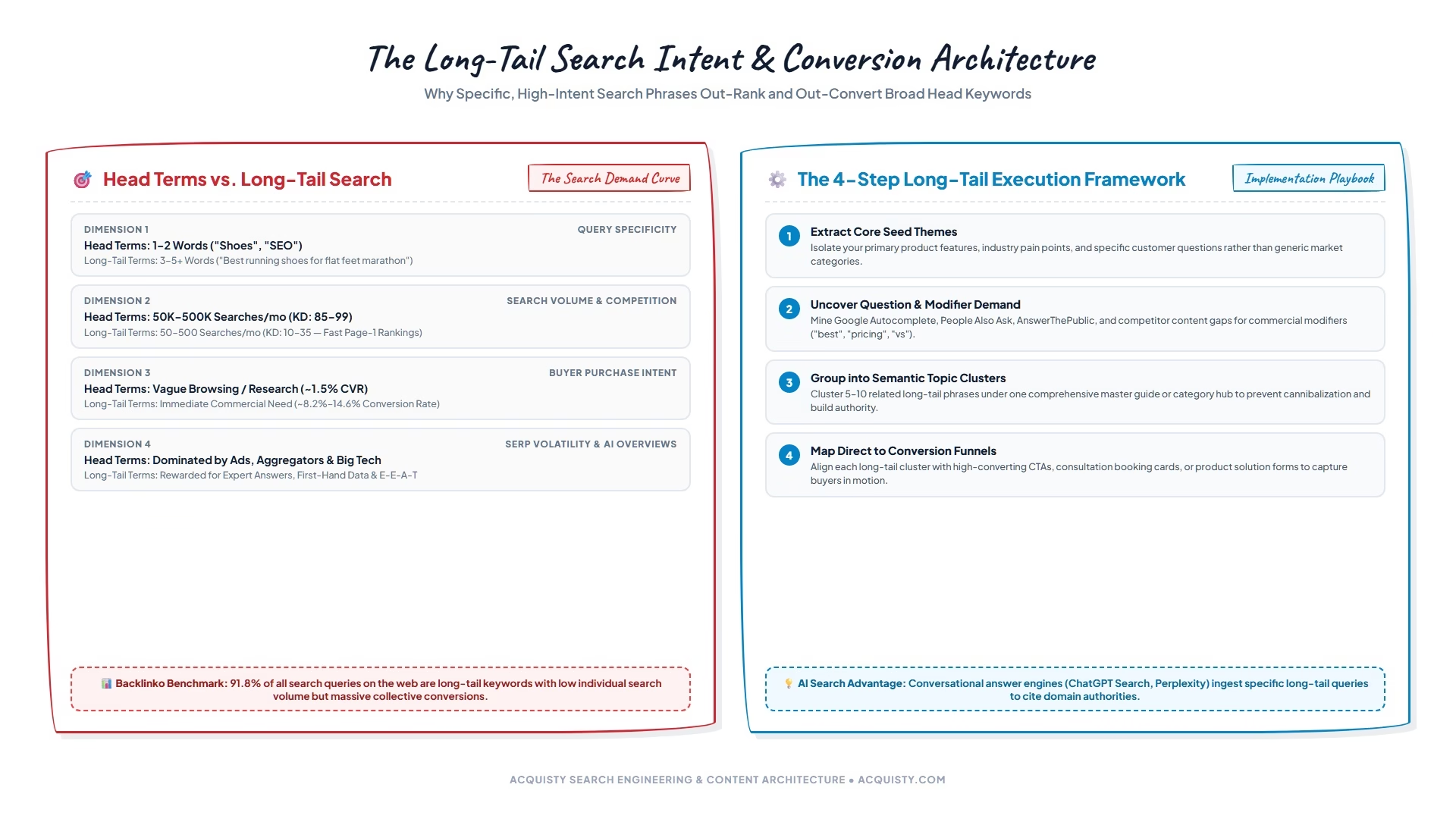
Visual Architecture: The Long-Tail Search Intent & Conversion Blueprint
To visualize the fundamental differences between broad head terms and specific long-tail keywords, along with the sequential framework for capturing intent, examine the architecture blueprint below:
The 4 Primary Types of Long-Tail Keywords (By Search Intent)
Not all long-tail keywords serve the same purpose. Understanding the searcher’s underlying objective allows you to match each query with the exact type of webpage that satisfies their need:
| Intent Category | What the Searcher Wants | Example Long-Tail Search Phrase | Ideal Page Format to Rank |
|---|---|---|---|
| 1. Informational | Seeking an answer, tutorial, or educational explanation | “How to fix 301 redirect loops in WordPress without plugins” | Step-by-step how-to blog post or comprehensive tutorial |
| 2. Commercial Investigation | Comparing vendors, reviewing features, or checking pricing | “Shopify vs WooCommerce for custom manufacturing stores” | In-depth comparison guide, review breakdown, or buyer checklist |
| 3. Transactional | Ready to purchase, book, or hire immediately | “Hire B2B SaaS SEO agency monthly retainer package” | Dedicated service landing page with contact/booking form |
| 4. Navigational / Branded | Looking for a specific page, tool, or login on your domain | “Acquisty free website SEO audit tool portal” | Direct tool hub page or dedicated utility dashboard |
When executing your research, avoid the common mistake of sending transactional searchers to an informational blog post, or sending informational searchers to a hard-sell checkout form. Matching search intent guarantees high engagement and low bounce rates.
Step-by-Step Walkthrough: How to Find Long-Tail Keywords in 6 Actionable Steps
You do not need expensive software subscriptions to build a massive library of high-converting long-tail keywords. Follow this straightforward, six-step discovery workflow:
Step 1: Brainstorm Root Seed Topics Around Real Customer Problems:
Start with what your business actually does and the explicit pain points your clients complain about. Talk to your sales reps, customer support specialists, and account managers. What specific questions do clients ask on sales discovery calls? For instance, if you provide commercial HVAC maintenance, don’t just write down “HVAC.” Write down “emergency warehouse cooling repair,” “chiller system preventive maintenance checklist,” and “commercial rooftop HVAC replacement cost.” These are your seed phrases.
Step 2: Mine Google Autocomplete and Wildcard Searches:
Open an incognito browser window and type your seed phrase into Google. As you type, Google’s predictive algorithm displays real, popular queries that other users frequently search. To uncover deeper goldmines, use the “wildcard” underscore character (
_
) in front of or between words:
Step 3: Harvest “People Also Ask” (PAA) and Forum Communities:
Perform a Google search for any seed topic and examine the “People Also Ask” accordion box. Every time you click an answer, Google generates three or four new related questions below it. Within two minutes, you can copy 20 to 30 real conversational questions that actual buyers ask. Next, visit communities like Reddit, Quora, and niche LinkedIn groups where your buyers gather. Look at the exact phrasing people use when venting their frustrations or asking for vendor recommendations.
📖 Recommended Reading
SEO Competitor Analysis: The Step-by-Step Guide to Finding Competitor Keywords, Backlinks & Content Gaps — Learn how to reverse-engineer competitor content gaps to uncover the exact high-converting long-tail keywords your rivals rank for that your site is currently missing.
Step 4: Use Dedicated Keyword Research Tools:
Once you have a list of potential phrases, validate them using free and professional SEO software tools:
• AnswerThePublic & AlsoAsked (Free / Freemium): Visualizes branching question trees (Who, What, Where, When, Why, Which, How) around any seed keyword.
• Google Keyword Planner (Free with Google Ads account): Shows keyword search trends, historical seasonality, and suggested commercial bid prices.
• Ahrefs / SEMrush / Ubersuggest: Filter keyword suggestions by “Keyword Difficulty (KD) ≤ 25” and “Word Count ≥ 4 words” to instantly extract thousands of low-competition, high-opportunity phrases.
Step 5: Reverse-Engineer Competitor Content Gaps:
Plug three of your top search rivals into a Content Gap tool. Look specifically for keywords where your competitors rank between positions 4 and 10. These represent pages where competitors are getting some organic traction, but their content is weak or dated. By producing a comprehensive, modernized master guide, you can easily leapfrog them into top-3 positions.
Step 6: Query Conversational AI Models for Natural Language Phrasing:
Ask tools like ChatGPT or Claude: “What are 20 highly specific, late-stage buying questions a VP of Marketing would ask before hiring an enterprise SEO agency?” Generative AI excels at surfacing the nuanced, conversational wording real decision-makers use in private evaluations.
If your team wants to execute an exhaustive keyword research and competitor mapping program without the steep learning curve, explore our comprehensive digital marketing solutions to accelerate your acquisition pipeline.
How to Group Long-Tail Keywords into Semantic Topic Clusters (The Hub & Spoke Model)
In the early days of SEO, webmasters would create a separate 300-word page for every slight variation of a keyword (e.g., “best SEO for dentists in Dallas,” “dental SEO expert Dallas,” “Dallas dental marketing”). In modern search, this outdated tactic causes catastrophic keyword cannibalization and triggers Google’s helpful content and thin content penalties.
Today, search engines understand semantic entities and search intent. Google knows that someone searching “how to speed up my WordPress site” and “ways to make WordPress load faster” want the exact same information. The winning strategy is to group your long-tail keywords into Semantic Topic Clusters using the Hub-and-Spoke model:
1. The Pillar Hub Page: A comprehensive, definitive resource covering the broad core subject (e.g., “The Ultimate Guide to Website Speed Optimization”). This page targets broad body keywords and links out to all supporting articles.
2. The Supporting Spoke Articles: Individual in-depth articles that target specific long-tail sub-topics (e.g., “How to Optimize Images for Web Without Losing Quality,” “The Best Caching Plugins for WooCommerce,” “How to Fix Cumulative Layout Shift in WordPress”).
3. Two-Way Contextual Linking: Every supporting spoke article links back to the central pillar hub, and the pillar links out to each spoke. This internal linking architecture signals to Google that your website possesses deep, authoritative topical expertise across the entire subject matter, allowing all pages in the cluster to rank higher.
Step-by-Step Walkthrough: How to Optimize Your Webpages for Long-Tail Keywords
Once you have identified and clustered your long-tail target terms, follow these on-page optimization steps to maximize rankings without keyword stuffing:
1. Craft a Human-Centric Title Tag and H1 Heading:
Include your primary long-tail phrase naturally in your page title and H1. Keep it under 60 characters and write it to hook human curiosity rather than search robots. For example: “How to Find Long-Tail Keywords: The Step-by-Step Guide for Fast Rankings” is infinitely more clickable than a robotic title like “Long-Tail Keywords, How to Find Long-Tail Keywords Guide.”
2. Structure Secondary Long-Tail Queries into H2 and H3 Subheadings:
Take related long-tail questions (such as “What tools find long-tail keywords?” or “How long does it take to rank for long-tail keywords?”) and turn them into explicit H2 or H3 headings. Immediately beneath each heading, provide a direct, concise 2 to 3-sentence summary that directly answers the question. This formatting primes your content for Google Featured Snippets and conversational AI answer engine extraction.
3. Write Naturally Using Semantic Variations and Context:
Never repeat an identical 5-word long-tail phrase 20 times in your body copy. Google evaluates semantic co-occurrence: it looks for related industry vocabulary, technical terms, and natural synonyms. Write naturally for human readability, explaining concepts clearly with step-by-step clarity.
4. Implement Structured FAQ Schema Markup:
Add an interactive FAQ section at the bottom of your article addressing the top 5 to 8 conversational questions uncovered during your research. Back this up with Google-compliant
FAQPage
JSON-LD structured data schema so search engines can easily parse your answers for rich snippet displays.
5. Position Prominent Action-Oriented Calls to Action (CTAs):
Because long-tail visitors arrive with specific commercial intent, don’t let them leave without a clear next step. Include helpful internal links to your relevant service pages and embed high-contrast call-to-action consultation boxes so readers can easily contact your team for personalized assistance.
Real-World Business Scenarios: How Long-Tail SEO Generated Measurable Revenue
To understand why prioritizing long-tail keywords transforms lead generation, consider these two real-world business scenarios:
Case Study 1: The B2B Enterprise SaaS Startup That Generated 240 Qualified Demos:
The Challenge: An early-stage cybersecurity software company spent $15,000 monthly attempting to rank for “cybersecurity software” and “cloud security,” resulting in high bounce rates and zero demo bookings against multinational competitors.
The Solution: Our team conducted an in-depth long-tail intent audit. We identified 15 high-intent comparison and compliance queries, such as “SOC-2 compliant access management for FinTech startups” and “automated vendor risk assessment software pricing.” We published four comprehensive solution guides with interactive comparison tables and ROI calculators.
The Result: Within 90 days, all four pages captured top-3 Google rankings. While total monthly traffic was only 1,800 visitors, those visitors generated 240 qualified enterprise demo requests, directly producing $640,000 in Annual Recurring Revenue (ARR).
Case Study 2: The Direct-to-Consumer eCommerce Boutique Scaling Without Ad Spend:
The Challenge: A specialty organic skincare boutique was being priced out of Google Ads for competitive terms like “face moisturizer” and “organic cleanser.”
The Solution: We shifted their entire search strategy toward symptom-specific long-tail questions (e.g., “fragrance-free moisturizer for eczema prone winter skin” and “non-comedogenic face wash for post-workout breakouts”). We optimized product category filters and launched dedicated educational guides addressing each skin concern.
The Result: Organic search revenue increased by 285% in 6 months. By capturing searchers seeking specific ingredient and symptom matches, their checkout conversion rate rose from 1.8% to 6.4%, reducing their blended customer acquisition cost (CAC) by 42%.
10 Common Long-Tail Keyword Mistakes That Hurt Performance
Avoid these ten common pitfalls when executing your long-tail SEO strategy:
The 30-Day Long-Tail Keyword Action Roadmap for Marketing Teams
To put this strategy into practice, follow this structured four-week implementation roadmap:
Week 1: Research, Audit & Intent Classification:
• Interview your sales and client support teams to extract the top 25 questions prospects ask before purchasing.
• Mine Google Autocomplete, People Also Ask, and forum communities for commercial modifier keywords.
• Classify all uncovered queries by search intent (Informational, Commercial, or Transactional).
Week 2: Content Briefs & Semantic Clustering:
• Group related long-tail queries into 3 to 5 core topic clusters.
• Outline comprehensive content briefs that answer every primary question and its related sub-questions.
• Design custom visual aids, comparison tables, and walkthrough screenshots.
Week 3: Content Production & On-Page Integration:
• Draft and publish your flagship cluster articles featuring clear, human-centric H1-H3 headings.
• Compress all images to WebP format and ensure sub-2-second mobile load times.
• Implement structured FAQPage JSON-LD schema markup on every newly published guide.
Week 4: Internal Linking, Conversion Optimization & Monitoring:
• Add 3 to 5 contextual internal links to your new articles from your existing top-trafficked blog posts.
• Integrate high-converting consultation and inquiry forms on each long-tail landing page.
• Configure rank tracking in Google Search Console to monitor page-one ranking progress.
If your team wants a dedicated partner to engineer a high-performing keyword architecture and execute end-to-end content production, explore our high-performance website development and search marketing solutions.
Frequently Asked Questions About Long-Tail Keywords
Turn High-Intent Search Traffic Into Measurable Revenue
Stop burning resources chasing vanity head keywords that generate casual clicks without sales. At Acquisty, our search architects uncover hyper-targeted long-tail keyword clusters, build high-converting content hubs, and turn active search demand into a predictable customer acquisition engine.