

Every business wants to rank at the top of Google for high-value search terms. But when you look at page one, you often find established competitors dominating the top spots, hoovering up the vast majority of clicks, phone calls, and customer inquiries. It can feel like an impossible uphill battle to break through.
Here is the good news that most marketing teams overlook: your competitors have already done the heavy lifting for you. Over years of trial and error, they have spent thousands of dollars testing which keywords convert, which content formats engage readers, and which websites provide authoritative backlinks. Their website is an open book of market data waiting to be read.
This is where SEO competitor analysis becomes your greatest competitive advantage. Rather than guessing what topics to write about or hoping that Google notices your pages, competitor analysis allows you to reverse-engineer exactly why your rivals rank where they do. It reveals their top traffic-driving keywords, highlights their content weaknesses, and provides a clear, step-by-step roadmap to surpass them.
You do not need to decipher complicated mathematical formulas or academic algorithms to conduct a game-changing competitor review. In this practical, step-by-step guide, we break down what SEO competitor analysis is, how to identify your real search rivals, and how to execute a straightforward audit that captures market share and drives revenue.
- 54.4% of Total Search Clicks Dominated by Top 3: Large-scale SERP research analyzing over 4 million Google queries conducted by Backlinko reveals that the top 3 organic positions capture 54.4% of all clicks, with position #1 averaging a 27.6% click-through rate.
- 3.4x Faster Organic Traffic Growth via Content Gaps: Research on search growth trajectories from Ahrefs Content Strategy Studies proves that marketing teams systematically closing competitor keyword gaps achieve organic search growth 3.4 times faster than teams producing isolated content without competitive data.
- 68% Higher Outreach Success via Link Intersect: Industry outreach data from HubSpot Inbound PR Benchmarks shows that digital PR pitches targeting websites linking to 2 or more direct competitors convert at a 68% higher rate than generic cold outreach lists.
- 2.8x Higher Commercial Conversion on Comparison Terms: B2B customer journey analytics published by Gartner Research reveals that buyers searching for competitor alternatives and solution comparisons convert into active sales conversations at 2.8 times the rate of broad informational queries.
What Is an SEO Competitor Analysis and Why Is It Your Secret Weapon?
At its core, an SEO competitor analysis is the practice of investigating the organic search presence of the websites currently ranking ahead of you. It answers four fundamental business questions:
1. Where does their organic traffic come from? Which specific blog posts, product pages, or service guides drive 80% of their search visitors?
2. What keywords are they ranking for that you are missing? Where are the lucrative “content gaps” where prospects are searching for solutions your business provides, but your website has no matching content?
3. Who links to them and why? Which industry publications, news outlets, trade associations, and directory sites have endorsed your competitors?
4. Where are their weaknesses? Are their articles outdated? Do their pages load slowly on mobile phones? Is their user experience clunky? Every flaw your competitor exhibits is an opportunity for your business to provide a better alternative.
Ranking on Google Is a Relative Game: Google does not require your website to be perfect in an absolute vacuum. Google simply strives to show the best, most helpful, and most trustworthy answer among the available choices. If your top competitor has a 1,200-word article with outdated 2021 statistics, you do not need to perform miracles to beat them—you simply need to provide a fresh, comprehensive 2,500-word guide with current data, actionable walkthroughs, and clean design.
By pairing competitor intelligence with strategic organic SEO services and targeted digital marketing campaigns, your company can bypass years of guesswork and scale organic lead generation rapidly.
Business Competitors vs. Organic Search Competitors: The Crucial Difference
One of the most frequent mistakes business owners make when starting an SEO analysis is only looking at their direct corporate competitors. It is vital to distinguish between two different competitor groups:
1. Direct Business Competitors: These are companies that offer the identical product or service as you, in the same pricing tier, targeting the exact same buyer. For example, if you run an accounting firm in Chicago, your direct business competitors are the other accounting firms downtown.
2. Organic Search Competitors: These are websites that occupy page one of Google for the search terms your potential clients type in. This includes your direct competitors, but it also includes industry blogs, software tools, news publishers (like Forbes or Investopedia), review sites, and comparison portals. Even if an industry publisher does not sell accounting services, if they rank #1 for “small business tax planning strategies,” they are competing for your audience’s attention.
To win on search, you must analyze both groups: your direct competitors to see how they position their service pages, and organic search competitors to see what informational content Google loves to reward.
The 5 Pillars of an Actionable SEO Competitor Analysis
An effective competitor audit examines five distinct pillars to construct a 360-degree view of your competitive landscape:
| Analysis Pillar | What to Inspect | Primary Discovery | Strategic Output |
|---|---|---|---|
| 1. Top Traffic Pages | Top-ranking URLs, organic monthly visits, traffic distribution | Which 5-10 pages generate 80% of their organic leads? | Identifies high-priority core topics for your editorial calendar. |
| 2. Keyword & Content Gaps | Keywords where rivals rank in top 10, but your site is missing | Uncovered search demand you are currently failing to capture. | Creates a prioritized list of high-intent articles to write. |
| 3. Backlink Profile & Outreach | Referring domains, anchor text distribution, digital PR citations | Which industry websites recommend your competitors? | Gives you an actionable list of warm outreach prospects. |
| 4. Technical Health & UX | Mobile PageSpeed, Core Web Vitals, site navigation, CTAs | Are competitors delivering a clunky or slow experience? | Allows you to win conversions by offering a faster, cleaner site. |
| 5. Modern AI Search Citations | Brand mentions in ChatGPT, Perplexity, and AI Overviews | Who is recognized as the definitive source by AI answer engines? | Positions your brand for the next decade of conversational search. |
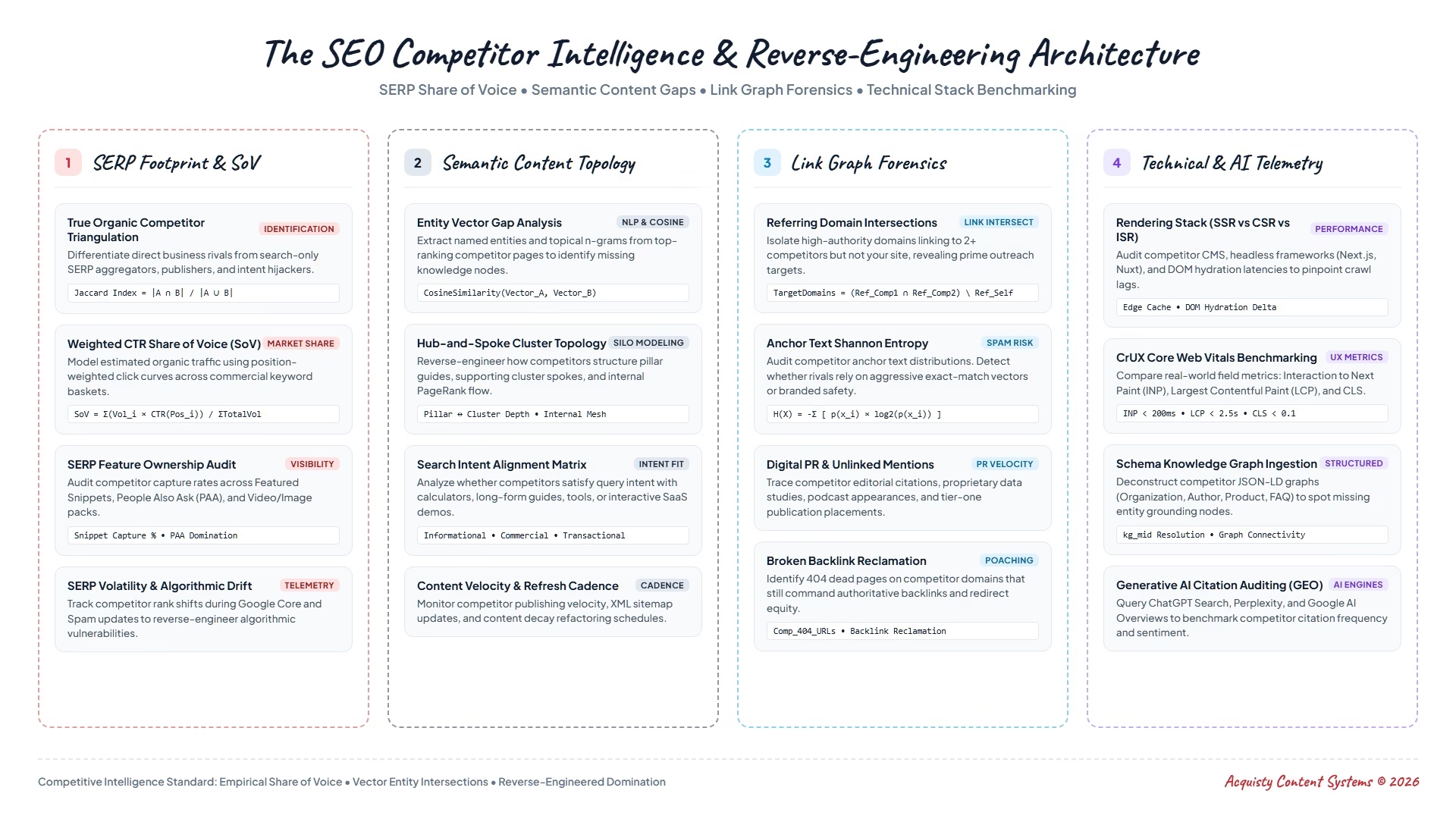
Visual Architecture: The Competitor Reverse-Engineering Framework
To see how competitor keyword intelligence, backlink reverse-engineering, and content execution flow together into a cohesive acquisition strategy, review the architectural diagram below:
Step-by-Step Walkthrough: How to Analyze Your Competitors in 5 Practical Steps
Follow this straightforward, five-step walkthrough to extract high-value competitor insights without getting lost in data overload:
Step 1: Identify Your Top 3 to 5 Organic Search Competitors:
Start by compiling a list of 5 to 10 of your most important commercial search terms (e.g., “B2B cybersecurity consulting,” “custom enterprise software,” or “commercial solar installation”). Open an incognito browser window, search for each keyword, and note which domains consistently appear in positions 1 through 5. You will quickly spot 3 or 4 recurring domains that dominate your niche. These are your primary organic benchmark targets.
Step 2: Uncover Their Highest-Traffic Pages:
Using an SEO research tool like Ahrefs, SEMrush, or Ubersuggest, enter your competitor’s domain name and open their Top Pages report. This report reveals which exact URLs drive the majority of their search traffic:
Step 3: Run a Keyword & Content Gap Analysis:
The Content Gap tool (available in SEMrush, Ahrefs, and Moz) is one of the most powerful features in digital marketing. Enter your own website URL in the “You” field, and enter your top three competitors in the “Competitors” fields. Set the filter to show keywords where at least two competitors rank in the top 10, but your website ranks nowhere.
Instantly, you receive a golden list of hundreds of search terms that your target buyers are searching for, proven by the fact that multiple competitors are successfully ranking for them. Export this list, group keywords by topic, and schedule them into your content roadmap.
📖 Recommended Reading
Website SEO Audit: The Step-by-Step Guide to Finding & Fixing Search Issues That Hurt Your Traffic — Before outranking competitors, ensure your own technical foundation, site speed, and indexation are completely error-free.
Step 4: Reverse-Engineer Their Backlinks Using Link Intersect:
Backlinks (links from other websites pointing to yours) remain one of Google’s strongest trust signals. Instead of cold-emailing random websites asking for links, use the Link Intersect tool in your SEO software. This tool shows you websites that link to multiple competitors in your space, but have not linked to you.
Why is this so effective? If an industry blog or trade association links to two or three of your competitors, they clearly cover your topic and are open to linking to businesses like yours. Reach out to these webmasters with a superior resource, an updated statistic, or a valuable guest insight to earn high-authority backlinks with significantly higher success rates.
Step 5: Benchmark Their Technical Performance & Conversion Path:
Finally, run your competitors’ top pages through Google’s free PageSpeed Insights tool. Do their pages take 6 seconds to load on mobile? Do intrusive pop-up banners obscure their text? Do they bury their contact forms? If so, you have found an immediate competitive wedge. By building a lightning-fast site with a clean, frictionless user experience, you will naturally win higher engagement and better conversion rates from the traffic you capture.
If your team wants to execute an exhaustive competitor audit without the learning curve of complex SEO suites, our experienced technical SEO specialists can deliver a full competitor intelligence dossier tailored to your market.
The Anatomy of 10x Content: How to Out-Execute Competitor Articles
Finding a competitor’s top-ranking page is only half the battle. To overtake them, you must understand how to create content that is genuinely ten times more useful to human searchers. In modern search engine optimization, this is called the 10x Content Framework. When analyzing a competitor’s winning article, look for these five specific enhancement opportunities:
1. Upgrade Content Freshness & Accuracy: Many top-ranking competitor pages were written three or four years ago. They reference obsolete software versions, quote discontinued pricing, or link to dead research papers. By providing current-year data, fresh industry survey findings, and up-to-date best practices, you immediately give searchers a compelling reason to prefer your guide.
2. Provide Actionable Step-by-Step Walkthroughs: Competitor articles often explain what a concept is, but completely fail to explain how to execute it. Transform theoretical advice into an actionable tutorial: include numbered step-by-step instructions, clear software configuration screenshots, copy-and-paste code snippets, and downloadable workflow templates.
3. Enhance Visual Engagement & Formatting: If your competitor presents a monolithic wall of gray text with no visuals, elevate your page with custom diagrams, branded process flowcharts, clean comparison tables, and highlighted pro-tip callout boxes. Visual aids break up dense topics, keeping readers on your page longer and lowering bounce rates.
4. Address Unanswered Search Intent (The “What Else?” Factor): Scroll to the bottom of the Google search results for your target query and examine the “People Also Ask” and “Related Searches” sections. Frequently, competitors only address one narrow facet of a topic. By answering related buyer questions and addressing common objections directly on your page, you provide a comprehensive one-stop resource.
5. Inject Authentic Real-World Case Examples: Generic advice fails to build brand authority. Ground your advice in real customer experiences: show real before-and-after metrics, discuss tangible challenges your team encountered, and explain how specific obstacles were resolved. Authenticity cannot be replicated by automated scrapers.
Competitor Backlink Replication: 5 Types of High-Value Links You Can Earn
When you reverse-engineer a competitor’s backlink profile using link intersect tools, you will discover that their links fall into several recognizable patterns. Here are five categories of competitor backlinks that your team can systematically replicate:
1. Industry Resource Pages & Tool Directories: Many industry blogs, trade associations, and regional chambers of commerce maintain curated lists of helpful tools, recommended vendors, and industry resources. If a page links to three of your competitors under “Top Industry Solutions,” email the site editor introducing your service and asking to be added to their list.
2. Editorial Roundups & Best-of Lists: Journalists and content creators love publishing roundups (such as “Top 10 B2B Marketing Agencies to Watch”). Find roundups where your competitors were featured, reach out to the author or publication, and share an exclusive data point, case study, or quote that makes your business a natural addition to their next update.
3. Podcast & Webinar Guest Appearances: Look at where competitor founders and marketing executives have been interviewed. Niche podcasts and webinars are constantly seeking knowledgeable guest experts. By pitching your leadership team to the exact same hosts, you earn high-authority editorial backlinks and build industry prestige simultaneously.
4. Unlinked Brand Mentions & Digital PR: Frequently, media publications cite competitor research data without linking, or link to a generic homepage. By tracking where industry journalists source competitor commentary, you can pitch your company’s proprietary data reports to those same journalists for upcoming stories.
5. Broken Competitor Backlinks: Competitors frequently redesign websites, retire old service pages, or change URL structures without setting up 301 redirects. When an external website links to a competitor’s page that now returns a 404 error, you can notify the webmaster of the broken link and politely suggest your live, comprehensive guide as an ideal replacement.
How to Monitor Competitor Changes in Real Time (Alerts & SERP Tracking)
Competitor analysis is not a static project you complete once and file away in a drawer. Search rankings and market strategies change every single week. To stay ahead of your rivals over the long haul, set up these three automated monitoring mechanisms:
1. Set Up Google Alerts for Brand and Executive Names: Create free Google Alerts for your competitors’ brand names, primary product names, and key leadership team members. Whenever a rival announces a new product, sponsors an industry conference, or receives media coverage, you receive an instant email alert.
2. Configure Daily or Weekly SERP Tracking: In your SEO tool (like Ahrefs Rank Tracker or SEMrush Position Tracking), configure automated rank tracking for your top 50 commercial keywords. Enable daily or weekly change alerts so you immediately notice if a competitor jumps into the top three or launches a new competing landing page.
3. Monitor Competitor Content Launches via RSS or Visual Ping: Use website change detection tools (such as Visualping or an RSS reader) to monitor your competitors’ blog hubs and resource libraries. Analyzing what new topics they publish gives you early signals about what new markets or customer pain points they are prioritizing.
10 Common SEO Competitor Analysis Mistakes to Avoid
Avoid these ten common pitfalls when conducting your competitive research:
The SEO Competitor Toolkit: Free vs. Paid Tools for Every Team
You can execute a powerful competitor analysis regardless of your software budget. Here is a breakdown of the most valuable tools available:
1. Google Search Incognito (100% Free): The most underutilized tool in SEO. Searching for target terms in a clean incognito window reveals who holds top rankings, what search features Google displays (such as People Also Ask boxes or AI Overviews), and how competitor titles are phrased to attract clicks.
2. Google PageSpeed Insights (100% Free): Test your competitors’ mobile loading speeds and Core Web Vitals to see where their technical performance falls short.
3. Ahrefs / SEMrush (Paid Suites starting at ~$99 – $130/month): The industry-standard platforms for competitive intelligence. Both offer robust Top Pages reports, Keyword Gap tools, and Link Intersect features that streamline hours of manual research into a few clicks.
4. Similarweb (Free Chrome Extension & Paid Plans): Provides estimated monthly traffic volume, top referral sources, geographic audience breakdown, and audience interest metrics for any major website.
5. AnswerThePublic & AlsoAsked (Free & Freemium): Visualizes the exact questions, comparisons, and prepositional searches users ask around your competitor’s core keywords, highlighting great opportunities for FAQ sections and detailed how-to guides.
Real-World Business Scenarios: How Competitor Analysis Drove Tangible Growth
To see how competitor reverse-engineering transforms into measurable business growth, consider these two real-world scenarios:
Case Study 1: The B2B Tech Consultancy That Found Hidden Long-Tail Gold:
The Challenge: A boutique cloud engineering consultancy struggled to rank against massive multinational IT corporations for broad terms like “enterprise cloud migration.”
The Competitor Discovery: An organic content gap analysis revealed that while legacy giants dominated broad head terms, they completely neglected specific comparison queries such as “AWS vs Azure migration cost calculator” and “HIPAA compliant cloud storage checklist.” Competitors had no dedicated content answering these high-intent buying questions.
The Result: The consultancy published five in-depth, step-by-step comparison guides with downloadable cost calculators. Within four months, they captured top-3 rankings for 42 high-intent search terms, increasing qualified sales conversations by 185% without directly competing for expensive broad keywords.
Case Study 2: The Direct-to-Consumer eCommerce Store Winning Link Intersect Outreach:
The Challenge: A new sustainable activewear brand needed authoritative backlinks to build domain authority, but received low response rates from generic blogger outreach.
The Competitor Discovery: Using a backlink intersect tool, they discovered 68 lifestyle and wellness publications that had linked to three established activewear brands in “Best Eco-Friendly Workout Clothes” roundups over the past year.
The Result: Instead of cold pitching, the brand reached out to the exact journalists who wrote those existing roundups, offering a free product sample and highlighting their unique carbon-neutral certification. Over 25% of the journalists updated their articles to include the new brand, boosting organic search traffic by 220% heading into the holiday shopping season.
Turning Intelligence into Action: The 30-Day Competitor Counter-Strategy
Data without action produces zero revenue. Once you have completed your competitor analysis, translate your findings into a simple, four-week execution sprint:
Week 1: Triage Your Content Gap Priorities:
• Select the top 5 to 10 keyword gaps with the highest buyer intent and moderate search difficulty.
• Outline comprehensive content briefs that address every question your competitors answer—plus the important questions they missed.
• Establish clear visual standards (such as custom diagrams and screenshots) to make your pages more engaging.
Week 2: Publish Your Cornerstone Flagship Resources:
• Draft and publish your first two flagship guides targeting major competitor gaps.
• Ensure proper on-page optimization: unique title tags, clean H1-H3 hierarchies, and fast-loading WebP images.
• Implement structured FAQ schema markup so your answers qualify for rich snippet display.
Week 3: Launch High-Probability Link Intersect Outreach:
• Build a target outreach list of 30 websites that already link to at least two competitors.
• Craft personalized, value-first email pitches offering your new flagship guide as a helpful reference or updated source.
• Reach out to industry podcasts or webinars where competitor executives have appeared as guests.
Week 4: Optimize Conversions and Monitor Ranking Movements:
• Add prominent, frictionless consultation and inquiry forms to all newly published pages.
• Set up rank tracking in your SEO tool to monitor your movement against competitors weekly.
• Celebrate ranking milestones and iterate your strategy based on which pages gain traction fastest.
If you want a dedicated partner to execute this entire growth blueprint on your behalf, explore our high-performance website development and full-funnel search marketing programs.
Frequently Asked Questions About SEO Competitor Analysis
Ready to Outrank Your Toughest Competitors?
Stop letting competitors capture the leads and revenue that should belong to your business. At Acquisty, our performance SEO and digital marketing teams conduct granular competitor intelligence audits that uncover high-impact keyword gaps, high-authority link opportunities, and winning growth roadmaps.