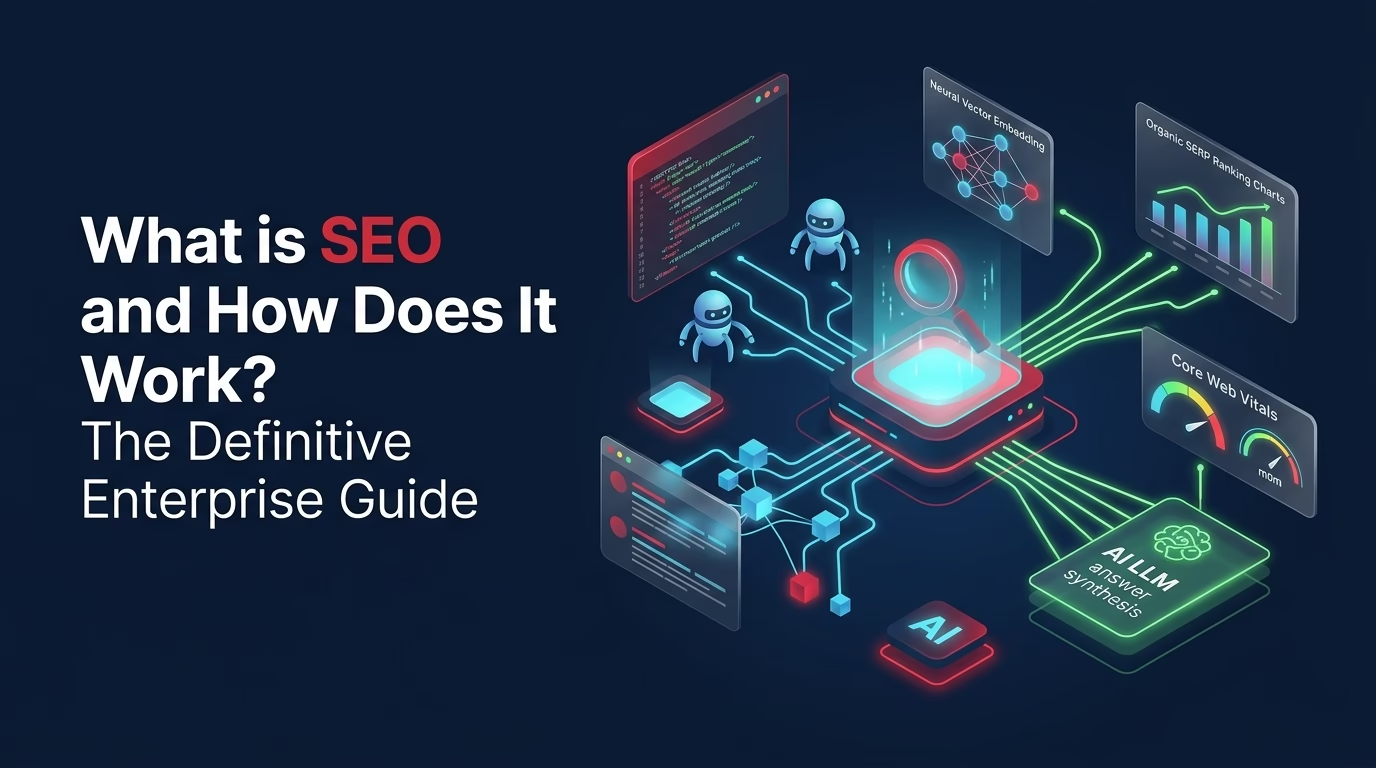


For mid-market enterprises, hyper-growth SaaS platforms, and global brands, organic search is no longer a tactical marketing exercise centered on publishing weekly blog posts or checking off generic 10-point on-page checklists. The modern search landscape has undergone a tectonic shift: retrieval algorithms powered by deep neural networks, vector embeddings, multimodal LLMs, and conversational AI interfaces have fundamentally dismantled legacy lexical SEO mechanics.
Today, achieving durable category leadership demands an architectural, engineering-led discipline. When websites scale to tens of thousands or millions of dynamic URLs, traditional SEO tactics inevitably break down under the weight of faceted crawl bloat, orphan page accumulation, semantic cannibalization, rendering latency, and uncoordinated release cycles. To capture and defend high-intent market share, growth executives must deploy an enterprise SEO strategy rooted in systems architecture, mathematical PageRank circulation, entity graph modeling, and automated engineering governance.
Enterprise Paradigm: Lexical search engines evaluated whether specific keyword strings existed on a webpage. Modern neural search engines evaluate whether an organization possesses verified real-world topical authority, verifiable entity relationships, and unique Information Gain within a specific knowledge domain. Tactical SEO optimizes pages; architectural SEO engineers authoritative knowledge graphs.
According to research from Gartner, corporate websites that formalize enterprise-grade technical governance and cross-functional search architecture realize 2.4x higher organic pipeline velocity and demonstrate 60% greater resilience against broad core algorithmic volatility compared to organizations operating on ad-hoc tactical models. In this definitive enterprise guide, the senior architects at Acquisty deconstruct the 5-pillar architectural framework required to dominate organic search, capture high-margin commercial demand, and future-proof enterprise search visibility.
1. The Paradigm Shift: Why Legacy SEO Checklists Fail at Enterprise Scale
Most corporate SEO initiatives stall because leadership applies small-business tactics to complex enterprise technical ecosystems. In a site with 50 pages, a marketer can manually optimize title tags, publish generic thought leadership, and request ad-hoc backlinks. However, when an enterprise catalog spans 100,000 product variants, multi-regional subdomains, headless single-page applications (SPAs), and continuous CI/CD deployment pipelines, manual checklists collapse into chaos.
Enterprise search success is governed by three fundamental shifts in search engine retrieval mechanics:
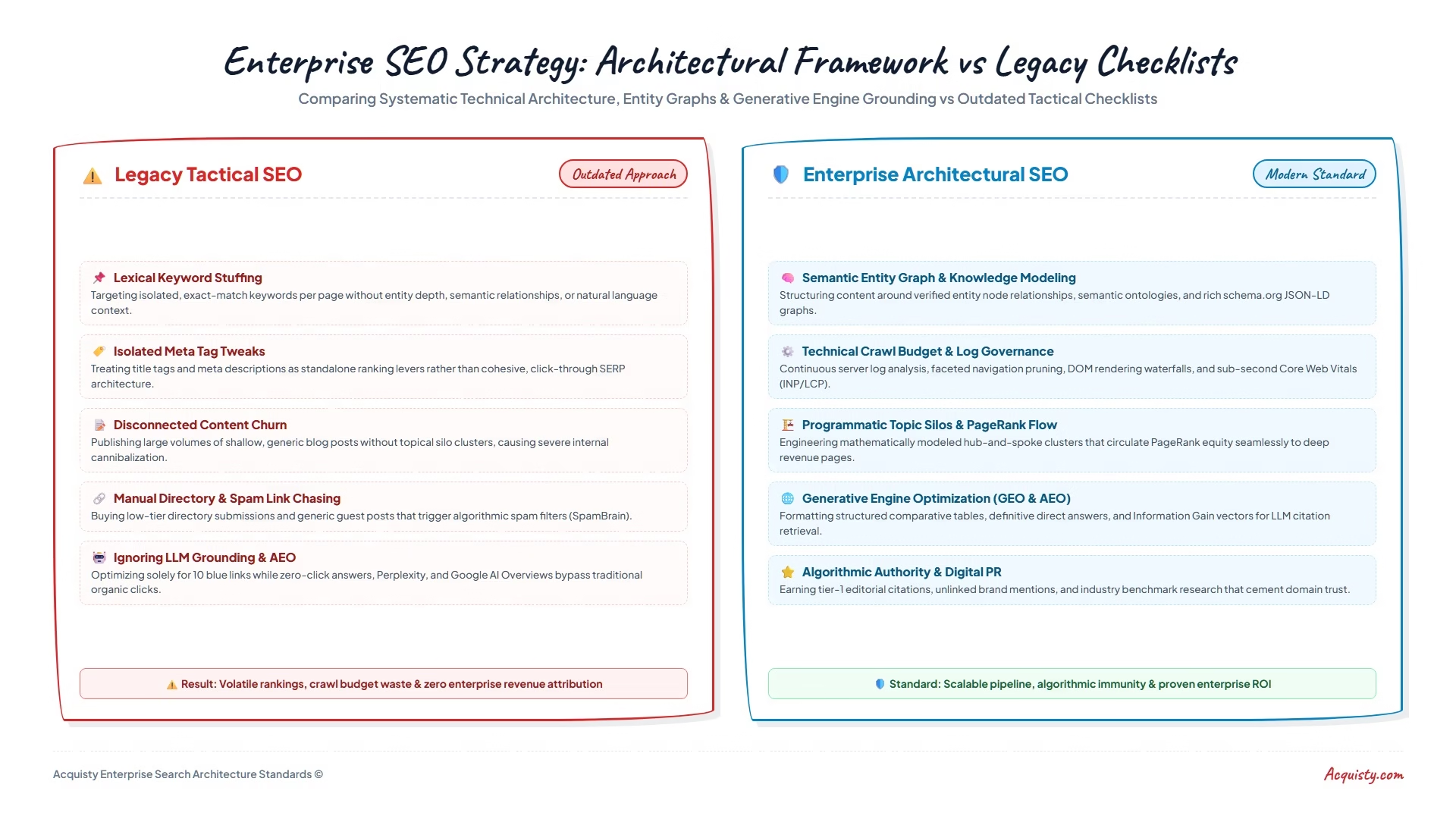
To navigate these algorithmic realities, organizations must replace superficial marketing checklists with a comprehensive 5-pillar strategic architecture. Before examining each technical pillar, the blueprint below contrasts legacy tactical practices against the modern enterprise framework.
2. Pillar 1: Technical Search Infrastructure & Crawl Budget Governance
At enterprise scale, technical SEO is not merely about resolving 404 errors or compressing images; it is the discipline of governing how search engine user-agents discover, render, and index vast digital estates. When a website contains hundreds of thousands of pages, search engine bots allocate a finite time and resource envelope known as the crawl budget. Without rigorous technical constraints, search bots squander resources on infinite parameter loops, faceted filters, and session IDs, leaving high-value commercial pages uncrawled and unindexed.
Executing an enterprise-grade technical SEO architecture requires mastering four core infrastructure disciplines:
A. Server Access Log Analysis & Ground-Truth Crawl Telemetry
Third-party crawling tools (e.g., Screaming Frog, Sitebulb) simulate bot behavior, but they do not reflect how Googlebot or Bingbot actually traverse your production infrastructure. Analyzing raw web server access logs (via ELK stack, Datadog, or BigQuery) reveals the empirical ground truth:
In unhealthy enterprise domains, the Crawl Efficiency Ratio frequently falls below 25%, indicating that over 75% of bot bandwidth is wasted crawling duplicate URLs, sorting queries, expired pagination parameters, or API staging routes. By analyzing log timestamps, status code distributions, and IP verification headers, enterprise technical teams eliminate crawler traps and ensure bot bandwidth directly serves revenue-generating assets.
B. Faceted Navigation Governance & Crawl Traps
Large-scale e-commerce, real estate, and directory platforms rely on faceted navigation to allow users to filter by price, color, brand, size, and location. However, dynamic combinations of 10 filter facets create millions of permutated URLs featuring near-identical content.
The enterprise standard dictates a disciplined three-tiered indexing architecture:
- Indexable Clean Silos: Facet combinations with demonstrated commercial search demand (e.g.,
/shoes/running/mens/) are assigned clean static permalinks, unique metadata, and dedicated XML sitemap entries. - Canonicalized Supporting Views: Single-filter variant views without independent search demand are canonicalized back to their primary parent category URL.
- Pruned Combinations via Robots.txt / AJAX: Multi-select filters (e.g., price ranges, sorting filters, color combinations) are decoupled from standard
<a href>HTML hyperlinks and executed via client-side AJAX or JavaScript state updates without generating crawlable URLs.
C. JavaScript Rendering Waterfalls & Dynamic SSR
Modern enterprise platforms built on React, Next.js, Angular, or Vue frequently suffer from the “two-wave indexing” problem. Googlebot crawls the raw HTML document first; if content and internal links are rendered via client-side JavaScript, the URL is parked in a secondary rendering queue until compute resources become available. This delay can span days or weeks, crippling dynamic product catalog indexing.
Enterprises must enforce Server-Side Rendering (SSR), Static Site Generation (SSG), or edge-computed dynamic pre-rendering (via Cloudflare Workers or Fastly Compute@Edge). When Googlebot requests a page, the complete DOM—including critical semantic headings, structured copy, schema markup, and crawlable
<a href>
internal links—must be delivered in the initial HTTP response packet.
D. Sub-Second Core Web Vitals & Interaction to Next Paint (INP)
User experience metrics directly impact algorithmic ranking thresholds. With Google’s formal transition to Interaction to Next Paint (INP) as a Core Web Vital replacing FID, enterprise engineering teams must govern main-thread JavaScript execution. Heavy tracking pixels, tag managers, unoptimized hydration bundles, and client-side DOM re-calculations induce input delays exceeding 200ms, triggering algorithmic ranking demotions.
Pro-Tip for Technical Leads: Audit third-party script bloat using Google Chrome User Experience Report (CrUX) API. Segregate marketing analytics tags via Server-Side Google Tag Manager (sGTM) hosted on a cloud instance. Moving tracking logic off the client browser reduces main-thread blocking time by up to 65%, instantly elevating INP and LCP scores into the 95th percentile.
3. Pillar 2: Semantic Entity Graph Modeling & Topical Authority Architecture
Modern search engines are not document indexing machines; they are real-world knowledge engines. Under Google’s “Things, Not Strings” framework, every search query is interpreted as an interaction with an underlying entity graph. An entity is a unique, well-defined concept or object (e.g., a corporation, a software category, a technical standard, or an author) characterized by specific attributes and relationships to other entities.
When engineering an enterprise on-page SEO optimization strategy, content teams must move beyond crude keyword lists and construct systematic entity ontologies.
Entity modeling operates across three critical technical layers:
- Subject-Predicate-Object Triples: Natural language processing algorithms decompose copy into relational triples (e.g.,
[Enterprise SEO] --[requires]--> [Crawl Budget Governance]). Copy that clearly articulates relationships between core concepts establishes high semantic confidence in search indexers. - Ontological Attribute Coverage: If an enterprise publishes a guide on “Cloud Security Architecture,” search engine vector models expect comprehensive coverage of co-occurring sub-entities: Zero Trust Network Access (ZTNA), Identity and Access Management (IAM), SOC 2 compliance, and API encryption protocols. Omitting critical semantic nodes signals superficial content depth.
- Interconnected JSON-LD Schema Graphs: Deploying isolated schema snippets (e.g., an unlinked WebPage snippet) is insufficient. Enterprises must connect nested JSON-LD schema graphs that explicitly link
Organization,Author,ItemPage,TechArticle, andAbout/Mentionsproperties back to authoritative Wikidata and Wikipedia URIs.
By defining entity relationships explicitly in machine-readable code, enterprises ensure search engines accurately classify their brand as a definitive topical authority, directly influencing eligibility for featured snippet cards and knowledge panel attributes.
📖 Recommended Reading
What is SEO and How Does It Work? The Enterprise Blueprint for Organic Search Supremacy — Explore the foundational mechanics of search engine indexing algorithms, neural retrieval pipelines, and full-funnel search architecture.
4. Pillar 3: Algorithmic Topic Silos & Mathematical PageRank Distribution
One of the most catastrophic failures in enterprise website architecture is the formation of chaotic, unstructured internal link graphs. In many organizations, internal links are inserted haphazardly without architectural oversight, resulting in two severe operational hazards:
First, keyword cannibalization occurs when multiple subpages compete against each other for identical commercial queries, dividing algorithmic authority and preventing any single page from achieving top-3 ranking positions. Teams can audit cluster boundaries using dedicated tools like Acquisty’s AI Keyword Cluster & Search Intent Generator to group raw keyword inventories into distinct semantic silos before authoring copy.
Second, link equity dilution traps PageRank within low-value utility pages (e.g., legal terms, outdated news releases) while mission-critical revenue landing pages suffer from high click-depth and starved equity circulation.
To eliminate these vulnerabilities, enterprise organizations deploy a Bidirectional Hub-and-Spoke Silo Architecture:
PR(Pillar) = (1 – d) + d × ∑ [ PR(Spoke_i) ÷ C(Spoke_i) ] where d is the damping factor (~0.85) and C(Spoke_i) represents the outbound link count of each supporting spoke.
In a disciplined silo model, a high-authority pillar page (such as an enterprise service or product category hub) links downstream to specialized, granular spoke pages. Crucially, each spoke page links directly back to the parent pillar and laterally only to sibling spoke pages within the exact same thematic cluster. Cross-silo links to unrelated topics are strictly quarantined. This preserves thematic topical purity, ensures crawl bots process tightly bounded semantic units, and routes accumulated link equity directly into high-margin commercial conversion pages.
5. Pillar 4: Generative Engine Optimization (GEO) & AI Answer Grounding
As conversational search interfaces like Google AI Overviews, Perplexity AI, and ChatGPT Search capture increasing query share, enterprises must expand their search strategy from traditional SERP placement to Generative Engine Optimization (GEO) and Answer Engine Optimization (AEO). Generative search interfaces do not simply return lists of blue links; they synthesize multi-source information into cohesive real-time summaries, citing only a select handful of verified authoritative sources.
According to empirical studies conducted by Search Engine Land, appearing inside a Google AI Overview generates a 3.8x higher conversion rate than a standard organic position 5 ranking, as generative citation confers immediate brand endorsement. Securing citations across LLM answer engines requires designing content for machine ingestion through our specialized AI SEO services framework:
6. Pillar 5: Algorithmic Authority, Entity Citations & Enterprise Digital PR
Backlinks remain a fundamental pillar of Google’s core ranking algorithms, but the mechanics of link equity have evolved dramatically. Algorithmic spam filters like Google SpamBrain automatically detect and neutralize artificial link-building schemes, paid directory links, and generic guest blogging networks. In enterprise environments, relying on outsourced manual link vendors introduces severe brand reputation hazards and algorithmic penalty liabilities.
Modern enterprise authority building is driven by off-page SEO strategies combined with data-led Digital PR:
Rather than chasing volume, enterprise brands engineer link-earning research assets: original industry benchmark reports, proprietary economic indices, interactive calculators, and original white papers. When a brand publishes novel empirical data, tier-1 financial publications (e.g., Bloomberg, Forbes, The Wall Street Journal), industry analyst firms, and academic institutions cite the research organically as the primary source.
Furthermore, search engines now evaluate unlinked brand mentions and topical co-occurrence. When your enterprise brand is consistently mentioned in conjunction with specialized technical concepts across authoritative publications, Google’s entity extraction models associate your domain with that topical node, conferring algorithmic authority even in the absence of a traditional hyperlink.
7. Strategic Archetypes: Comparative Matrix Across Enterprise Operating Models
Different enterprise business models require distinct strategic adaptations. A global B2B SaaS platform cannot execute the same tactical playbook as an enterprise multi-location retailer or programmatic marketplace. The benchmark matrix below evaluates how search architecture requirements vary across five enterprise operating archetypes:
| Enterprise Operating Model | Primary Technical Bottleneck | Strategic Architecture Priority | AI Engine (GEO) Readiness | Target ROI Horizon |
|---|---|---|---|---|
| Enterprise B2B SaaS | Thin feature pages, lack of technical depth, cannibalization across buyer personas | High-intent comparison matrices, programmatic integration hubs, software workflow schemas | High (Software buyer prompts) | 6 – 9 Months |
| eCommerce & Retail Catalog | Faceted navigation crawl bloat, out-of-stock URL recycling, pagination depth | Log file crawl budget pruning, automated Product schema graphs, dynamic faceted canonicals | Moderate (Merchant Center sync) | 3 – 6 Months |
| B2B Professional Services | Low search volume, highly fragmented consultative queries, generic corporate marketing speak | Author E-E-A-T entity graphs, proprietary benchmark reports, decision-maker intent mapping | Critical (RAG source grounding) | 4 – 8 Months |
| Multi-Regional & Global Brands | Hreflang validation failures, regional duplicate content, localized search engine compliance | Self-referencing bidirectional hreflang XML maps, CDN edge localization, multi-ccTLD governance | Moderate (Multi-language LLMs) | 6 – 12 Months |
| Multi-Location Enterprise Networks | NAP inconsistency across 500+ locations, thin localized landing pages, local entity dilution | Automated GBP API synchronization, local schema graphs, localized service silo architecture | High (Conversational local search) | 3 – 6 Months |
8. Financial Modeling: Measuring Enterprise SEO ROI & Capital Efficiency
To justify significant engineering resources and retain boardroom buy-in, enterprise SEO leaders must transition from reporting vanity metrics (e.g., raw impressions, average position) to rigorous financial modeling. Unlike paid advertising channels where Customer Acquisition Cost (CAC) scales linearly with media spend, architectural organic search exhibits strong compounding returns: once technical infrastructure and topical authority are established, incremental traffic incurs near-zero marginal cost.
Enterprise executive teams evaluate search initiatives across three financial formulas:
CAC Payback (Months) = Total SEO Investment ÷ (Net Monthly Organic Conversions × Gross Margin × Average Order Value)
OPV ($/Day) = (Qualified Organic Pipeline × Closed-Won Win Rate %) ÷ Sales Cycle Length (Days)
CRV ($) = ∑ [ Organic Non-Brand Clicks_i × Commercial CPC Equivalent_i ]
According to benchmark data from Forrester Research, mature enterprise search engines routinely achieve an Organic Capital Replacement Value of 4.5x to 8x relative to their total annual SEO program expenditures. Leaders can model these revenue trajectories using Acquisty’s interactive digital marketing strategy tools to establish verifiable financial attribution.
9. Cross-Functional Governance & CI/CD Automated SEO Testing
The greatest threat to enterprise search performance is not competitor activity or search engine algorithm updates; it is internal software regressions. In fast-moving engineering environments where multiple teams ship daily software releases, critical SEO assets are routinely compromised by uncoordinated deployments: staging robots.txt directives accidentally push to production, canonical tags point to incorrect development environments, or redesigns inadvertently eliminate structured schema and internal link architectures.
To eliminate deployment risks, modern enterprise search practices integrate automated SEO unit testing directly into CI/CD build pipelines (GitHub Actions, GitLab CI, Jenkins):
Aligning product management, front-end software engineering, and the content marketing team under shared technical standards transforms organic search from a fragile marketing silo into a resilient enterprise capability.
10. Frequently Asked Questions (FAQs)
Ready to Engineer an Unshakeable Enterprise Search Architecture?
Navigating neural retrieval models, crawl budget constraints, and generative engine grounding requires seasoned technical search engineering. Partner with Acquisty’s senior search architects to audit your enterprise infrastructure, eliminate crawl waste, structure high-converting topic silos, and dominate high-margin commercial demand.