


Every day, over 8.5 billion searches are conducted on Google alone. Millions more occur across next-generation generative search platforms like ChatGPT Search, Perplexity, and Google Gemini. When high-intent consumers, enterprise procurement officers, and B2B decision-makers search for solutions to critical business challenges, the companies that appear at the very top of those results capture over 70% of all clicks, commercial trust, and inbound revenue.
The scientific discipline responsible for capturing that organic market share is Search Engine Optimization (SEO).
However, how search engines operate today is fundamentally different from the outdated keyword-stuffing tactics of the past. Modern search optimization is an intricate engineering discipline that integrates technical web architecture, vector embeddings, neural semantic matching, generative engine optimization (GEO), and digital PR authority.
Whether you are an enterprise executive evaluating organic growth channels or a growth marketer seeking to outpace competitors, this definitive master guide from Acquisty’s Senior Search Engineering team explains what SEO is, how modern search engines work under the hood, and how to build a dominant organic revenue engine.
- 53.3% Organic Traffic Dominance: Comprehensive digital channel analysis by BrightEdge Research proves that organic search generates 53.3% of all trackable web traffic, substantially outpacing paid search (15%) and social channels (5%) as the primary growth engine.
- 99.4% Page 1 Click Concentration: Industry SERP analytics documented by Search Engine Journal demonstrate that 99.4% of all search clicks take place on Page 1, with the top 3 positions securing over 54.7% of total search volume.
- Neural Vector Retrieval: Technical documentation published by Google Search Central details how modern search engines leverage high-dimensional vector embeddings and neural match algorithms to rank content based on conceptual semantic relevance rather than simple keyword frequency.
The Modern Search Paradigm: Search is no longer a simple database query that matches strings of text. Modern search engines are neural networks that convert concepts, user intent, and commercial entities into multi-dimensional mathematical vectors. Winning organic search dominance requires engineering your web properties as structured, high-authority intellectual infrastructure that both traditional web crawlers and generative AI answer engines can seamlessly parse and trust.
1. What is SEO? (Definition, Commercial Purpose & Compounding Value)
Search Engine Optimization (SEO) is the systematic engineering process of optimizing a website’s technical infrastructure, semantic content architecture, and web authority to maximize its organic (non-paid) visibility, rankings, and traffic across search engines and AI answer platforms.
Unlike paid search advertising (PPC), where traffic ceases the millisecond you stop paying for ad clicks, SEO builds compounding digital enterprise value. An optimized, high-authority domain continues to generate qualified buyer traffic, inbound leads, and closed-won pipeline month after month at zero incremental media cost.
When engineered correctly, SEO delivers four primary commercial advantages:
2. How Search Engines Work: The 4-Stage Ingestion & Retrieval Pipeline
To optimize a website successfully, you must understand the technical pipeline search engines execute to discover, process, and rank web pages:
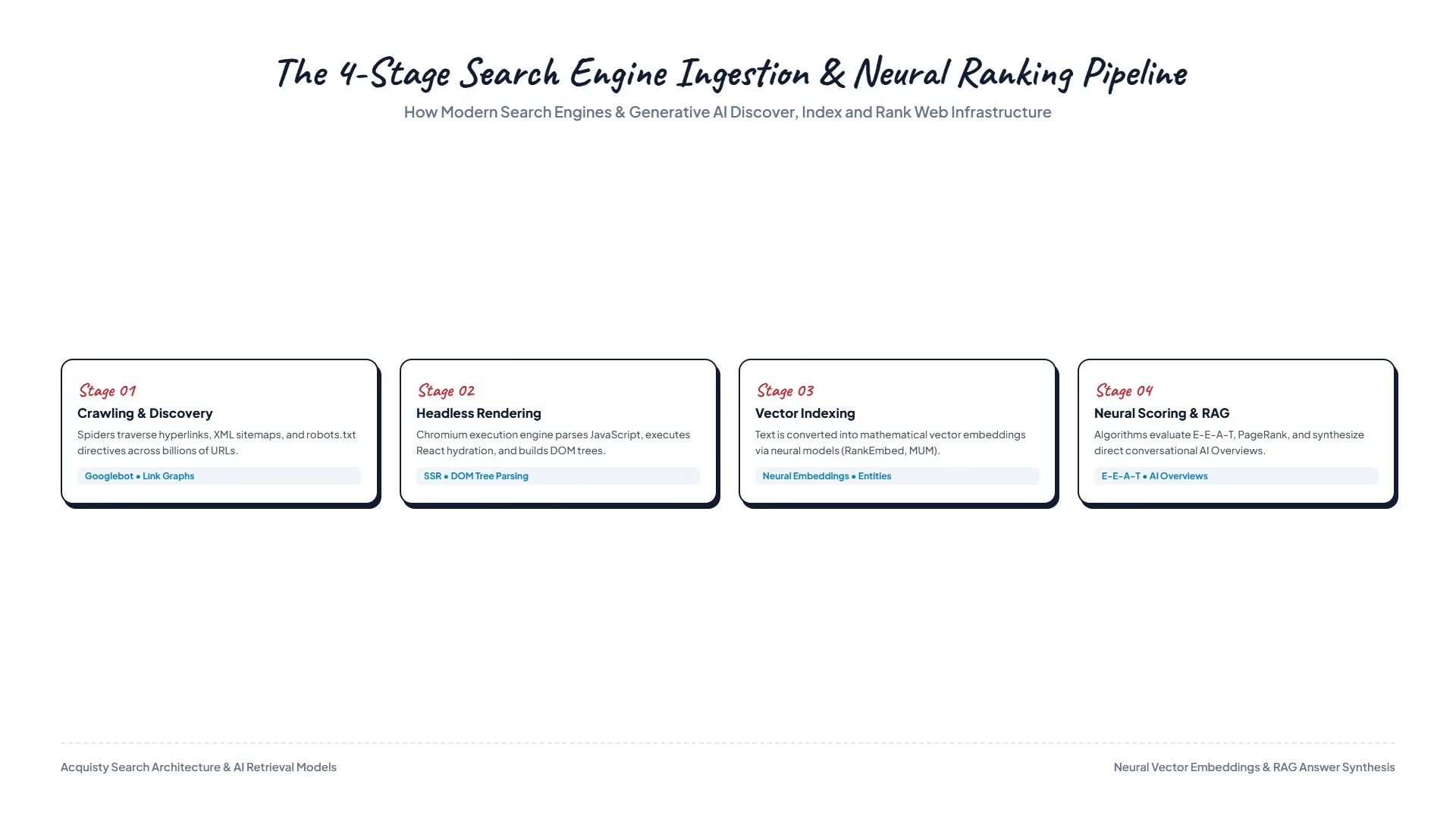
Stage 01: Crawling (Discovery & Link Graphs)
Automated search engine bot spiders (such as Googlebot) continuously traverse the web by following hyperlinks from known pages to new URLs. Crawlers read XML sitemaps, robots.txt directives, and internal link structures to discover new and updated content across billions of web pages.
Stage 02: Rendering (JavaScript Execution & DOM Parsing)
Modern websites built with React, Next.js, Angular, or Vue require JavaScript execution before the final DOM is rendered. Google executes JavaScript in a headless Chromium browser environment. If rendering is blocked by client-side hydration bottlenecks, content remains invisible to search engines.
Stage 03: Indexing & Vector Embeddings (Storage & Semantic Categorization)
Once parsed, the page is analyzed and stored in Google’s colossal database (the Index). In modern search, text is converted into multi-dimensional mathematical vector embeddings via neural models (like RankEmbed and MUM), mapping the conceptual relationship between topics, entities, and search intent.
Stage 04: Ranking & Retrieval (Neural Scoring & RAG Synthesis)
When a user enters a search prompt, complex machine-learning algorithms evaluate hundreds of ranking signals in milliseconds to return the most relevant, authoritative results. For conversational queries, Google’s Retrieval-Augmented Generation (RAG) models synthesize direct AI Overviews, citing the highest-authority web sources.
📖 Recommended Reading
A Unified Theory of SEO, AEO and GEO — How traditional search indexing, direct answer engines, and generative AI synthesis converge into a single visibility framework.
3. The 4 Core Pillars of Modern Search Engine Optimization
Achieving sustained organic dominance requires executing across four interconnected pillars:
Pillar 01: Technical SEO (Infrastructure & Performance)
Technical SEO ensures search engines can crawl, render, and index your website without friction. It encompasses Server-Side Rendering (SSR), XML sitemaps, canonical tags, mobile responsiveness, SSL security, and Core Web Vitals optimization (Largest Contentful Paint < 1.2s, Interaction to Next Paint < 150ms).
Pillar 02: On-Page SEO (Content Architecture & Entities)
On-Page SEO involves optimizing individual web pages to satisfy search intent. This includes strategic heading structures (H1, H2, H3), semantic entity density, internal linking hub-and-spoke models, and structured JSON-LD schema markup that communicates entity relationships directly to search crawlers.
Pillar 03: Off-Page SEO & Digital PR (Authority & Link Equity)
Off-Page SEO establishes external domain trust and authority. High-tier editorial backlinks from industry trade publications, Tier-1 media outlets, and digital PR campaigns act as verified third-party endorsements that power Google PageRank and entity prominence.
Pillar 04: AI SEO & Generative Engine Optimization (GEO)
AI SEO & Generative Engine Optimization (GEO) is the cutting-edge frontier of search. It formats web assets into structured, citable passages with high Information Gain and verified E-E-A-T credentials, ensuring your brand is prominently recommended in Google AI Overviews, ChatGPT Search, and Perplexity answer panels.
The Information Gain Law: As generative AI floods the internet with billions of commoditized, regurgitated articles, search algorithms have deployed aggressive Information Gain filters. Pages that simply summarize what already exists on page 1 of Google are penalized. To rank and capture AI citations, your content must contribute net-new empirical data, proprietary frameworks, or unique expert insights.
4. Strategic Comparison: Legacy SEO vs. Acquisty Technical & AI Search Framework
Examine how Acquisty’s engineering-led organic growth methodology outperforms traditional agency retainers and commoditized SEO services:
The E-E-A-T Moat: In high-stakes commercial, financial, and healthcare queries (YMYL – Your Money or Your Life), algorithms evaluate the verified human credentials of your organization. Demonstrating first-party Experience, recognized Expertise, third-party Authoritativeness, and rigorous Trustworthiness protects your brand against algorithmic core updates.
5. Specialized Search Disciplines: Local SEO, B2B SaaS & Enterprise Growth
Search engine optimization is not a one-size-fits-all discipline. Industry leaders execute specialized strategies tailored to their commercial business models:
6. Frequently Asked Questions (FAQ) About Search Engine Optimization
7. Scale Your Organic Revenue Engine with Acquisty
Dominating organic search in today’s AI-accelerated landscape requires more than basic checklists; it demands senior search engineers, technical data architects, and proven growth strategists.
At Acquisty, we engineer comprehensive organic search systems for ambitious scaleups and global enterprise market leaders. We eliminate technical roadblocks, deploy authoritative semantic content clusters, build high-tier digital PR links, and connect organic search visibility directly to measurable enterprise revenue growth.
Ready to audit your organic search visibility and engineer your market leadership? Claim your comprehensive SEO & AI search audit today or schedule an executive strategy consultation with our search engineering directors.
Build an Unshakeable Foundation for Organic Search Leadership
Search Engine Optimization is the highest-compounding asset in digital marketing. From technical crawling foundations to semantic entity graphs and authoritative backlinks, Acquisty’s SEO consultants engineer predictable, long-term revenue growth.