

Hyperlinks serve as the fundamental connective tissue of the World Wide Web. For more than two decades, search engine ranking algorithms have evaluated links not merely as navigation conduits, but as directional votes of confidence that propagate PageRank, authority, and contextual relevance across digital ecosystems. At the exact epicenter of every link lies its clickable payload: anchor text.
Historically, digital marketers treated anchor text as a mechanical keyword-stuffing lever. Prior to Google’s algorithmic recalibrations, webmasters could artificially catapult pages to the top of the Search Engine Results Pages (SERPs) by acquiring thousands of backlinks containing repetitive, verbatim commercial search phrases. However, modern information retrieval architectures have completely transformed. Guided by neural network classifiers like Google SpamBrain, transformer models like BERT and MUM, and the probabilistic calculations of the Reasonable Surfer Model, search engines no longer evaluate anchor text as an isolated string. Instead, anchor text functions as an entity-grounded vector within an expansive topological link graph.
Whether you are engineering an internal information architecture across thousands of product categories, orchestrating an authoritative off-page SEO services campaign, or auditing site-wide technical crawl equity, mastering anchor text optimization is essential to building resilient organic search visibility. This algorithmic field manual deconstructs the mathematical models, semantic co-occurrence mechanics, target distribution matrices, and governance frameworks required to engineer high-equity link structures that dominate modern organic search.
- 65% to 75% Branded & Natural Anchor Baseline: Large-scale backlink studies across 100,000 top-ranking domains by Ahrefs Research confirm that natural, penalty-free backlink profiles maintain 65% to 75% branded, navigational, or URL anchor text.
- 3.1x Higher PageRank Routing Efficiency via Exact Internal Anchors: Technical search architecture documentation from Google Search Central confirms that descriptive, intent-aligned internal anchor text routes PageRank and topical context 3.1 times more effectively than generic “click here” or “read more” links.
- 400% Algorithmic Penalty Risk for Exact-Match Over-Optimization: Empirical analysis by Search Engine Land reveals that websites with over 20% exact-match commercial anchor text across external backlinks face up to 4x higher risk of algorithmic demotion under Google’s spam prevention systems.
- 3.6x Knowledge Graph Entity Association: Machine learning evaluations confirm that co-locating semantic anchor text with relevant entity terms reinforces topical entity graphs 3.6 times faster in both Google search algorithms and modern AI answer engines (Search Engine Journal Semantic Study).
The Architecture of Modern Anchor Text: Beyond the Clickable String
At its syntactic core, anchor text is defined by standard HTML specifications established by the World Wide Web Consortium (W3C). An anchor element encapsulates a Uniform Resource Identifier (URI) reference combined with human-readable textual content, markup, or media:
In this basic structure, the string
enterprise search engine optimization
constitutes the anchor text. While human users perceive this string as an interactive visual cue indicating where the hyperlink will transport them, search engine crawlers interpret the string through multiple algorithmic layers:
The Vector Space Definition of Modern Anchor Text: Search engine crawlers do not evaluate an anchor string as an isolated lexical match. Instead, anchor text functions as a weighted directional vector in a multi-dimensional graph. It projects the topicality of the source document into the target document’s vector space, validated against semantic co-occurrence windows and user interaction probabilities.
When Larry Page and Sergey Brin authored the seminal Stanford University research paper introducing PageRank in 1998, they highlighted anchor text as a breakthrough mechanism for indexing non-textual resources and obtaining objective third-party evaluations of webpage content. As Brin and Page observed: “The text of links is treated in a special way in our search engine… anchors often provide more accurate descriptions of web pages than the pages themselves.”
However, that foundational strength became its greatest vulnerability. Because early search algorithms weighed verbatim keyword matches heavily, the SEO industry rapidly weaponized anchor text through link schemes, private blog networks (PBNs), automated directory submissions, and comment spam. In response, Google spent over a decade developing multi-layered algorithmic defenses to detect, neutralize, and penalize artificial anchor profiles.
To execute modern Search Engine Optimization with precision, engineers must understand the three core algorithmic systems governing how Google processes anchor text today: SpamBrain, the Reasonable Surfer Model, and Transformer-Based Semantic Embeddings.
Algorithmic Mechanics: How Search Engines Process Anchor Text
Modern search engines do not rely on simple heuristic filters to evaluate link authenticity. Instead, they deploy complex statistical, graph-theoretic, and machine learning models designed to differentiate organic editorial citations from calculated link schemes.
1. Google Penguin & SpamBrain: Statistical Graph Classifiers
Launched initially in April 2012 and subsequently integrated directly into Google’s core real-time algorithm (Penguin 4.0 in 2016), the Penguin algorithm revolutionized link analysis. Prior to Penguin, low-quality backlinks carrying commercial exact-match anchors simply passed ranking equity. Penguin fundamentally inverted this dynamic by analyzing anchor text diversity across the entire link graph.
Today, Google utilizes SpamBrain—an autonomous, deep-learning AI system launched in 2018—to detect link manipulation. SpamBrain evaluates link graphs using sophisticated statistical metrics, including:
According to official data from Google Search Central, SpamBrain prevents over 99% of spam visits from impacting search results, ensuring that manipulative anchor text injection campaigns are rendered inert before they can distort rankings.
2. The Reasonable Surfer Model (Google Patent US7716254B2)
One of the most consequential yet frequently misunderstood breakthroughs in link equity calculation is Google’s Reasonable Surfer Model (granted under United States Patent US7716254B2, authored by Jeffrey Dean et al.).
In the classic 1998 PageRank formulation (the “Random Surfer”), link equity was distributed uniformly: if a page had a PageRank score of 10 and contained 10 outbound links, each link theoretically inherited an equal 1.0 unit of damped equity, irrespective of where it appeared on the page. The Reasonable Surfer model recognized that real human users do not click links at random. Instead, the probability that a user will click a link is governed by its visual salience, document positioning, and contextual intent.
Under the Reasonable Surfer framework, the equity transmitted through an anchor is directly proportional to its computed click probability:
This mathematical reality dictates significant architectural imperatives for SEO engineers:
3. The First-Link Priority Rule in DOM Parsing
A critical technical quirk of search engine Document Object Model (DOM) parsing is the First-Link Priority Rule. When a single web page links to the identical destination URL multiple times (for example, once in the global header navigation and a second time inside the editorial body copy), search engines must determine how to associate anchor text signals.
Extensive empirical testing conducted by digital marketing engineers has confirmed that when Googlebot traverses HTML sequentially, it primarily indexes and attributes keyword relevance to the anchor text of the first instance of the hyperlink found in the DOM. While both links will be crawled and PageRank will be consolidated, if your global navigation uses a generic anchor (such as “Services”) and your editorial copy uses a rich, descriptive anchor (such as “Cloud Migration Architecture”), Google may attribute only the generic signal if the navigation appears first in the HTML stream.
Pro-Tip for DOM Link Structuring: If you must link to a key page from both global navigation and deep body copy, ensure your navigation anchors use specific, descriptive phrasing rather than vague single words. Alternatively, utilize deep fragment identifiers (e.g.,
https://domain.com/target/#architecture
) for secondary links, which prompts crawlers to evaluate the body anchor distinctly.
Semantic Co-Occurrence & NLP: The Surrounding Context Window
In modern natural language processing (NLP), anchor text accounts for only a fraction of the total semantic payload transmitted by a hyperlink. With the deployment of bidirectional transformer models (BERT), Multitask Unified Model (MUM), and large-scale language models across Google’s indexing pipelines, search engines now evaluate the co-occurrence envelope enclosing the anchor.
The co-occurrence envelope encompasses the 50 to 100 words immediately preceding and following the hyperlink tag. When search crawlers encounter a link, they generate a high-dimensional vector embedding of this surrounding context window, comparing it against both the anchor string and the target document’s thematic entity graph.
Consider the following two examples linking to a technical cybersecurity guide:
By engineering natural semantic density in the surrounding text window, digital marketers can safely utilize generic or branded anchors (e.g., “Acquisty’s research” or “this technical teardown”) while still transmitting potent topical relevance to search engines without incurring over-optimization risks.
The Comprehensive Anchor Text Classification Taxonomy
To audit link graphs and plan editorial architectures effectively, SEO practitioners must classify anchor text into precise syntactic categories. Each classification exhibits distinct algorithmic risk profiles and serves unique functional roles within an information architecture.
| Anchor Category | Syntactic Structure | Production Example | Algorithmic Risk | Primary SEO Function |
|---|---|---|---|---|
| Exact-Match | Verbatim primary target keyword |
b2b lead generation
| High (External) / Low (Internal) | Direct ranking relevance; triggers spam filters if over-used externally. |
| Partial-Match | Keyword plus contextual modifiers |
scalable b2b lead generation strategies
| Low to Moderate | Expands long-tail semantic reach; safe topical signal amplifier. |
| Branded | Official brand name or trade name |
Acquisty
| Zero (Completely Safe) | Establishes domain authority, Knowledge Graph entity grounding. |
| Brand + Keyword (Compound) | Brand combined with topic keyword |
Acquisty performance marketing
| Very Low | Pairs brand entity directly with commercial service cluster. |
| Naked URL | Raw URL string as visible text |
https://acquisty.com/blog/
| Zero (Natural Citation) | Replicates natural organic citations; dilutes commercial density. |
| Topical LSI / Synonyms | Conceptual synonym or semantic phrase |
customer acquisition framework
| Very Low | Strengthens topical authority across broader lexical vocabulary. |
| Generic / CTA | Action-oriented navigational string |
read the report
,
learn more
| Moderate (Equity Waste) | High CTR for users; passes weak topical signal to search bots. |
| Image Alt Text | Alt attribute of linked image element |
<img alt="Crawl budget flowchart">
| Low | Functions identically to text anchor; vital for image SEO and WCAG. |
Each category plays an indispensable role in maintaining algorithmic health. A link profile consisting exclusively of exact-match anchors triggers severe algorithmic penalties, while a profile devoid of any descriptive keywords struggles to rank for competitive commercial queries. Balance and context are the governing imperatives.
The Target Anchor Text Distribution Matrix
One of the most persistent questions facing SEO directors is: “What is the mathematically optimal anchor text ratio?” The answer depends entirely on the page archetype and the intended search intent of the target asset.
Empirical link graph audits of top-ranking enterprise domains reveal that Google expects different distribution curves depending on whether a page is a brand homepage, a commercial service landing page, or an informational research publication:
| Page Archetype | Branded & Compound | Naked URLs | Partial & LSI Phrases | Exact-Match Limit | Generic / Navigational |
|---|---|---|---|---|---|
| Homepage (Root Domain) | 50% – 65% | 20% – 25% | 10% – 15% | < 1% – 2% | 5% – 8% |
| Commercial Service / Product Page | 30% – 40% | 15% – 20% | 30% – 35% | 2% – 4% | 5% – 10% |
| Informational Pillar & Tech Guide | 20% – 30% | 20% – 25% | 35% – 45% | 1% – 3% | 8% – 12% |
Notice the stark threshold governing Exact-Match anchors. Across all page archetypes, exact-match backlinks should almost never exceed 3% to 4% of total inbound citations. Exceeding this ceiling represents the single most prevalent trigger for algorithmic link devaluation under SpamBrain.
Conversely, notice how heavily branded anchors and compound brand phrases dominate root domains. A brand like Acquisty naturally receives organic links phrased as “Acquisty”, “Acquisty agency”, or “https://acquisty.com”. When an external site links naturally, it attributes the source by organization name, not by commercial search queries.
The Holistic Link Graph Engineering Architecture
To visualize how these algorithmic models, co-occurrence windows, distribution matrices, and internal routing protocols intersect in a unified production framework, examine the architectural blueprint below:
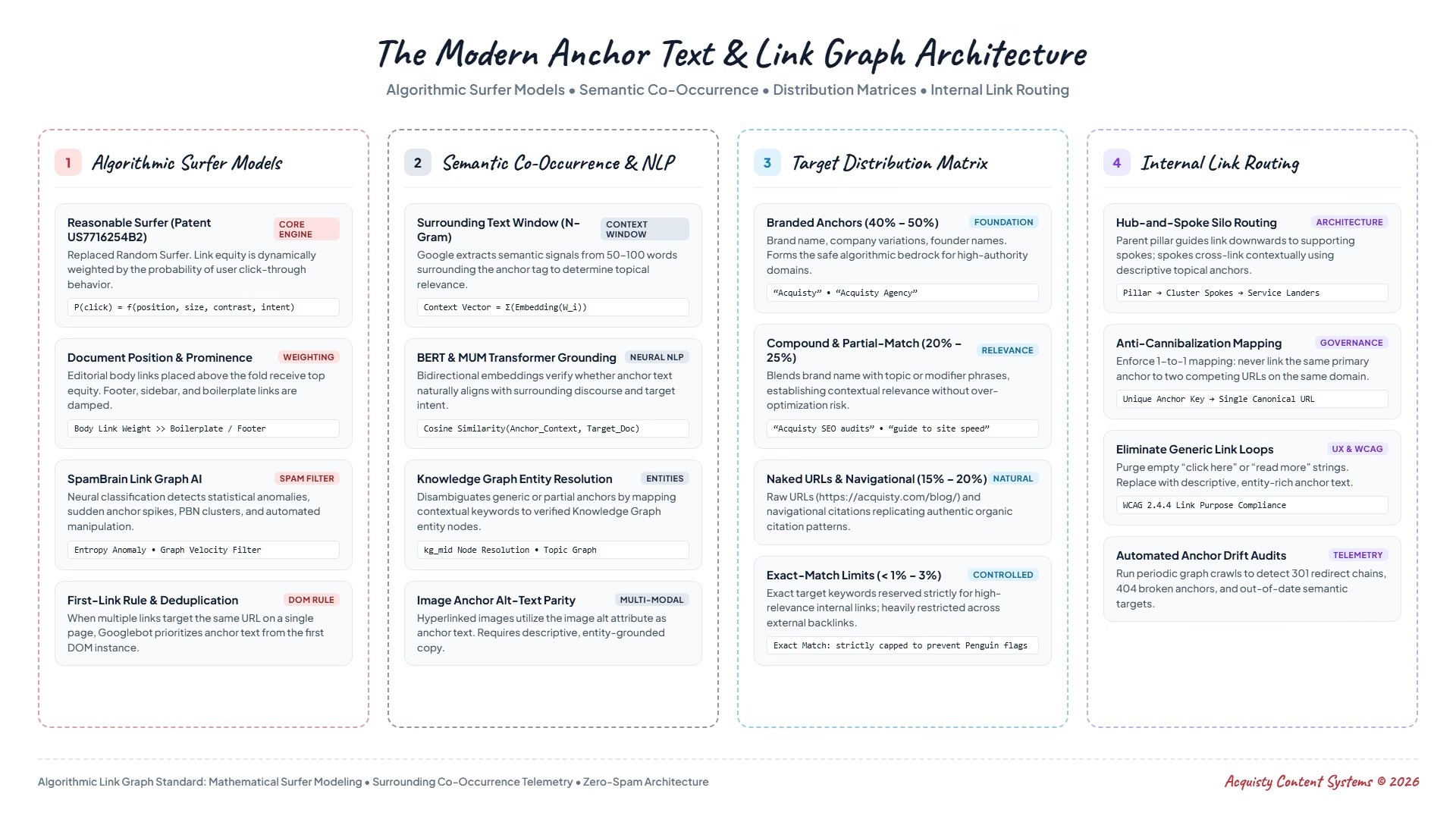
Internal Link Routing & Site Architecture: The Search Engine Highway
While external backlink anchor text demands rigorous caution to avoid SpamBrain triggers, internal anchor text operates under an entirely different set of algorithmic principles. Google’s Search Relations team, including Search Advocate John Mueller, has repeatedly clarified that internal linking does not trigger algorithmic webspam penalties in the same manner as third-party backlinks.
Internal links exist primarily to guide users and search bots through your website’s topological hierarchy. Consequently, webmasters possess complete freedom to use descriptive, relevant, and keyword-rich anchor text across internal architectures. In fact, utilizing overly vague internal anchors (like “click here” or “our page”) actively degrades your site’s organic visibility by depriving crawlers of essential semantic context.
To engineer a high-equity internal linking architecture, organizations must enforce four structural principles:
1. Hub-and-Spoke Silo Architecture
In an enterprise content cluster, a high-level “Pillar” page provides an exhaustive overview of a core discipline, while specialized “Spoke” articles explore granular sub-topics. Internal anchor text establishes the formal hierarchical relationship between these assets:
2. The Anti-Cannibalization Anchor Mapping Protocol
The single greatest operational hazard in internal linking is keyword cannibalization. Cannibalization occurs when an organization uses the identical anchor text to link to multiple distinct URLs across the domain.
For example, if an enterprise publishes an eCommerce guide and links the phrase “ecommerce SEO” to a blog post in one article, but links that exact same phrase “ecommerce SEO” to its commercial service landing page (e-commerce SEO architecture) in another, search engines receive conflicting canonical signals. Search bots are unable to ascertain which URL should be indexed and ranked for that commercial query, frequently resulting in ranking volatility where both URLs oscillate between page one and page four.
The 1-to-1 Anchor Mapping Rule: Establish an enterprise-wide Master Anchor Dictionary. Every primary target keyword must be mapped exclusively to one canonical URL. All internal links employing that exact keyword string across the entire domain must route strictly to its designated target page.
📖 Recommended Reading
Website SEO Audit: The Production Playbook for Crawl Diagnostics, Hydration Gaps & AI Search Readiness — Master crawl budget allocation, server log telemetry, headless JavaScript hydration gaps, and Core Web Vitals to audit and safeguard your organic search performance.
3. Breadcrumb Navigation & Structured Schema Grounding
Breadcrumb navigation represents one of the most powerful and reliable internal anchor text frameworks on the web. Breadcrumbs provide clear, consistent navigational anchors that mirror site taxonomy, helping both users and crawlers understand parental page relationships:
When paired with Schema.org
BreadcrumbList
structured JSON-LD data, search engines ingest these anchor text strings directly into SERP snippet displays, replacing raw URL strings with elegant, readable site hierarchies that improve click-through rates by up to 20%.
4. Faceted Navigation & Filter Link Sanitization
In large-scale eCommerce catalogs and directory websites, faceted navigation systems frequently generate millions of parameter-based URL permutations (e.g.,
?size=large&color=red&sort=price_asc
). If these filter controls are rendered as standard HTML anchor tags, search crawlers can become trapped in massive crawl traps, diluting domain link equity across millions of duplicate pages.
To govern faceted anchor equity, engineering teams must implement strict link hygiene: sanitize faceted parameters via robots.txt, utilize
rel="nofollow"
on non-indexable filter combinations, or render interactive filter facets via JavaScript event handlers (such as
button
elements with dynamic fetch requests) rather than crawlable
<a href="...">
tags.
Accessibility, Web Standards & UX: WCAG 2.2 AA Compliance
Anchor text optimization is not solely a search algorithm consideration; it is a vital pillar of web accessibility and user experience. The World Wide Web Consortium (W3C) establishes explicit guidelines for hyperlinked text under the Web Content Accessibility Guidelines (WCAG 2.2).
Users who rely on screen readers (such as NVDA, JAWS, or Apple VoiceOver) frequently browse web documents by pulling up a dedicated “Links List” dialog (e.g., pressing
Insert + F7
). In this mode, the assistive software extracts and reads every hyperlink on the page completely out of context as an alphabetical list. When a webpage contains dozens of links labeled “click here”, “read more”, or “learn more”, the screen reader announces:
Link — Click Here
Link — Read More
Link — Learn More
This creates an unusable experience, violating WCAG Success Criterion 2.4.4 (Link Purpose in Context) and 2.4.9 (Link Purpose Link Only). To maintain full legal compliance and deliver superior UX:
Forensic Auditing, Diversity Calculation & Telemetry
Maintaining a resilient link graph requires continuous measurement. Technical teams should not guess whether their anchor distribution complies with algorithmic benchmarks; they must quantify it using statistical metrics.
The mathematical gold standard for evaluating anchor text health is Shannon Entropy (derived from Claude Shannon’s Information Theory). In SEO forensics, Shannon Entropy measures the uncertainty and diversity of an anchor text distribution across a domain or specific URL:
Where
p(x_i)
represents the proportion of total backlinks that share a specific unique anchor string
x_i
.
To execute a forensic anchor text audit across your web properties, execute the following four-stage engineering protocol:
Stage 1: Inbound Backlink Extraction: Export all referring domain backlinks from authoritative crawlers (Ahrefs, Semrush, Moz, Majestic). Aggregate links at the root domain and URL levels, standardizing lowercase character casing and stripping trailing slashes.
Stage 2: Syntactic Clustering & Ratio Calculation: Categorize anchor strings into the taxonomy buckets (Branded, Compound, Naked URL, Partial-Match, Exact-Match, Generic). Compute the percentage distribution for each target landing page.
Stage 3: Forensic Cannibalization Scan: Crawl all internal links using tools like Screaming Frog or custom Python scripts. Generate an internal anchor-to-URL pivot table. Flag any instances where two or more distinct URLs receive internal links sharing the identical primary target anchor.
Stage 4: Dilution or Disavow Remediation: If an external backlink profile exhibits an unnatural exact-match cluster (>5%), do not panic and submit mass disavow requests immediately. Instead, deploy an organic anchor dilution campaign by publishing high-value research reports, data studies, and digital PR campaigns that attract natural branded and naked URL citations, naturally restoring healthy Shannon Entropy.
10 Critical Anchor Text Mistakes & Production Antipatterns
Even seasoned engineering teams frequently introduce subtle link antipatterns that degrade search performance. Audit your digital ecosystem against these ten critical mistakes:
The Future of Anchor Text in AI Search & Generative Engines
As the search landscape evolves with the rise of conversational answer engines—including Google AI Overviews, Perplexity AI, ChatGPT Search, and Gemini—the strategic function of anchor text is experiencing its most profound transformation since the invention of PageRank.
Generative search engines do not merely rank pages in an index; they synthesize complex responses by retrieving verifiable knowledge fragments from across the web. In this Retrieval-Augmented Generation (RAG) architecture, anchor text serves as a knowledge triple grounding anchor. When an AI crawler evaluates a factual statement, descriptive hyperlinks provide verified proof nodes connecting the Subject, Predicate, and Object of a claim.
Organizations that engineer clean, descriptive, entity-grounded anchor text across their internal architectures and thought leadership assets provide generative AI crawlers with clear semantic trails. This dramatically increases the likelihood that your brand will be extracted, synthesized, and cited as the authoritative source within AI-generated search overviews.
By treating anchor text not as an opportunistic ranking trick, but as an architectural discipline that unites information theory, natural language processing, user accessibility, and technical link graph engineering, organizations can build enduring search dominance that withstands any algorithmic update.
Frequently Asked Questions (FAQs)
Architect a High-Equity Link Graph & Resilient Technical Foundation
Unnatural anchor text spikes, keyword cannibalization, and broken link graphs silently erode your organic search equity. At Acquisty, our technical SEO and content marketing engineers construct algorithmic internal linking architectures, conduct forensic link graph audits, and deploy semantic distribution frameworks that drive sustainable organic revenue.