

Every business owner, founder, and marketing executive faces the exact same fundamental question when allocating growth capital: “Where should we invest our marketing budget to generate predictable, sustainable revenue at the lowest possible cost?”
For many companies, the immediate default is paid advertising. You set up a Google Ads or Meta Ads campaign, enter your credit card, and within hours visitors start arriving on your landing page. However, business leaders quickly discover the uncomfortable reality of paid media: the moment you decrease your daily ad spend, your traffic, lead flow, and sales plummet to zero overnight. You are essentially renting attention on an increasingly expensive treadmill where cost-per-click (CPC) rates climb year after year.
This is where Search Engine Optimization (SEO) represents a completely different strategic paradigm. SEO is not an expense—it is a long-term capital investment in digital equity. When you optimize your website to rank at the top of organic search results, you create an automated, 24/7 customer acquisition engine that works tirelessly for your business. Every single visitor, lead, and phone call you generate through organic search arrives with zero per-click charges.
In this comprehensive master guide, we deconstruct the full spectrum of benefits of SEO in plain English. We explore why organic search delivers the highest return on investment in digital marketing, how it compares financially to paid media, the 15 core strategic advantages it provides to growing companies, and the step-by-step framework your business can use to turn organic search into an enduring competitive moat.
- 53.3% of All Website Traffic Originates from Organic Search: Comprehensive cross-industry benchmark research conducted by BrightEdge demonstrates that organic search drives 53.3% of all trackable web traffic globally, outperforming paid search (15%), organic social (5%), and display ads combined.
- 14.6% Lead-to-Customer Close Rate for SEO Inbound Leads: Empirical lead conversion data published by HubSpot reveals that inbound SEO leads achieve an average 14.6% close rate, compared to just 1.7% for traditional outbound marketing methods (cold outreach, print, and cold calling).
- 70% to 80% of Search Users Completely Ignore Paid Ads: Eye-tracking and click distribution analytics verified by Backlinko confirm that between 70% and 80% of search engine users focus exclusively on organic listings and bypass sponsored advertising placements altogether.
- 1,000%+ Higher Lifetime ROI Over Paid Media: Long-term commercial tracking compiled by Search Engine Journal proves that while paid search delivers a stable 2:1 to 3:1 return, mature organic search campaigns compound to deliver over 10:1 to 20:1 ROI because the marginal cost of each additional visitor trends toward zero.
- 84% of B2B and High-Value Buyers Begin with Search Engines: Market intelligence from Gartner shows that 84% of business buyers, enterprise decision-makers, and consumer shoppers conduct independent Google research before ever contacting a vendor or sales representative.
The Core Difference: Renting Traffic vs. Owning an Appreciating Digital Asset
To truly appreciate the value of SEO, it helps to use a simple real estate analogy: PPC is like renting an apartment, while SEO is like purchasing and developing prime commercial property.
When you rent an apartment (PPC), you get immediate shelter. It works on day one. But you must pay rent every thirty days without fail. If your landlord raises the rent by 20% next year, you must pay it or leave. And after five years of faithful payments, you walk away with zero equity. The moment you stop writing checks, you are out on the street.
SEO, by contrast, is like buying land and constructing a flagship retail building. It takes time, architectural planning, foundation pouring, and deliberate construction upfront. You won’t move in tomorrow. However, once the building is complete, you own it outright. You don’t pay rent to Google for each customer who walks through the front doors. Over time, as your domain authority strengthens and your content library matures, your property appreciates in value while your operational cost per customer drops precipitously.
Let’s examine how these two channels compare across fundamental business dimensions:
| Strategic Dimension | Paid Advertising (PPC / Social Ads) | Organic Search Engine Optimization (SEO) |
|---|---|---|
| Cost Structure | Pay for every single click (linear expense) | Zero per-click charges; 100% free marginal traffic |
| Longevity & Sustainability | Traffic stops the instant budget is paused | Rankings continue generating leads for years |
| Cost per Acquisition (CAC) | Inflationary (rises 15%–25% annually due to bidding wars) | Deflationary (decreases as topical authority expands) |
| User Trust & Click Share | Captures only 15%–30% of total clicks | Captures 70%–85% of total search engine clicks |
| Scalability Dynamics | Linear (to double traffic, you must double ad budget) | Exponential (topic clusters unlock compounding visibility) |
| Company Valuation Impact | Zero enterprise value added on the balance sheet | Substantially increases business sale multiple & brand equity |
| AI Answer Engine Readiness | Excluded from generative AI answers (ChatGPT, Perplexity) | Primary training & citation data source for AI search engines |
While paid advertising undeniably has a valuable role in rapid testing, event promotions, and short-term tactical surges, relying exclusively on paid channels makes your business financially fragile. SEO builds the durable foundation that ensures your company continues to thrive regardless of economic cycles or advertising algorithm adjustments.
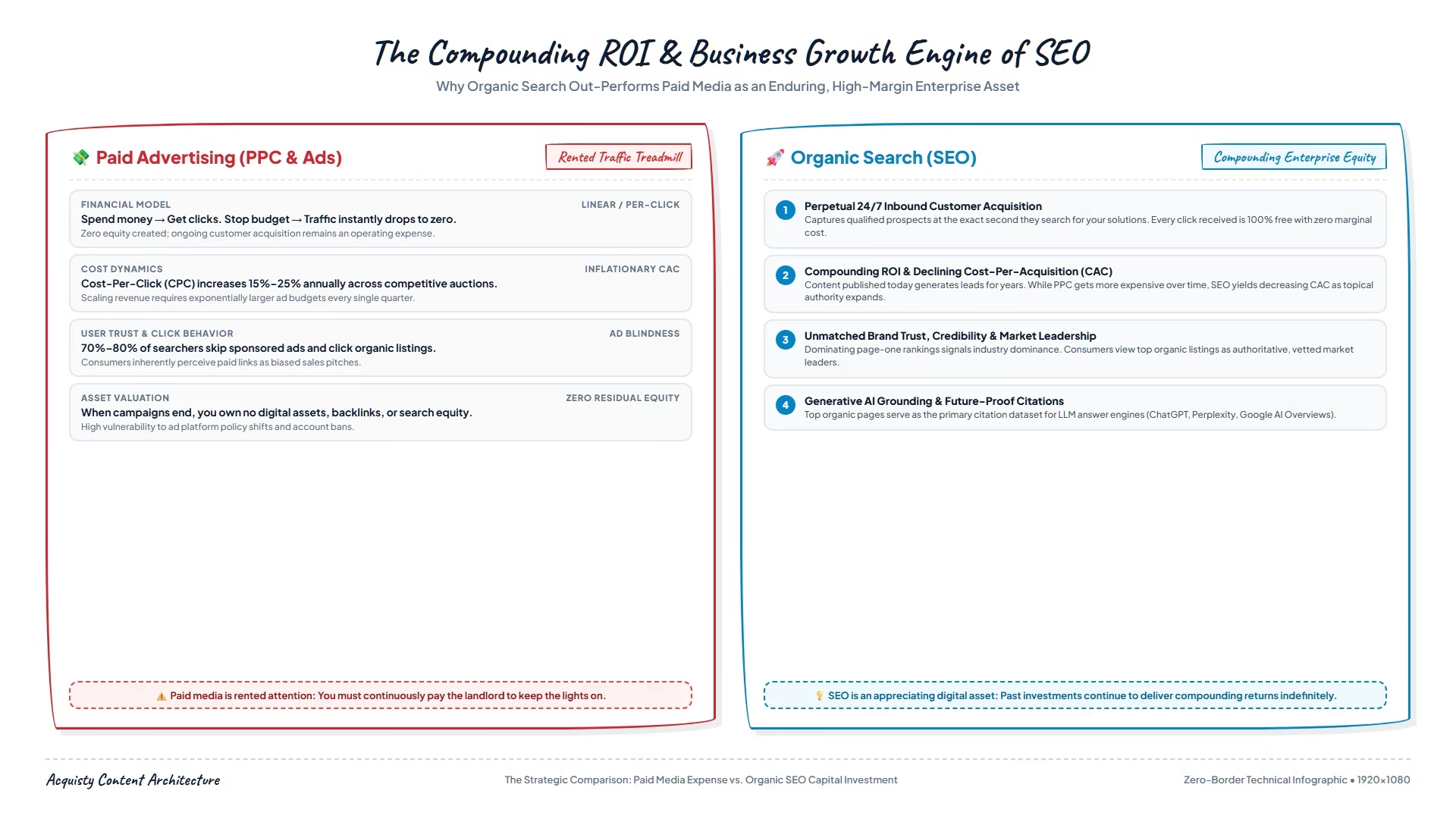
Visual Architecture: The Compounding Growth Engine of SEO
To visualize the fundamental economic differences between renting paid clicks and building compounding organic equity, examine the architectural comparison below:
The 15 Strategic Benefits of SEO for Growing Businesses
The advantages of SEO extend far beyond simple website visitors. When executed properly, search engine optimization transforms every layer of your business—from customer acquisition costs to sales conversion velocity and enterprise brand equity. We have organized the 15 primary benefits into four practical pillars:
Pillar 1: Financial & ROI Advantages
1. Exponentially Compounding Returns on Investment (ROI):
Unlike traditional marketing where spending ends the moment results are tallied, SEO operates on the law of compounding returns. An authoritative guide or service page published this year will continue attracting qualified buyers two, four, and six years from now with minimal ongoing expense. As your domain authority strengthens, new content ranks faster, creating a snowball effect where your cost-per-lead drops every single quarter.
2. Zero Marginal Cost-Per-Click:
In competitive sectors like legal services, SaaS software, financial consulting, or healthcare, a single Google Ads click can cost anywhere from $25 to over $150. If you receive 1,000 paid visitors, you might spend $50,000. With SEO, whether your page receives 10 visitors or 100,000 visitors per month, you pay Google exactly zero dollars. That freedom from per-click extortion dramatically protects your operating profit margins.
3. Decreasing Customer Acquisition Cost (CAC):
As advertising platforms become saturated with competing venture-backed bids, paid CAC inevitably rises. SEO counters this inflationary pressure. By creating an organic inbound pipeline, your blended CAC continuously trends downward over time, allowing your sales team to acquire new customers at a fraction of the cost incurred by your competitors.
4. Tangible Increase in Business Valuation & Enterprise Equity:
When institutional investors, private equity firms, or prospective buyers evaluate a company, customer acquisition concentration is a major risk factor. A business that relies solely on paid ad spend is considered high-risk because its revenue would collapse if ad costs spike or account algorithms shift. Conversely, a business with dominant, defensible page-one organic rankings possesses an enduring competitive moat that directly increases EBITDA multiples upon sale.
Pillar 2: Lead Generation & Conversion Quality
5. Captures High-Intent Inbound Demand:
Traditional outbound marketing (cold calling, direct mail, display ads) interrupts people while they are trying to do something else. SEO is purely inbound: it connects your business with prospects at the exact millisecond they are actively searching for a solution to their problem. When someone types high-intent long-tail keywords into Google, their commercial intent is at its peak.
6. Accelerates and Shortens Sales Cycles:
Modern B2B and high-ticket B2C buyers conduct thorough independent research before speaking with sales representatives. By producing authoritative educational guides, comparison tables, and implementation walkthroughs, your content answers their objections, addresses pricing questions, and establishes solution frameworks before the first sales call, dramatically shortening your sales cycle.
7. Complete Marketing Funnel Coverage (Top, Middle & Bottom):
SEO is not just for closing immediate transactions; it allows you to capture buyers across every stage of their decision-making process:
8. Dominates Local Foot Traffic & Regional Inquiries:
For multi-location businesses, medical practices, law firms, and regional service providers, local SEO is a revenue lifeline. Optimizing your Google Business Profile and local landing pages ensures your business appears in the coveted Google Map 3-Pack. When nearby consumers search for “commercial roofing contractor near me” or “best pediatric dental clinic in [city],” local SEO drives direct phone calls and immediate foot traffic.
📖 Recommended Reading
Long-Tail Keywords in SEO: The Step-by-Step Guide to Finding High-Intent Search Terms That Convert — Discover how to uncover low-competition, high-converting search queries that attract ready-to-buy customers to your business without expensive paid advertising.
Pillar 3: Market Authority & Trust
9. Implicit Trust & Market Credibility:
Consumers have developed acute banner blindness and innate skepticism toward sponsored ads. Anyone with a credit card can run a Google ad, but ranking organically at the top of Google requires genuine relevance, technical excellence, and authoritative backlinks. Searchers intuitively recognize this distinction and treat page-one organic rankings as an objective stamp of industry leadership.
10. Complete SERP Real Estate Dominance:
When you combine organic search optimization with structured data schema, video snippets, People Also Ask accordions, and Google Business Profiles, your brand occupies massive visual real estate on the search results page. Dominating the entire screen above the fold establishes your company as the obvious market leader and pushes aggressive competitors below the digital horizon.
11. Ethical Suppression of Search Competitors:
Search engine results are a zero-sum game. There are only ten organic spots on page one of Google. Every keyword position your company wins is a position your direct rivals cannot occupy. By building a comprehensive topic cluster, you effectively starve competitors of high-intent search traffic while consolidating market share in your category.
12. Sustainable Digital PR & Earned Backlinks:
Journalists, podcast hosts, industry bloggers, and content creators constantly search Google for statistics, research data, and expert commentary to reference in their articles. When your website ranks in top positions for industry terminology and data benchmarks, other publications naturally link to and cite your content, generating free tier-one press mentions and authoritative natural anchor text backlinks on autopilot.
Pillar 4: Technical & Modern Search Advantages
13. Substantially Improved Website Speed & User Experience (UX):
Google’s Core Web Vitals and page experience updates mandate that websites load rapidly, remain visually stable, and respond instantly to user interactions. When you execute technical SEO, you aren’t just pleasing search crawlers—you are upgrading your website’s performance for real human visitors. Faster page loading times directly correlate with lower bounce rates and higher on-page checkout conversions.
14. Frictionless Mobile Optimization & Accessibility:
With Google’s mobile-first indexing, the mobile version of your website determines your organic rankings. Proper SEO requires responsive layouts, intuitive touch targets, legible typography, and streamlined mobile navigation. This ensures that the 60%+ of customers browsing on smartphones experience a seamless, frictionless purchasing journey.
15. Generative AI & LLM Answer Engine Future-Proofing:
The modern search landscape is evolving rapidly with the rise of conversational AI engines like ChatGPT, Claude, Perplexity, and Google AI Overviews. These Large Language Models do not generate facts out of thin air; they pull and synthesize citations directly from authoritative, well-structured, high-ranking websites. Executing modern SEO guarantees that your brand becomes the default source AI models recommend when prospective clients ask conversational buying questions.
If your executive team wants to audit your existing digital footprint and unlock the compounding revenue benefits of organic search, partner with our specialized professional SEO services to build an enduring market advantage.
Step-by-Step Walkthrough: How to Build an SEO Engine That Delivers Real Revenue
Understanding the benefits of SEO is exciting, but capturing those benefits requires a structured, repeatable implementation framework. Businesses that fail at SEO typically make the mistake of publishing random, disconnected blog posts without a coherent architecture.
Follow this proven, six-step execution workflow to transform your website into an organic customer acquisition powerhouse:
Step 1: Fix Technical Foundation Errors & Core Web Vitals:
Search engines cannot rank what they cannot crawl and index. Start by conducting a rigorous website SEO audit to eliminate broken links (404 errors), redirect loops (301 chains), unoptimized images causing layout shifts, and missing XML sitemaps. Ensure your robots.txt allows clean crawler access and verify your canonical tags to prevent duplicate content penalties.
Step 2: Conduct High-Intent Commercial Keyword Research:
Do not waste time chasing vanity search terms that bring casual browsers who will never buy. Instead, interview your sales team and analyze customer support transcripts to uncover the exact commercial and transactional questions serious buyers ask. Target high-converting long-tail phrases where intent is specific and competition is manageable.
Step 3: Analyze Search Competitors to Uncover Content Gaps:
Before drafting a single piece of content, execute a structured SEO competitor analysis against your top three search rivals. Identify the keywords driving their organic leads, pinpoint where their guides are thin or outdated, and reverse-engineer their backlink profiles to identify outreach opportunities.
Step 4: Build Comprehensive Semantic Topic Clusters (Hub & Spoke):
Organize your website into cohesive topic clusters. Create a central Pillar Page that covers your core service broadly (the “Hub”), and surround it with 5 to 10 in-depth supporting articles answering specific sub-questions (the “Spokes”). Link all spokes back to the pillar hub to demonstrate undeniable topical authority to Google’s ranking algorithms.
Step 5: Optimize On-Page Elements for High Click-Through Rates (CTR):
Craft compelling, benefit-driven meta titles and descriptions that entice searchers to click your link over competitors. Ensure your primary keyphrase appears naturally in the H1 title, opening 100 words, and subheadings without keyword stuffing. Include structured data schema (FAQPage, Article, Organization) so Google displays rich, eye-catching search snippets.
Step 6: Build Authoritative Backlinks & Internal Link Bridges:
Backlinks remain one of Google’s top three ranking signals. Earn authoritative editorial links through digital PR, original industry research reports, and guest thought leadership. Internally, connect high-performing blog guides directly to your high-converting service landing pages so organic traffic flows seamlessly into your sales funnel.
How to Measure and Calculate Your True SEO Return on Investment (ROI)
One of the most common reasons leadership teams hesitate to invest in SEO is the misconception that organic search is impossible to measure. In reality, modern analytics allows you to track the financial return of your SEO campaign with surgical precision.
Use this straightforward formula to measure your ongoing SEO Return on Investment:
SEO ROI (%) = [ (Total Revenue from Organic Search − Total SEO Investment Cost) / Total SEO Investment Cost ] × 100
Example: If you invest $30,000 in an annual SEO campaign and generate $180,000 in gross margin revenue directly from organic leads, your SEO ROI is 500% [ ($150,000 / $30,000) × 100 ].
To accurately capture this data inside Google Analytics 4 (GA4) and your CRM, track these four key metrics:
To explore an end-to-end multi-channel strategy that pairs organic search with high-converting inbound marketing, review our full suite of integrated digital marketing services designed to scale growth sustainably.
How Different Industries Benefit Uniquely from Organic Search
While every business benefits from compounding organic traffic, the specific commercial payoff varies significantly depending on your business model and target audience. Here is how distinct industry verticals leverage SEO to unlock massive competitive advantages:
1. B2B SaaS & Enterprise Technology Companies:
In the software industry, Customer Acquisition Cost (CAC) via paid ads has reached unprecedented highs, with paid search bids for keywords like “cloud ERP software” or “CRM integration platform” frequently exceeding $100 per click. For SaaS companies, SEO provides high-margin customer acquisition by capturing decision-makers during their technical research phase. Ranking for software comparison terms (“Competitor A vs Competitor B”) and feature-specific long-tail queries delivers enterprise buyers with multi-year contract values at virtually zero marginal cost.
2. Professional Services (Agencies, Legal, Accounting & Consulting):
High-ticket professional service firms rely heavily on trust, reputation, and intellectual authority. Potential corporate clients rarely hire an agency or law firm based on an ephemeral social media ad. They conduct deep due diligence on Google. Ranking for complex advisory questions, regulatory compliance guides, and regional commercial terms establishes your partners as verified thought leaders, pre-selling your expertise before the initial discovery call takes place.
3. E-Commerce & Direct-to-Consumer (D2C) Brands:
For online retailers, relying solely on paid ad campaigns erodes gross margins down to unsustainable levels. If an e-commerce brand spends $35 in ad spend to sell an $80 pair of boots, their net profit margin is razor-thin. By optimizing product category pages, product schema markup, and buying guides, e-commerce stores capture organic shoppers who are ready to purchase, transforming unprofitable paid transaction volume into high-margin organic revenue.
4. Local Service Businesses & Medical Practices:
For dental clinics, cosmetic surgery centers, commercial HVAC specialists, and local contractors, geographic search intent represents the primary driver of revenue. Ranking in the Google Local 3-Pack and securing top localized organic listings captures consumers with urgent, immediate purchasing needs (“emergency commercial plumbing near me”). Local SEO delivers hyper-targeted phone inquiries and scheduled appointments with industry-leading close rates.
10 Costly SEO Misconceptions That Derail Business Growth
Despite the overwhelming empirical data supporting the value of SEO, many business owners still hesitate to invest or abandon their campaigns prematurely due to persistent industry myths. Let’s debunk the ten most damaging misconceptions in modern search marketing:
Myth 1: “SEO is a one-time setup project you complete when launching a website.”
The Reality: SEO is an ongoing operational strategy, not a one-and-done checklist. Search algorithms update constantly, competitors publish new content daily, and technical issues naturally accumulate as websites evolve. Sustained market dominance requires ongoing content expansion, technical monitoring, and link acquisition.
Myth 2: “More keywords crammed into the text means higher Google rankings.”
The Reality: Keyword stuffing has been heavily penalized by Google for over a decade. Modern search algorithms rely on semantic entity analysis and natural language processing. Success comes from thoroughly answering searcher intent with clear, engaging, and well-structured explanations, not repeating a phrase twenty times.
Myth 3: “Only massive corporate conglomerates with million-dollar budgets can rank.”
The Reality: Massive corporations often move slowly, suffer from bloated legacy CMS platforms, and create generic content. Agile small and mid-sized businesses frequently outperform corporate giants by dominating targeted long-tail keywords, producing deeper tactical guides, and providing localized relevance.
Myth 4: “Social media marketing can completely replace search engine optimization.”
The Reality: Social media is outbound and temporary—a post’s shelf life is typically less than 24 hours, and users are on social platforms for entertainment. Search engine users have explicit, active intent: they are deliberately looking for an answer, a vendor, or a product. The conversion rate of organic search traffic consistently dwarfs social media clicks.
Myth 5: “Generative AI and ChatGPT are making SEO obsolete.”
The Reality: AI answer engines do not eliminate SEO; they make it even more critical. Large Language Models rely on crawled organic web content to answer user prompts. By structuring your content with clear semantic entities, schema markup, and authoritative data, you ensure your brand is cited as the primary recommendation in AI answers.
Myth 6: “Any backlink is a good backlink, regardless of source.”
The Reality: Low-quality, spammy directory links or automated private blog networks (PBNs) trigger severe algorithmic penalties that can wipe out your traffic overnight. Google values topical relevance and editorial trust above all else. Ten relevant links from respected industry publications are worth more than ten thousand spam directory links.
Myth 7: “Traffic volume is the only metric that matters.”
The Reality: Attracting 50,000 casual visitors who bounce immediately does nothing for your bank account. Attracting 1,500 hyper-targeted prospects searching for your exact commercial service generates real revenue. Professional SEO prioritizes search intent and conversion probability over vanity traffic numbers.
Myth 8: “Technical SEO is strictly a web developer issue, not a business priority.”
The Reality: Technical factors such as mobile responsiveness, Core Web Vitals, and crawl efficiency directly dictate whether Google’s index will serve your pages to buyers. Technical SEO is directly tied to revenue, conversion rates, and user retention.
Myth 9: “You must rank #1 for broad single-word head terms to succeed.”
The Reality: Single-word head terms (“shoes,” “software,” “marketing”) have high search volume but virtually zero commercial intent. Over 90% of actual purchasing searches occur in the long tail. Capturing 20 specific long-tail queries will generate significantly more revenue than ranking for one vanity head term.
Myth 10: “SEO results take too long to justify the marketing investment.”
The Reality: While SEO is a medium-to-long-term channel (typically 3 to 6 months for meaningful traction), it is also the only marketing channel where your past investment continues paying dividends for years. The true cost of waiting is giving your competitors an insurmountable lead in search market share.
Frequently Asked Questions About the Benefits of SEO
Ready to Build an Organic Inbound Pipeline That Compounds Over Time?
Stop pouring marketing budget into the rented treadmill of rising ad costs. Partner with Acquisty’s technical SEO and content architecture specialists to capture high-intent search traffic, lower your customer acquisition costs, and build a lasting competitive moat for your enterprise.