


Creators, entrepreneurs and established businesses all face a common dilemma. There is constant pressure to build and launch digital products faster than ever, capturing market opportunities before they vanish. Yet, there’s an equally powerful need for those products to be scalable, high-performing and successful in the long run. Speed often comes at the cost of control, while robust, custom solutions traditionally require significant time and investment. This is the classic trade-off between building fast and building to last.
Now, new AI-powered methods are changing the game. The rise of “vibe coding“, using natural language to guide an AI in writing software, promises the speed of simplified tools with the power of real code. At the same time, no-code platforms continue to democratize development, allowing anyone to build with drag-and-drop interfaces. But as the lines blur, the choices become more nuanced. The platform you choose is no longer just a technical decision, it’s a strategic one that will define your product’s potential for growth, search engine visibility and long-term success.
1. What is Vibe Coding?
“Vibe Coding” Isn’t Just a Buzzword for No-Code. It’s a New Way to Collaborate.
At first glance, vibe coding might sound like a new name for no-code development, but they are fundamentally different. Vibe coding is a process where a user guides an AI assistant using natural language prompts to generate real, reviewable code. It’s a collaboration between a human with a clear goal and an AI that handles the syntax and boilerplate, turning plain instructions into working software. This stands in stark contrast to traditional no-code platforms, which rely on pre-built templates and visual, drag-and-drop interfaces to construct applications within a closed ecosystem.
With vibe coding, the output isn’t a proprietary, locked-in project, it’s actual code that you can inspect, edit and own. It’s a conversation where you describe what you want, the AI builds it, you test it and you refine it with more instructions. As AI researcher Andrej Karpathy described the purest form of this approach :
…You fully give in to the vibes, embrace exponentials, and forget that the code even exists.
This method dramatically lowers the barrier to entry, allowing designers, marketers and founders to participate directly in the creation process. However, unlike no-code, it still produces a tangible code asset, a foundation that a professional developer can manage, version control and scale without hitting the platform-imposed ceilings of a visual builder.
2. No-Code Platforms Impose a Hidden “Growth Tax”
No-code platforms offer incredible speed for launching initial products, but for projects with long-term growth ambitions, they come with counter-intuitive drawbacks. These platforms often impose a “growth tax” through hidden costs and technical limitations that only become apparent when success forces a costly and high-stakes migration.
- Scalability Ceilings : No-code applications are generally not optimized for high performance. They often struggle with large user loads, sometimes creating performance bottlenecks with as few as 10,000 users. During periods of high traffic, shared resources can cause sites to slow down or even crash, creating a poor user experience and damaging brand reputation.
- Vendor Lock-In : When you build on a no-code platform, you become completely dependent on that vendor for security, updates, features and performance. The underlying code and infrastructure are proprietary and not designed for easy export. This vendor dependency means you are vulnerable to price hikes, feature removals or even a complete platform shutdown.
- The Costly Migration Trap : Outgrowing a no-code platform is not a simple upgrade, it almost always requires a complete rebuild from the ground up. This forces a business into a difficult position, often paying for the no-code subscription and new custom development simultaneously. The migration itself is complex and risky, with a high potential for broken links and lost SEO rankings, jeopardizing the very growth that made the move necessary.
This growth tax isn’t just an internal problem of cost and migration, it creates a hard ceiling on your most valuable external asset : organic search visibility.
3. Your Website’s Architecture Is Now a Direct SEO Ranking Factor
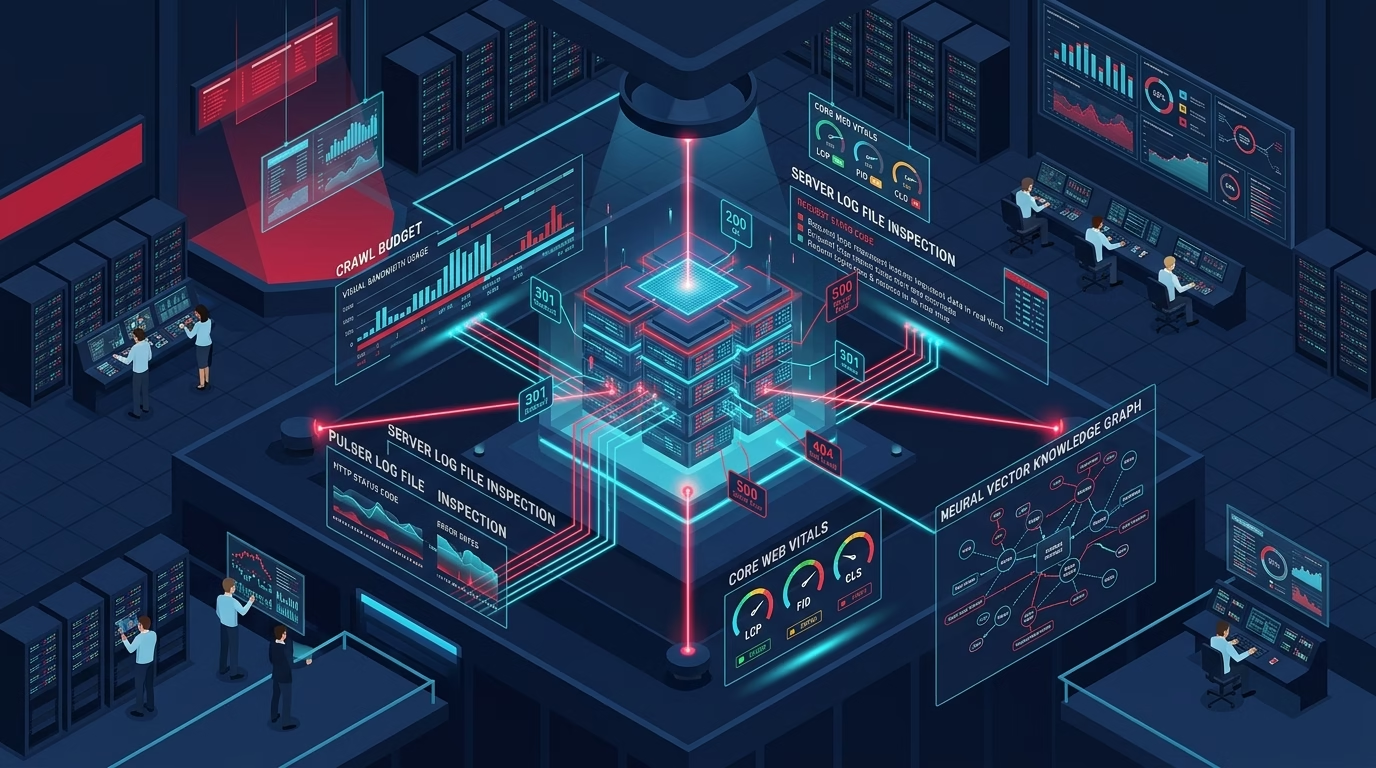
The link between a website’s underlying code and its ability to rank on Google has never been more direct. Google’s Core Web Vitals (CWV) are a set of standardized metrics that measure a page’s real-world user experience and they are a confirmed ranking factor. Achieving “Good” scores is essential for sustainable success in organic search.
The three key metrics that define a site’s health are :
No-code platforms often struggle to meet these strict thresholds. Their reliance on pre-built templates and plugins can add unnecessary bloat to the site’s code. Furthermore, many of these platforms default to Client-Side Rendering (CSR), where the user’s browser must download and execute JavaScript to render the content. This process is inherently slower and can make it difficult for search engine crawlers to index the page effectively.
In contrast, custom code gives developers full control to implement Server-Side Rendering (SSR). With SSR, the server sends a fully rendered HTML page to the browser, which is demonstrably superior for both loading speed (improving LCP) and search engine indexability. This architectural control is a critical advantage for any business that relies on organic traffic.
The technical ceiling imposed by the chosen development platform creates a fixed constraint on potential organic revenue and growth viability.
While a custom architecture with SSR provides the technical foundation for growth, the velocity of building on it has been revolutionized by a new skill : guiding AI.
Want to know how your website is doing?
Enter your domain below and get an Instant Audit, for free !
4. Prompting Is the New Superpower, But It’s a Skill You Have to Learn
The power of vibe coding is unlocked not by the AI alone, but by the skill of the human guiding it. Effective prompting is a craft that turns a vague idea into a precise, functional product. It’s a collaborative conversation, not a magic button. Simply telling an AI to “build an app” will lead to a mess of errors; success requires treating the AI as a collaborator that needs context, clear instructions and iterative feedback.
Mastering this interaction requires adopting a set of best practices. The most effective users have learned to :
- Define the end goal clearly : Provide the AI with the complete context and high-level objective from the start. Avoid vague instructions and specify the purpose, target user and desired outcome of the tool you’re building.
- Work iteratively, not all at once : Build the foundational elements first, like API calls, then move on to the user interface, and finally add polish. This makes the project manageable and easier to debug.
- Make debugging a conversation : Instead of just stating “the code doesn’t run,” describe the specific error, explain the expected result and ask the AI to analyze the script and find the mistake.
- Assign roles to the LLM : Give the AI a specific persona and context to improve the quality of its output. For example: “You are a Next.js developer with experience deploying on Vercel. Help me build a front-end…”
- Always ask for explanations : Don’t just accept a fix. Ask the AI to explain how it solved the problem. This helps you learn the underlying concepts and avoid making the same mistake twice.
This new workflow reframes the developer’s role. Instead of being a manual coder focused on syntax, they become a strategic guide, a reviewer and an architect of logic, using their expertise to steer the AI toward an optimal solution.
5. The Winning Formula : Custom Code Accelerated by AI
The debate isn’t about choosing between the rigid simplicity of no-code and the slow, manual process of traditional coding. The most forward-looking and efficient strategy for modern product development is a hybrid approach : building on a flexible, scalable custom code architecture, but accelerating the workflow with AI-assisted engineering.
This method combines the best of both worlds. It provides the total control, unlimited scalability and optimized performance of custom development, ensuring your product never hits an artificial ceiling. At the same time, it harnesses the speed and efficiency of vibe coding, allowing developers to generate boilerplate, write tests and build features in a fraction of the time.
This synergy allows teams to move from concept to prototype in hours, not weeks, while still producing a high-quality, maintainable and ownable codebase. Developers can offload repetitive and time-consuming tasks to an AI partner, freeing them to focus on high-level problem-solving, complex business logic and creating a superior user experience.
From “How Do I Build This?” to “What Should We Build Next?”
In the age of AI, the choice of a development platform has become a fundamental strategic decision. It’s no longer just about getting a website online, it’s about building an asset that can grow, perform and compete. The path you choose impacts everything from your initial budget and time-to-market to your long-term scalability, SEO potential, and total cost of ownership.
While no-code platforms are excellent tools for validating an idea or launching a simple project quickly, their limitations can create a significant “growth tax” down the line. The future of building scalable, high-performance digital products lies in the powerful synergy between human expertise and AI acceleration. By combining the ultimate flexibility of custom code with the velocity of AI-assisted engineering, we can finally have both speed and control.
As these tools become more powerful, how will you shift your focus from the technical ‘how’ to the strategic ‘what’ and ‘why’?